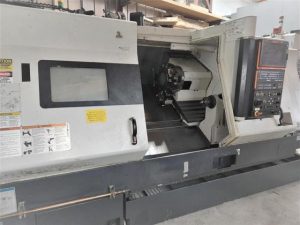
What is Industrial CNC Plasma Pipe Cutting & Profiling Machine & Single Operator Material Handling System?

1. Core Definition
An Industrial CNC Plasma Pipe Cutting & Profiling Machine is a specialized computer-numerical-controlled (CNC) system designed to cut, bevel, and profile cylindrical materials (pipes, tubes, hollow sections) using a plasma arc as the cutting source.
When combined with a Single Operator Material Handling System, the equipment integrates loading, clamping, rotating, cutting, and unloading functions into one streamlined workflow that can be managed by just one operator — improving productivity, safety, and precision.
2. Main Components & Subsystems
CNC Control & Programming
- CNC control unit with 2D/3D nesting software specialized for pipes.
- Capable of importing CAD/CAM drawings (DXF, STEP, IGES).
- Generates toolpaths for straight cuts, miter cuts, holes, slots, saddles, fish-mouth profiles, branch intersections etc.
Plasma Cutting Source
- Typically uses high-definition plasma (HD plasma) for smooth kerf and reduced heat-affected zone.
- Current range: 100–400 A depending on pipe wall thickness.
- Cutting capability: thin tubes (2–3 mm) up to heavy pipes (50+ mm wall thickness).
Pipe Handling & Rotation System
- Chuck / rollers hold and rotate the pipe precisely along its axis.
- Servo motors synchronize rotation with plasma torch movement.
- Length handling: usually 6 m, 8 m, or 12 m pipes.
- Diameter range: ~50 mm up to 600 mm+ depending on model.
Torch Positioning & Beveling
- 5-axis torch head allows angled cuts, bevels, weld prep.
- Cuts can be perpendicular or up to ±45° bevel.
- Some systems include auto-height sensing (arc voltage control) to maintain torch-to-surface distance.
Material Handling System (Single Operator)
- Automatic loading racks / conveyors feed raw pipes into the chuck.
- Hydraulic / pneumatic clamping secures pipes.
- Unloading conveyors or supports move finished pieces to storage bins.
- One operator controls the entire cycle from the HMI (Human Machine Interface).
3. Technical Functions & Profiling Capabilities
The profiling software + CNC control enables complex pipe geometry cutting without manual marking or grinding:
- Straight Cut & Miter Cut – for joining pipes at different angles.
- Saddle / Fishmouth Cuts – for T-joints and intersections.
- Slotting & Notching – cutouts for mechanical or welded connections.
- Branch & Y-Cutting – precise intersection for process piping.
- Beveling / Chamfering – weld preparation edges directly during cutting.
- Hole & Pattern Cutting – flanges, bolt holes, rectangular cutouts.
All cuts are CNC-precise — minimizing weld gap and rework.
4. Integration in Sheet Metal & Fabrication Sector
Although mainly used for pipes and tubes, it complements sheet metal fabrication in several ways:
- Piping systems for industrial plants – oil & gas, HVAC ducts, exhaust systems, water lines.
- Steel construction & infrastructure – bridges, stadiums, building frameworks using hollow sections.
- Shipbuilding & offshore – large bore pipes for structural and process lines.
- Automotive & heavy machinery – exhaust manifolds, roll cages, frames.
- Energy sector – pipelines, wind tower sections, power plant piping.
In sheet metal shops, combining plate cutting machines (flatbed plasma/laser) with pipe plasma cutting systems allows manufacturers to cover both flat sheets and cylindrical components in one workflow.
5. Advantages of CNC Plasma Pipe Cutting & Profiling
- Precision & Repeatability
- Eliminates manual marking & grinding.
- CNC ensures ±0.5 mm accuracy depending on machine quality.
- Automation with Single Operator
- Integrated loading/unloading reduces manpower needs.
- One operator can oversee multiple machines in some setups.
- Faster Production
- Cuts complex profiles in minutes instead of hours.
- Optimized nesting reduces material waste.
- Improved Weld Quality
- Precise bevels and joints reduce filler material and welding time.
- Minimal rework required for fitting.
- Flexibility in Material Types
- Carbon steel, stainless steel, aluminum, alloys.
- Suitable for structural pipes, pressure pipes, tubes.
- Cost Savings
- Lower labor costs.
- Reduced material waste.
- Faster cycle times.
6. Challenges & Considerations
- Initial investment is high compared to manual cutting setups.
- Consumables (electrodes, nozzles) wear faster in plasma compared to laser.
- Cut edge quality: HD plasma is very good but may still require finishing for high-precision applications.
- Maintenance: Regular calibration of rotation chucks, rollers, torch height control is necessary.
- Pipe condition: Bent, rusty, or oval pipes can reduce accuracy.
In summary:
An Industrial CNC Plasma Pipe Cutting & Profiling Machine with Single Operator Material Handling System is a fully automated, CNC-controlled solution that enables precise, fast, and repeatable cutting of pipes and tubes with minimal manpower. For the sheet metal and fabrication sector, it bridges the gap between flat sheet cutting and cylindrical component processing, boosting productivity, weld quality, and overall competitiveness.