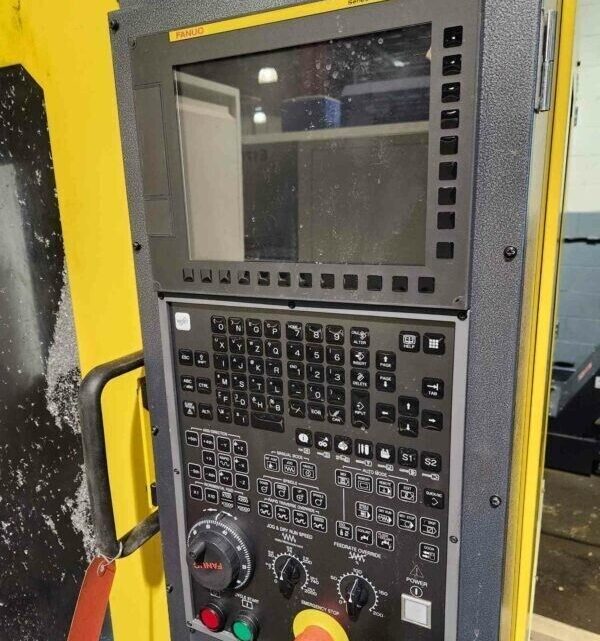
Industrial Insights: How to Spot Quality in Pre-Owned, Used, Secondhand, Surplus CNC Equipment Before Purchase Fanuc Robodrill D21MiB5 CNC Tapping Center made in Japan
Below is an industrial-grade checklist + insight guide for assessing a pre-owned / surplus FANUC Robodrill D21MiB5 (vertical machining center / drill-tap machine) to help you decide whether it’s a solid buy. (You might see variants “D21MiB5 Plus / ADV / 24K” etc.; use the specs of the specific variant as your benchmark.)
First I summarize key specs (so you know what “should” be good), then walk through subsystem inspections, red flags, and decision logic.
Key reference specs & benchmarks
Before going on site, arm yourself with the nominal specs of the Robodrill D21MiB5 so you can spot deviations. The following come from FANUC datasheets:
- Travels (X / Y / Z): 500 × 400 × 330 mm
- Table size: 650 × 400 mm
- Max table load: 300 kg
- Spindle options: 10,000 rpm standard, with optional 24,000 rpm high-speed variant
- Spindle power / torque (10,000 rpm, 1 min): ~ 14.2 kW / 80 Nm; continuous: ~ 4.0 kW / 13.6 Nm
- Rapid traverse (X, Y, Z): 54 m/min
- Maximum programmable cutting feed: 30,000 mm/min
- Tool change time (2 kg tool, cut-to-cut): ~ 1.6 sec
- Bidirectional accuracy: < 0.006 mm
- Bidirectional repeatability: < 0.004 mm
- Control: FANUC 31i-B5 Plus (or equivalent)
These are the standards you should try to see the machine approach (or not deviate excessively).
Key inspection & test checklist (by subsystem)
Use this on site — take measurements, listen, feel, stress-test where possible:
| Subsystem / Feature | What to Inspect / Test | What “Good / Acceptable” Looks Like | Red Flags / Warning Signs |
|---|---|---|---|
| Frame, base, column structure | Visual inspection of castings, frame, support welds, any repaired cracks | No structural cracks, no suspicious weld repairs, uniform surfaces, no twisting | Weld patches in high-load zones, cracks near column base or bed, misalignment visible |
| Way covers, bellows, guards | Move axes slowly, observe covers and bellows for dragging, interference, torn sections | Covers move freely, no binding or contact with axes or table | Torn bellows, sagging covers, covers contacting table or supports |
| Linear guides / ball screws / backlash | Jog each axis, reverse direction, measure backlash with a dial indicator, test for “dead” zones | Backlash small (within a few microns), smooth motion, uniform response across travel | Excessive backlash, binding in certain zones, roughness or vibration in slow motion |
| Spindle (milling / drill mode) | Run spindle across speed range (low → high), listen for bearing noise, measure runout (test bar), monitor temp rise | Quiet at all speeds, vibration low, runout in microns, stable temp over time | Humming / knocking sounds, high vibration, thermal drift, wobble in test bar |
| Tool changer / magazine | Cycle all tool changes, test indexing, tool pick/drop, measure time, check for mis-index | Fast, repeatable tool changes without error, secure tool holding | Tool drop, mis-indexing, worn pockets, slow or inconsistent indexing, collision marks |
| Servo drives / axis motors / electronics | Rapid traverse, accelerations, decelerations, reversals; watch for faults, current spikes or instability | Responsive axes, no servo faults or alarms, stable behavior under all motions | Fault alarms, drive trips, axis stiffness or oscillation, overheating amplifiers |
| CNC control / wiring / cabinet | Open the control cabinet, inspect wiring, check for burnt connectors or discoloration, test fans; power on, check for error history, I/O signals, parameter memory | Clean wiring, no burnt parts, fans operational, control boots clean, parameter memory healthy, no persistent alarms | Burn marks, broken wires, fan failure, parameter corruption, erratic behavior |
| Thermal stability / warm-up drift | Run machine for a period, then re-check reference positions or test cuts to see drift | After warm-up, machine stabilizes; minimal drift in positions | Positional drift over hours, offsets changing with temperature, hysteresis |
| Accuracy / repeatability | Use gauge blocks, test bars, measure multiple points repeatedly | Repeatability within small tolerance (e.g. < 0.005 mm or better), consistency over range | Variation in repeat position, larger error than spec, variation across table travel |
| Load / cutting test | If allowed, run a representative part or contour under typical cutting / tapping loads | Stable performance, no chatter, good surface finish, axes hold contour, no alarms | Chatter, tool deflection, axis stalls, poor finish, servo errors, inconsistent performance under load |
| Tapping / drilling cycles | Run tapping/drilling routines, including rigid tapping, speed reversals, tapping under spindle load | Tap cycles clean, minimal vibration, accurate threads, no slippage | Thread errors, chatter, missed taps, slippage in tapping mode, problems reversing direction |
| Software / CNC features / options | Check that all control options (probes, offsets, macro functions, interpolation) are active and functioning | All licensed options working, parameters accessible, control stable with advanced features | Missing option licenses, control crashes under advanced routines, parameter memory issues |
| Documentation / spare parts | Request manuals, wiring diagrams, parts list, software backups | Complete documentation, parts lists, known suppliers, history of servicing | Missing manuals, no parts catalog, unknown modules, control firmware not backed up |
Red-flag “deal breakers” you should not ignore
When inspecting, these issues are especially dangerous / costly, and may justify walking away unless price is extremely low:
- Spindle bearing noise / excessive runout under test bar — indicates imminent failure.
- Irreparable backlash in axes — if ball screws or guide systems are worn beyond adjustment.
- Servo drive faults / instability / frequent alarms — control electronics are often expensive to replace.
- Control cabinet / wiring damage (burned wires, melted insulation) — suggests past short circuits or electrical trauma.
- Thermal drift too high / unstable geometry — hard to compensate in production use.
- Tapping / drill mode failures — since D21MiB5 is used for drilling / tapping, this is core functionality.
- Missing or corrupt control software / parameter memory — if CNC cannot load parameters, you may lose ability to restore functioning state.
- No documentation / missing parts lists / missing maintenance history — increases risk of hidden issues.
- Unavailability of spare parts for FANUC Robodrill / specific modules in your region — leads to long downtimes or high cost.
Decision logic & offer negotiation framework
Once you’ve collected observations and measurements, here’s how to interpret and decide:
- Qualify “acceptable deviation”: Some wear is expected in a used machine. Create tolerance thresholds (e.g. < 10x spec in backlash, < 20% deviation in spindle runout) beyond which you reduce your valuation.
- Repair / risk margin estimation: For each defect you find, estimate parts cost, labor, downtime, and margin. Subtract that from the “as-equivalent new / good used” value and negotiate accordingly.
- Spare parts & service support check: Ensure you can source replacements (spindle bearings, servo drives, control modules, tool changer parts) locally or affordably. If not, the machine’s value drops materially.
- Residual useful life: Derive how much life remains based on wear signs. Use that to discount the machine.
- Control / software risk: Even a mechanically good machine may be hampered by outdated or unsupported control electronics; ensure replaceability or upgrades.
- Acceptance / validation window: Try to negotiate a post-delivery acceptance / trial window (30–90 days) under production conditions where the seller must remedy hidden defects or you can reject.
- Transport / re-installation risk buffer: Always assume that reinstallation, realignment, calibration will be required after moving the machine. Factor in time & cost for final tests.
- Weighted scoring: Assign more weight to critical subsystems (spindle, axes, drive electronics, tapping function) over less critical subsystems. If a high-weight category fails, that may be sufficient to reject or demand a large discount.