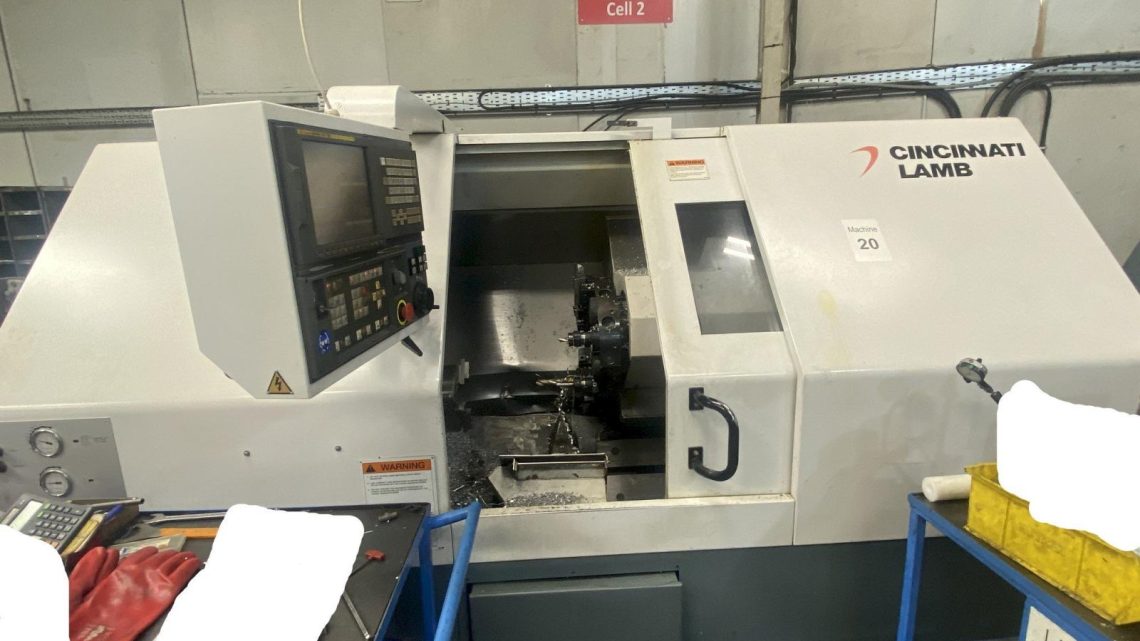
Industrial Insights: How to Spot Quality in Pre-Owned, Used, Secondhand, Surplus CNC Equipment Before Purchase Cincinnati HTC 200 CNC Lathe made in USA
Here’s a detailed, industrial-quality checklist and insight guide for evaluating a pre-owned / surplus Cincinnati HTC 200 CNC lathe. The goal is to help you spot both visible and latent defects, assess risks, and decide whether to proceed, negotiate or walk away.
Known specs & reference benchmarks (what “healthy” looks like)
Before you inspect, you should have a benchmark of what a good HTC 200 is supposed to deliver. Based on listings, here are reference data to help you judge deviations:
- One listing for a Cincinnati HTC 200 states: spindle speed up to 4,500 rpm; X-axis travel ~ 245 mm; Z-axis travel ~ 540 mm; tool turret of 12 stations, static turret type.
- The machine in that listing is shown as a 2-axis turning machine with Fanuc 21i-TB control unit.
- Dimensions: about 3,000 mm wide × 1,900 mm deep × 1,800 mm tall; weight ~ 4,500 kg.
- The workpiece maximum (turning) diameter quoted: ~300 mm.
These figures give you rough bounds: e.g. expect ~4,500 rpm max, ~245 mm X travel, ~540 mm Z travel in that version, etc. If the unit you inspect is much weaker, or has degraded performance, that’s a red flag.
Use these benchmarks as “anchoring metrics” during inspection.
What to inspect & test — comprehensive checklist
Use this checklist on site. Where you can, measure, record deviations, and rank defects by severity. Always test across full travel, in both directions, under load if possible.
| Subsystem / Area | What to Inspect / Test | What “Good / Acceptable” Looks Like | Red Flags / Warning Signs |
|---|---|---|---|
| Frame / base / structure | Visually inspect for cracks, weld repairs, deformations in bed, columns, base | No structural repairs, no visible cracks or distortions, rigid feel | Welded patches in critical load zones, cracks at joints, sagging bed or frame |
| Way covers / bellows / guards | Jog axes, look for dragging, interference, torn bellows, misalignment of covers | Covers move freely, no contact or binding | Torn covers, sagging bellows, covers scraping table or sliding surfaces |
| Linear guideways / ball screws / backlash | Move each axis back and forth, stop and reverse, measure backlash (with dial indicator), inspect for binding or jerks | Backlash within acceptable small tolerance, smooth motion across full stroke | Excessive backlash, “dead” zones, binding in parts of travel, vibration under slow movement |
| Spindle (turning spindle) | Run spindle across speed range (low → high), listen for bearing noise, measure spindle runout with a test bar, monitor temperature | Quiet operation, minimal vibration, runout in microns, stable temperature | Bearing noise, knocking, wobble, high runout, overheating at speed |
| Turret / tool changer / turret indexing | Cycle the turret, index tools, verify tool change accuracy, load/unload tools, check for repeatability | Fast, precise indexing, secure tool retention, no mis-index or interference | Mis-index, tool drop, worn turret pockets, slop in turret, collision marks |
| Servo drives / axes motors / electronics | Rapid moves, acceleration / deceleration, direction reversals, monitor for drive alarms, current surges, motor heating | Clean, responsive motion, no fault alarms, motors heating within spec | Drive faults or trips, overheating amplifiers, axis jitter or instability |
| Control cabinet / wiring / electronics | Inspect wiring, look for burnt terminals, dust, fan condition; power up CNC, check alarm history, parameter memory, I/O health | Neat wiring, no burn damage, fans working, stable control, no persistent alarms | Burnt connectors, smoky smell, fan failure, corrupt parameters, frequent errors |
| Thermal drift / warm-up stability | Let machine run for some time, then re-check key reference measures or repeat cycles | After warm-up, machine stabilizes; positional drift minimal | Drift in positions during cycles, dimensions changing over time, hysteresis |
| Accuracy / repeatability tests | Use gauge blocks / test bars, run multiple cycles to same point, measure variation | Repeatability within small tolerance (micron or sub-ten micron as spec) | Significant variation, drift across positions, inconsistent repeats |
| Load / cutting test | If possible, run a representative turning job under typical cutting conditions; observe performance | Smooth cutting, no chatter, stable dimensions, no alarms or instability | Chatter, tool deflection, irregular finishes, servo errors under load |
| Control features / CNC / software | Check control features: offsets, macro functions, backup / restore, parameter edits, diagnostics | Full features operational, no locked modules, stable behavior under complex motion | Missing features, crashes under certain commands, disabled modules, parameter corruption |
| Spare parts / tooling / documentation | Request manuals, wiring diagrams, parts lists, tooling list; check availability of critical spares | Complete documentation, spare parts list, known sources or supplier availability | Missing or incomplete documentation, unknown or obsolete parts, no spares source |
Interpreting results & decision strategy
Once you’ve done your inspections, here’s how to interpret findings and make a decision.
1. Cosmetic vs functional defects
- Minor cosmetic issues (paint, non-critical dents) are often acceptable, unless they hide structural damage.
- But functional defects (spindle bearing damage, excessive backlash, turret problems, control faults) are often deal breakers.
2. Cost & risk of remediation
- For each defect, estimate cost of parts, labor, alignment, and test time.
- Your offer discount should more than cover the worst-case repair cost + margin for hidden surprises.
3. Spare parts / support availability
- Cincinnati machines (or their successor parts) may have limited local support; check whether spindle bearings, turret components, control modules, drives are available in your region.
- If parts are hard to source, that imposes risk and downtime.
4. Remaining useful life
- Even a “good” machine may have many hours on components like spindle bearings, turrets, ways.
- If many subsystems show wear signs, factor that “future overhaul” cost into your offer.
5. Control / electronics obsolescence
- Even mechanically sound machines fail if their controls or electronics become unsupported.
- Ensure control modules, parameter backups, and replacement electronics are feasible.
6. Negotiation & acceptance window
- Try to negotiate a post-delivery acceptance / test period (e.g. 30–90 days) during which you can run production parts and reject or require fixes if performance is below expectation.
7. Transport & re-install risk
- Moving heavy precision machines often disturbs alignment, spindle preload, axis calibration.
- Always budget time and cost for re-leveling, alignment, test cuts post-installation.
8. Weighted scoring & threshold logic
- Assign more weight to critical subsystems (spindle health, turret integrity, axis precision, control electronics).
- A failure in a high-weight subsystem may justify rejecting the machine entirely, even if most others are acceptable.