What is HOT AIR ARCH BENDING Machine?
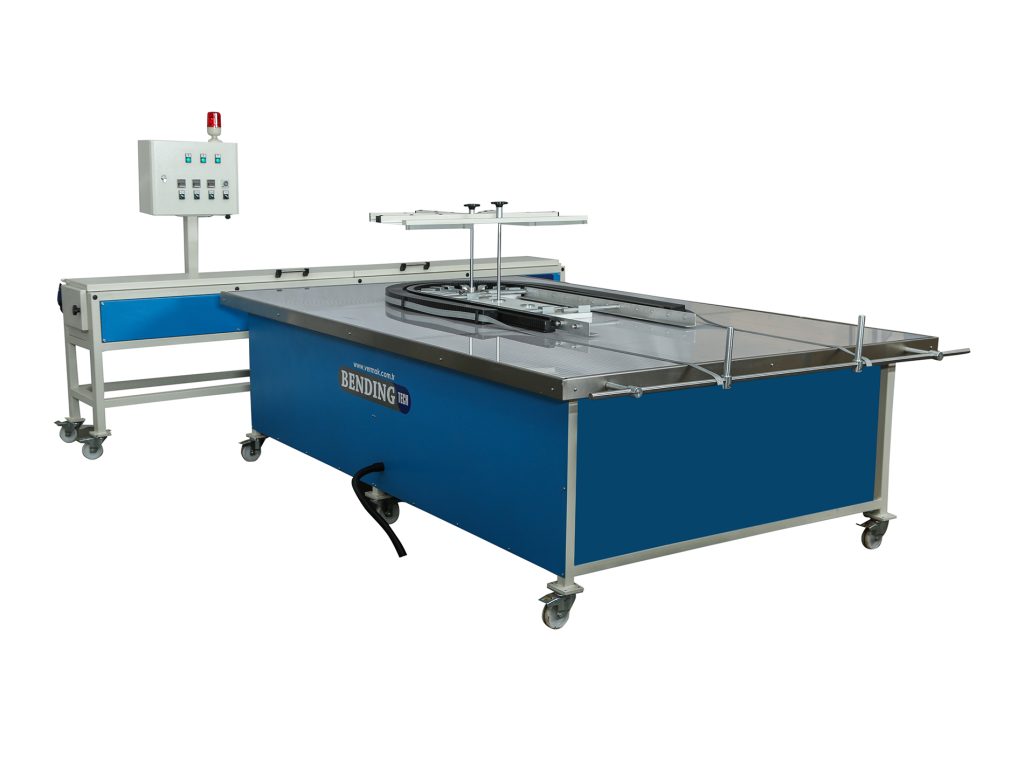
Overview of the Hot Air Arch Bending Machine
A Hot Air Arch Bending Machine is a specialized piece of industrial equipment primarily used in the manufacturing of PVC (polyvinyl chloride) or vinyl profiles for applications such as arched windows, doors, and decorative elements in construction and fenestration industries. It employs a thermal softening process to bend rigid thermoplastic profiles into curved shapes like arches, arcs, ellipses, or other radii without causing deformation, cracking, or loss of structural integrity. Unlike cold bending methods that rely on mechanical force alone, this machine uses controlled hot air heating to reduce the material’s viscosity, making it pliable for precise forming around custom molds.The machine is particularly suited for profiles up to 3000–6000 mm in length and widths/heights of 120 mm x 70 mm or similar, depending on the model. It contrasts with hot liquid (e.g., glycerin or oil) bending machines, which immerse profiles in heated fluids; hot air systems offer cleaner operation, faster setup for dry heating, and reduced risk of contamination but require more precise temperature control to avoid uneven softening.Technical PrinciplesMaterial Behavior Under HeatPVC profiles are amorphous thermoplastics with a glass transition temperature (Tg) around 80–100°C and a Vicat softening point of approximately 70–85°C. At room temperature, PVC exhibits high rigidity due to its molecular structure, where long polymer chains are entangled and crystalline regions provide stiffness. When heated via hot air to 120–180°C (depending on profile thickness and formulation), the material enters a viscoelastic state:
- Thermal Softening Mechanism: Heat increases molecular mobility, reducing intermolecular forces (van der Waals and hydrogen bonding). This lowers the yield strength from ~40–60 MPa (cold) to <10 MPa, allowing plastic deformation without fracture. The process exploits PVC’s thermoplastic nature, enabling reversible softening (though cooling sets the shape permanently due to chain relaxation).
- Stress-Strain Response: During bending, the outer fibers experience tensile stress (elongation up to 5–10%), while inner fibers undergo compression. Hot air ensures uniform heating, minimizing thermal gradients that could cause warping. Post-bending, controlled cooling (air or water quench) allows recrystallization, restoring ~90% of original stiffness within minutes.
- Key Parameters:
- Heating Temperature: 130–160°C to achieve optimal pliability without degradation (e.g., dehydrochlorination above 200°C).
- Heating Time: 2–5 minutes per section, influenced by profile cross-section (thicker sections require longer exposure).
- Bending Radius: Minimum 250–500 mm, depending on mold; larger arches (up to 2–3 m radius) for window frames.
- Springback Compensation: PVC exhibits 2–5% elastic recovery upon cooling; molds are over-curved by this amount.
Heating SystemThe core of the machine is an automatic hot air oven or heater, typically 3 m long, consisting of:
- Hot Air Generator: Electric resistance heaters (e.g., 2–4 kW) combined with blowers (centrifugal fans, 500–1000 m³/h airflow) to circulate air at 150–200°C. Air is ducted through nozzles or a chamber for even distribution.
- Temperature Control: PID (Proportional-Integral-Derivative) controllers with thermocouples maintain ±5°C precision. Some models include infrared sensors for real-time profile temperature monitoring.
- Heating Zone: Enclosed tunnel or open chamber where the profile is fed. Airflow prevents hotspots, ensuring uniform softening across the profile’s width (e.g., via laminar flow design).
This dry heating method avoids liquid media, reducing cleanup and enabling use with laminated or coated profiles without delamination.Machine Components and OperationHot Air Arch Bending Machines are typically manual or semi-motorized, with working lengths of 3–6 m. Key components include:
- Bending Table/Workbed: A flat, adjustable steel table (e.g., 3000 mm x 1000 mm) with machined slots for clamps. It supports the profile during heating and initial positioning.
- Clamping and Tooling System:
- Fast-Clamping Tooling: Pneumatic or manual vices (clamping force 500–1000 N) secure the profile ends and sections. Special inserts prevent slippage and distortion.
- Distance Gauges and Skids: Aluminum or heat-resistant templates (e.g., 2500–3000 mm long) position clamps for uniform radius. For example, a compass-like adjuster sets mold holders to the desired diameter.
- Bending Molds: Custom external/internal molds (heat-resistant silicone or PTFE-coated aluminum, 3000 mm segments) and inner paddings/fillings (flexible, slippery materials like nylon or EPDM). Molds are 28–30 pieces per set, forming the arch shape. Internal spades (inserts) support the profile’s inner radius, preventing collapse at small diameters (<500 mm).
- Motorized Elements (in Advanced Models): Gear shafts or servo motors (e.g., 1–2 kW) for parallel movement of mold holders, enabling side lengthening for larger arches. Hydraulic cylinders (up to 20 tons pressure) may assist in final forming.
- Control Interface: Digital panels for temperature, timer, and mold positioning. CNC variants (less common for hot air) import DXF files for automated radius calculation.
Step-by-Step Operation
- Preparation: Select and install custom molds/inserts for the desired profile (e.g., frame, sash, or glass bead) and radius. Calibrate clamps using gauges for symmetry.
- Profile Loading: Place the PVC profile (e.g., 60–120 mm wide) on the table, secure ends with clamps.
- Heating Phase: Feed the profile into the hot air oven. Hot air circulates, softening the material (monitored via sensors). Profile temperature reaches 140–160°C uniformly.
- Bending Phase: Transfer the softened profile to the mold setup. Manually or motor-assisted, pull/push the profile around the external mold while internal supports prevent buckling. Clamps ensure even force distribution (typically 100–500 N manual force).
- Forming and Cooling: Lock the profile in the arched position. Cool with ambient air or fans (5–10 minutes) to set the shape. For complex shapes (e.g., elliptical), multiple passes may be needed.
- Finishing: Remove from molds; trim excess if required. Repeat for symmetrical halves if building full arches.
Precision and Tolerances
- Repeatability: ±0.5–1 mm on radius; ±0.02 mm cylinder positioning in motorized models.
- Distortion Control: Inner paddings minimize cross-sectional deformation (<1% change in dimensions).
- Speed: 5–15 minutes per arch, depending on length and complexity.
Advantages and Limitations
- Advantages: Clean (no liquids), versatile for various profiles (including laminated PVC), low energy use (3–6 kW total), and suitable for small-batch production. Enables tight radii without fillers like sand.
- Limitations: Slower than roll-bending for straight curves; requires skilled operators for manual models. Not ideal for very thick (>5 mm) or reinforced profiles, where hot liquid systems perform better. Overheating risks discoloration or embrittlement.
Applications Primarily in PVC window/door fabrication for arched designs in residential/commercial buildings. Also used for decorative trim, signage, and custom fenestration. Models like the DRAGON (manual, 3 m) or HEAT 6000 HB (6 m) are common in workshops producing arched sashes or fanlights.This technology ensures high-quality, distortion-free bends, enhancing aesthetic and functional value in architectural products.