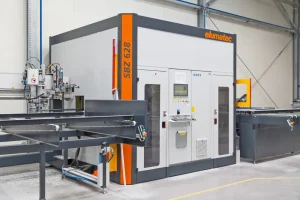
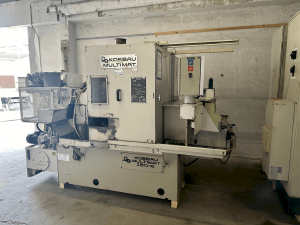
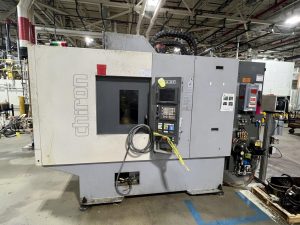
What is Horizontal POST STYLE CNC Band SAW?

A Horizontal Post Style CNC Band Saw is an advanced industrial cutting machine designed for precise, automated cutting of metal, wood, or other materials. It integrates Computer Numerical Control (CNC) technology with a horizontal band saw configuration, specifically featuring a post-style design. Below is a technical explanation of its components, functionality, and applications:
Definition and OverviewA horizontal post style CNC band saw is a type of band saw where the saw blade operates in a horizontal plane, cutting through a stationary workpiece clamped in a vice. The “post style” refers to the structural design, typically a dual-column or single-column framework that guides the saw head’s vertical movement. The CNC system automates the cutting process, allowing for programmable, repeatable, and precise cuts with minimal operator intervention.This machine is used in industries such as metal fabrication, manufacturing, and woodworking for cutting large or heavy materials like bar stock, structural steel, or logs into smaller, precise pieces.
Key Components
- Saw Frame and Post Structure:
- The saw frame is supported by one or two vertical posts (columns), which provide stability and rigidity during cutting.
- Dual-column designs (common in high-end models like the Amada HFA700CII or DYNASAW 430) use two posts for enhanced precision and support, especially for heavy-duty applications. Single-column designs are less common but used in lighter-duty saws.
- The frame moves vertically along the posts, guided by precision linear guides or hydraulic pistons, ensuring smooth and accurate blade motion.
- Saw Blade:
- A continuous, thin metal band with hardened teeth forms the cutting tool. The blade is looped around two or more wheels, one of which is driven by a motor.
- Blade width and tooth pitch vary based on the material being cut (e.g., 1-1.5” wide blades with 6/10 TPI for stainless steel). Bi-metal or carbide-tipped blades are common for durability and versatility.
- CNC Control System:
- The CNC system (e.g., Mitsubishi touchscreen in the DoALL S-320CNC) allows operators to program cutting parameters such as feed rate, blade speed, cut length, and angle.
- Features include:
- Programmable job storage: Stores multiple cutting programs for repeatability.
- Self-diagnostics: Monitors blade deviation, tension, and cutting conditions, stopping the machine if parameters are exceeded.
- Automatic indexing: Advances material for multiple cuts without manual repositioning.
- Feed and speed optimization: Adjusts based on material type (e.g., steel, aluminum).
- Vice System:
- An integral vice (manual or hydraulic) clamps the workpiece securely. Advanced models feature bundle vises for cutting multiple pieces simultaneously or shuttle vises for automatic material feeding.
- Some vises include pressure control valves to adjust clamping force, preventing deformation of delicate materials.
- Feed Mechanism:
- The saw head is lowered into the workpiece using hydraulic pistons or ball screw drives (e.g., DoALL S-320CNC uses a 3.5 HP motor with ball screw feed).
- A hydraulic downfeed valve controls the cutting pressure and speed, ensuring consistent cuts and reducing blade wear.
- Coolant System:
- A coolant pump delivers a mixture (e.g., 10:1 to 30:1 semi-synthetic fluid and water) to the cutting zone to reduce heat, extend blade life, and improve cut quality.
- Coolant reservoirs and chip trays manage debris, with filters to prevent pump damage.
- Motor and Drive System:
- Typically powered by a 3.5–7.5 HP motor, depending on the saw’s capacity (e.g., Amada HFA700CII uses a 7.5 HP motor).
- The motor drives the blade via a belt or gear system, with variable speed settings to accommodate different materials (e.g., higher SFM for aluminum, lower for stainless steel).
- Optional Features:
- Mitering capability: Allows angled cuts (e.g., 45° or 60°) for applications like structural steel fabrication.
- Non-contact material positioning: Uses light beams or sensors for precise material alignment.
- Smart blade change: Simplifies blade replacement for efficiency.
Working Principle
- Setup: The workpiece is clamped in the vice, and the operator inputs cutting parameters (e.g., cut length, number of cuts, blade speed) into the CNC controller.
- Operation: The saw blade, driven by the motor, moves in a continuous loop. The saw head lowers vertically (or at an angle for mitering) into the workpiece, using gravity or hydraulic force to feed the blade.
- CNC Automation: The CNC system controls blade speed, feed rate, and material advancement. For example, a shuttle vice or powered rollers automatically reposition the material for subsequent cuts.
- Cutting: The blade cuts through the material in a straight, fixed-angle path. It excels at cross-cutting but cannot produce curved or intricate cuts (unlike vertical band saws).
- Completion: After the cut, the saw head rises, and the material is advanced for the next cut or removed. Coolant is applied during cutting to manage heat and debris.
Technical Specifications (Example: Amada HFA700CII)
- Capacity: 32″ x 28″ (rectangular), 28″ (round).
- Blade Size: 2″ wide, suitable for heavy-duty cutting.
- Motor: 7.5 HP for high torque.
- Features: Blade deviation monitor, CNC light cutting rate controller, full-capacity bundle vises, auto trim cut function.
Advantages
- Precision: CNC control ensures repeatable, accurate cuts with tolerances as tight as ±0.01″ in high-end models.
- Automation: Reduces operator fatigue and labor costs by automating material feeding, cutting, and head movement.
- Versatility: Cuts a wide range of materials (e.g., steel, aluminum, titanium, plastics) with appropriate blade selection.
- Durability: Dual-column designs provide rigidity for heavy-duty applications, extending machine and blade life.
Limitations
- Limited to Straight Cuts: Cannot cut curves or intricate shapes, unlike vertical band saws.
- Size and Cost: Large footprint and high cost (e.g., $300,000 for high-end models like the Marvel 800A) make it unsuitable for small shops.
- Complex Maintenance: CNC systems and hydraulic components require regular maintenance and skilled technicians.
- Material Handling: Large or heavy workpieces require cranes or conveyors for loading.
Applications
- Metal Fabrication: Cutting bar stock, structural steel (e.g., I-beams, pipes), or tubes for manufacturing or construction.
- Production Shops: High-volume cutting of materials for CNC machining or assembly.
- Lumber Processing: Cutting large logs or beams in woodworking (less common).
- Specialized Tasks: Miter cuts for structural components or precise length cutting for machining stock.
Comparison with Other Band Saws
- Vs. Vertical Band Saws: Horizontal saws are better for straight, high-volume cuts and harder materials (e.g., stainless steel), while vertical saws excel at curved or intricate cuts in softer materials.
- Vs. Pivot-Style Horizontal Saws: Post-style saws (especially dual-column) offer greater rigidity and precision compared to pivot-style saws, which are cheaper but less stable for heavy cuts.
ConclusionA horizontal post style CNC band saw is a robust, automated cutting solution designed for high-precision, high-volume straight cuts in industrial settings. Its post-style structure ensures stability, while the CNC system enhances efficiency and repeatability. It is ideal for large-scale metalworking and manufacturing but requires significant investment and space. For specific models, brands like Amada (HFA700CII, DYNASAW 430) and DoALL (S-320CNC) are industry standards, offering advanced features for demanding applications