What is High-Frequency Welding Machine used for PVC and similar materials?
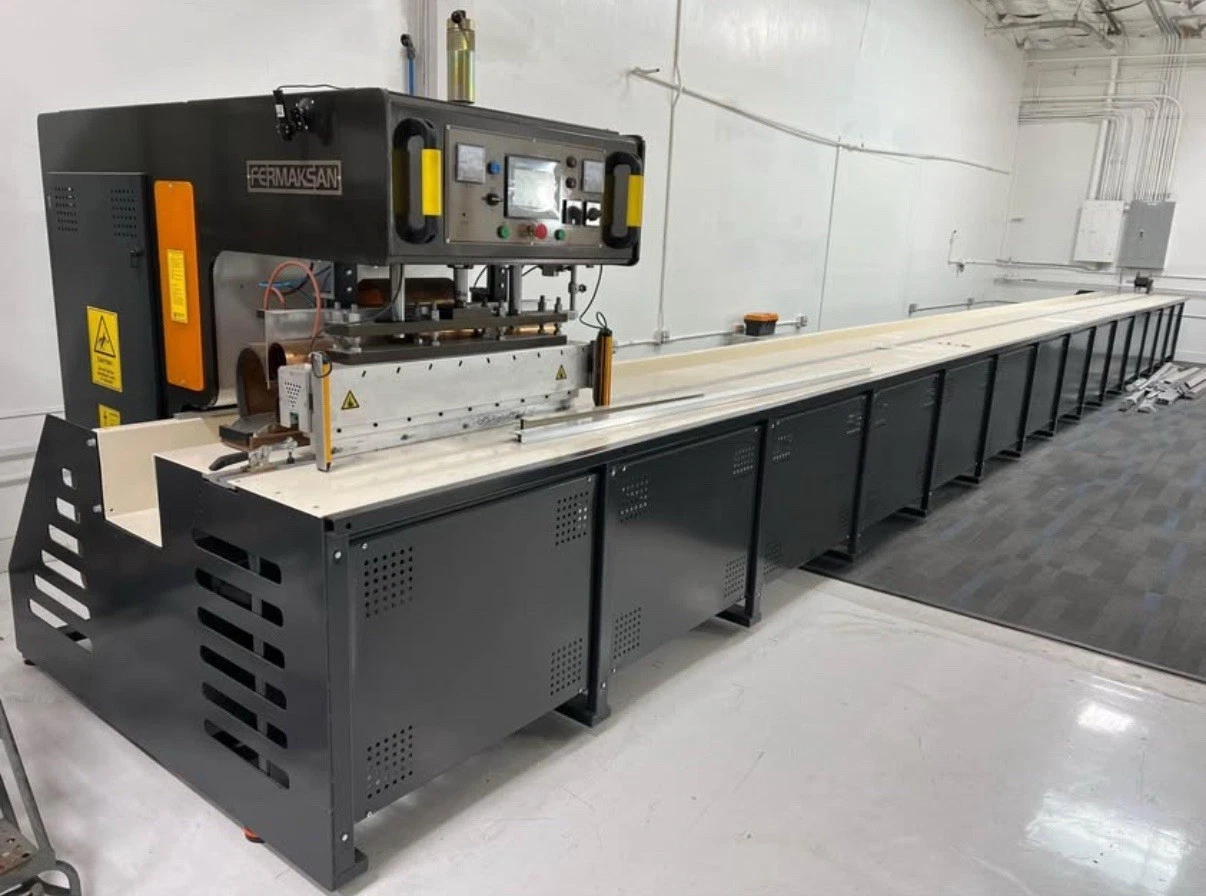
A High-Frequency (HF) welding machine, also known as a Radio Frequency (RF) or dielectric welding machine, is an advanced industrial tool designed for joining thermoplastic materials, particularly polar polymers like Polyvinyl Chloride (PVC) and similar compounds such as Polyurethane (PU), Thermoplastic Polyurethane (TPU), and Ethylene Vinyl Acetate (EVA). In the welding and PVC sectors, these machines enable the creation of strong, airtight, and waterproof seams without external heat sources, relying instead on internal molecular excitation. This process is widely used for fabricating flexible products like tarpaulins, inflatable structures, medical devices, automotive interiors, and banners, where seam integrity is critical for durability and functionality. HF welding excels in high-volume production due to its speed (weld times of 2-8 seconds) and precision, producing joints with strength comparable to the base material (often >95% of original tensile strength).Technical Principles of OperationHF welding operates on the principle of dielectric heating, where a high-frequency alternating electromagnetic field (typically 13.56 or 27.12 MHz, as per ISM bands) induces molecular dipoles in polar thermoplastics to oscillate, generating frictional heat through dielectric losses. The heat softens or melts the material at the interface (temperature rise to 120-200°C for PVC), and applied pressure fuses the parts during cooling, forming a molecular interdiffusion bond. This is governed by the material’s dielectric properties: high dielectric constant (ε’ >2.0) for field penetration, high dielectric loss factor (ε”), and dipole moment, which quantify energy dissipation as heat (Power density P = 2πf ε₀ ε” E², where f is frequency, ε₀ is permittivity of free space, and E is field strength).Non-polar materials (e.g., polyethylene, polypropylene) lack sufficient dipoles and thus cannot be welded this way, as they exhibit low ε” (<0.1). For PVC, with its asymmetric Cl-C bonds creating a strong dipole (μ ≈ 1.7 D), the process achieves uniform heating without thermal degradation, unlike conduction-based methods.Key Technical Components
| Component | Function | Technical Specifications (Typical for PVC Welding) |
|---|---|---|
| HF Generator | Produces oscillating electromagnetic field via vacuum tube or solid-state oscillator. | Frequency: 27.12 MHz (±0.163 MHz); Power: 1-50 kW (e.g., 5 kW for 0.5-1 mm sheets); Efficiency: >80% with IGBT inverters for low harmonics. |
| Electrodes (Die Set) | Conduct field; upper movable, lower fixed; shaped for seam geometry. | Material: Brass/copper alloys; Area: 100-5000 cm²; Gap: 0.1-2 mm; Quick-release systems for tooling changes (<5 min). |
| Press Mechanism | Applies clamping force to ensure intimate contact. | Force: 500-5000 kg; Pneumatic/hydraulic actuators; Cycle time: 5-15 s; Precision: ±0.05 mm alignment. |
| Control System | PLC or touchscreen for parameter tuning (power, time, pressure). | Features: Auto-tuning for impedance matching (50-200 Ω); Sensors for temperature/current feedback; Programs: 50+ presets for PVC/PU variants. |
| Safety/Shielding | Faraday cage to contain RF emissions; interlocks for operator safety. | Compliance: FCC/ICNIRP limits (<10 V/m leakage); Cooling: Water/air (5-10 L/min) for tubes/components. |
| Worktable/Chamber | Supports material loading; optional vacuum assist for thin films. | Size: 1-6 m length; LED illumination for visibility; Foldable for large sheets (up to 3 m wide). |
Step-by-Step Technical Process
- Material Preparation: Overlap PVC sheets (thickness 0.2-5 mm) or insert components into the die. Ensure clean, dry surfaces to avoid contaminants reducing ε”.
- Loading and Clamping: Place assembly between electrodes. Actuator applies pressure (1-5 bar) to minimize air gaps, ensuring uniform field distribution (E-field uniformity >90%).
- Field Application and Heating: Generator energizes electrodes, creating an oscillating E-field (10-50 kV/m). Polar molecules align/realign at 27 MHz (≈37 million cycles/s), causing torque and friction. Heat generation follows tan δ = ε” / ε’ (loss tangent; PVC: 0.1-0.3 at 150°C), raising interface temperature above glass transition (T_g ≈80°C for PVC) to viscous flow state without bulk melting.
- Fusion: Maintain field for 2-8 s until melt pool forms (viscosity drops to 10³-10⁵ Pa·s). Pressure promotes flow into micro-voids, enhancing diffusion (Fick’s law: J = -D ∇C, where D is diffusion coefficient).
- Cooling and Release: De-energize field; hold pressure 1-3 s for solidification (crystallinity <5% in amorphous PVC). Eject part; post-cool if needed for warp prevention.
Suitability for PVC and Similar Materials
- PVC (Polyvinyl Chloride): Ideal due to high ε” (0.05-0.2) and low melt viscosity; enables welding of flexible (plasticized) or rigid grades. Achieves peel strength >20 N/cm; used for 0.1-4 mm thicknesses. Challenges: Overheating in highly plasticized PVC (add stabilizers).
- Similar Materials (PU, TPU, EVA): PU/TPU (ε” ≈0.1-0.4) for medical/inflatables; EVA alloys for packaging. Special polyolefins (modified PE/PP) now viable with additives boosting polarity. Not suitable for non-polars like PTFE (ε” <0.001) or PC.
Advantages in the Welding and PVC SectorsHF machines outperform hot air/impulse welding in seam strength (airtight to 0.1 mbar) and aesthetics (no burn marks), with throughput up to 1000 m/h for banners. In PVC processing, they reduce waste (<2% defects) and support sustainability (no fillers/adhesives). ROI: 6-18 months via energy efficiency (0.5-2 kWh per m seam). Models like Miller Weldmaster RFlex or Forsstrom TD series offer modularity for custom dies, integrating IoT for predictive maintenance.In summary, HF welding machines revolutionize thermoplastic joining in the PVC sector by leveraging electromagnetic principles for precise, robust bonds, enabling innovative applications from truck covers to life-saving medical bags.