What is a High-speed, Multi-Spindle Rotary Table, and why is it particularly suited for multi-spindle vertical machining centers?
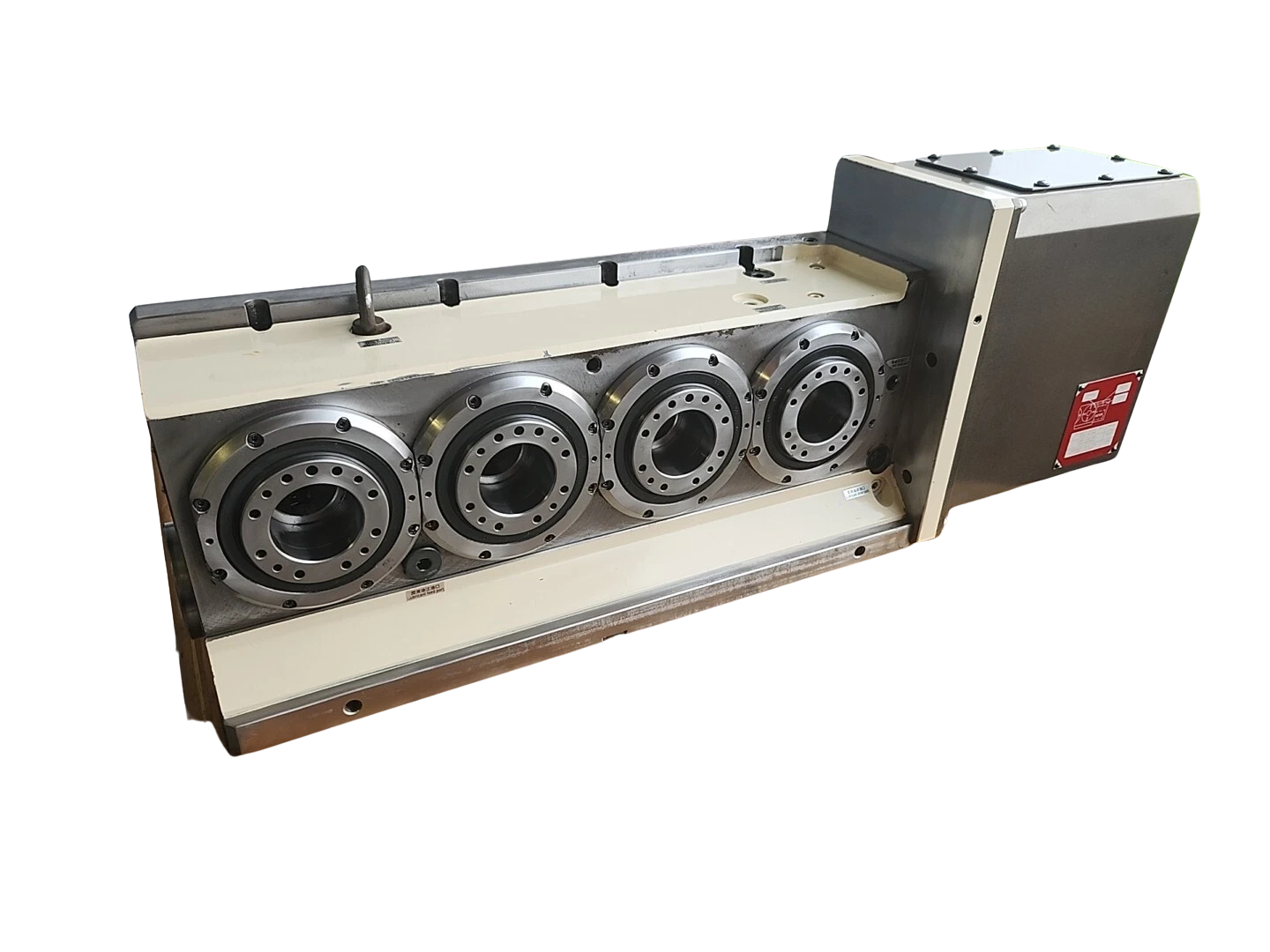
A high-speed, multi-spindle rotary table is a precision-engineered indexing or positioning device used in CNC (Computer Numerical Control) machine tools for metalworking. It consists of a rotary base (typically a worm-gear or direct-drive mechanism) that supports multiple vertical spindles—usually 2 to 8 or more—arranged in a circular or polygonal configuration. Each spindle holds a workpiece or tool, enabling simultaneous machining operations across all spindles as the table rotates to index positions.Key technical specifications include:
- Rotational Speed: Up to 1,000–3,000 RPM (revolutions per minute), far exceeding standard rotary tables (often <500 RPM), achieved via high-torque servo motors or frictionless direct drives.
- Indexing Accuracy: Sub-5 arc-second repeatability, with positioning times under 0.5 seconds per index, using encoders and closed-loop feedback systems.
- Load Capacity: 50–500 kg per spindle, depending on size, with balanced dynamic loading to minimize vibration.
- Drive System: Often employs curvilinear tooth belts or harmonic drives for backlash-free motion, integrated with CNC controllers (e.g., Fanuc or Siemens) for synchronized axis control.
In metalworking, these tables are fabricated from high-stiffness materials like hardened steel or cast iron, with hydrostatic or air bearings to reduce friction and wear during high-speed operation.Technical Explanation in the Context of Metalworking and CNC Machine ToolsIn the CNC sector, rotary tables convert linear machine tools into multi-axis systems (e.g., adding a fourth or fifth axis). A multi-spindle variant amplifies throughput by parallelizing operations: while one spindle is under active machining (e.g., milling, drilling, or tapping on a vertical machining center), others can be loading/unloading or in idle index positions. This is governed by G-code programming for coordinated motion, where the table’s C-axis (rotary) interpolates with the machine’s X/Y/Z axes.For high-speed performance:
- Kinematics: The table uses a torque motor with electronic commutation, delivering peak torques of 100–500 Nm for rapid acceleration (up to 5,000°/s²). This enables “flying indexing,” where rotation occurs without stopping the main spindle, reducing cycle times by 30–50%.
- Vibration Control: At elevated speeds, centrifugal forces on multi-spindles (each offset from the center) generate unbalanced loads. Counterweights or active damping (e.g., piezoelectric actuators) maintain <1 µm deflection, ensuring surface finishes of Ra 0.8 µm or better in aluminum or steel workpieces.
- Thermal Management: High-speed operation induces heat from friction; liquid cooling channels or forced-air systems keep thermal expansion below 5 µm, preserving tolerances in precision parts like aerospace turbine blades.
Why It’s Particularly Suited for Multi-Spindle Vertical Machining Centers (VMCs)Multi-spindle VMCs are vertical-axis machines optimized for high-volume production of prismatic parts (e.g., automotive components, engine blocks) with multiple tooling stations. The high-speed, multi-spindle rotary table is ideally matched due to synergistic technical advantages:
| Aspect | Suitability to Multi-Spindle VMCs | Technical Benefits in Metalworking |
|---|---|---|
| Throughput Optimization | VMCs often feature multiple tool changers and spindles for parallel ops; the rotary table extends this to workpieces, allowing simultaneous roughing on one station while finishing another. | Reduces cycle time by 40–70% (e.g., from 2 min/part to 30 s/part in batch runs of 1,000+ steel housings), via overlapped indexing without halting Z-axis feeds. |
| High-Speed Compatibility | VMC main spindles run at 10,000–20,000 RPM; the table’s speed matches this to avoid bottlenecks, enabling continuous contouring (e.g., helical interpolation). | Minimizes chip-to-chip time; in titanium machining, it sustains 80% spindle utilization vs. 50% on single-spindle setups, per ISO 23177 standards. |
| Vertical Orientation Synergy | VMCs excel in gravity-fed chip evacuation; vertical multi-spindles on the table align with this, preventing coolant pooling and improving rigidity against downward forces. | Enhances stability for deep-pocket milling (aspect ratios >5:1), with <0.01 mm form errors, ideal for die-cast aluminum prototypes. |
| Scalability and Automation | Integrates with VMC’s pallet changers and robots for lights-out operation; multi-spindles distribute load across the table’s high-inertia base. | Supports Industry 4.0 via Ethernet/IP for real-time monitoring, cutting downtime in high-mix/low-volume runs (e.g., custom gears) by predictive maintenance on wear-prone worm gears. |
| Precision in Dynamics | VMCs handle heavy axial loads; the table’s multi-spindle design balances moments, reducing tool deflection during 4-axis simultaneous machining. | Achieves ±2 µm positional accuracy at 2,000 RPM, critical for 5-axis VMC upgrades in mold-making, where harmonic distortion must stay <0.5%. |
In summary, this table transforms a standard VMC into a high-efficiency transfer line equivalent, slashing per-part costs in metalworking by leveraging parallelism and speed without sacrificing the precision demanded by CNC tolerances (e.g., IT6–IT7 grades). Applications include valve bodies in automotive CNC lines, where it boosts OEE (Overall Equipment Effectiveness) from 60% to 85%