03/09/2025
What is Hammer Milling Machine that is Ideal for smaller production runs or pilot-scale testing?
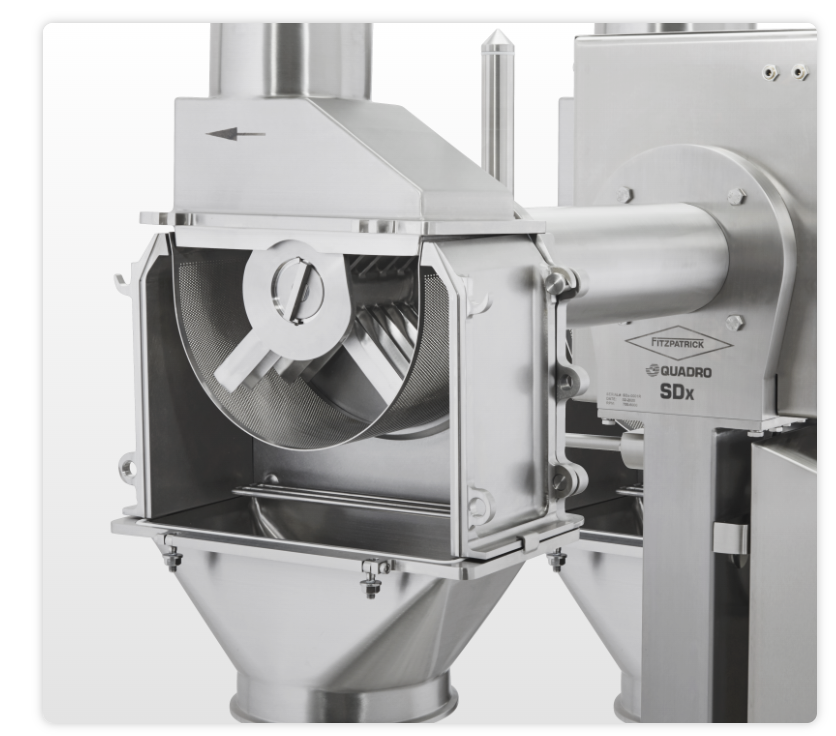
What Is a Hammer Milling Machine for Pilot/Small Production?
Purpose. A hammer mill is used for particle size reduction and granulation prep of dry solids (granules, crystals, flakes, cakes, etc.). At pilot scale it helps define the process window that will later be scaled to production.
Working Principle
- A high-speed rotor fitted with hammers/paddles applies impact and attrition to the material.
- Product exits once it can pass through the surrounding perforated screen; oversize recirculates inside the impact zone until small enough.
- Key variables:
- Tip speed = π × rotor diameter × rpm; the primary driver of breakage energy.
- Screen aperture and open area: set the target PSD and throughput.
- Feed rate: typically via a screw feeder for stability; over-feeding causes heating/excess fines.
Main Subsystems
- Product-contact surfaces: 316L stainless steel, Ra ≤ 0.8 µm; dead-leg-free seals.
- Rotor/hammer sets: straight, angled, or knife styles; quick-release for fast changeover.
- Screens: 0.2–10 mm perforations; flat/cylindrical; optional support bars.
- Drive: 3–11 kW motor with VFD; typical 1,000–12,000 rpm.
- Feeding: Gravity hopper or screw feeder for tighter control.
- Dust control: Enclosed body with HEPA-filtered aspiration or vacuum collection; ATEX/Ex-proof options.
- Cleaning: Rapid disassembly; CIP/SIP options; gasketed door and swing clamps.
- Controls: Speed, load (kW), product temperature, ∆P; recipe/profile storage.
Performance (pilot class)
- Capacity: Typically 5–200 kg/h (material dependent; free-flowing granules > hard crystals/flakes).
- Particle size (D50): About 50–1,000 µm, tuned by screen and tip speed.
- Temperature rise: Impact generates heat; for heat-sensitive products use lower tip speed + larger screen + assist air.
- Uniformity: Improved by screen open area and rotor–screen clearance.
Why It Fits Pilot Scale
- Direct scalability: Keep similar tip speed and similar screen open area/geometry when moving to production; only rotor diameter and open area grow.
- Quick changeover: Swap rotor/screen in 10–20 min → ideal for multi-product pilot work.
- Compact/mobile skid: Fits beside a lab or pilot line.
- GMP/Validation: Batch traceability, MOC, and IQ/OQ documentation available.
Application Examples
- Pre-tablet granule conditioning / rework breaking
- Deagglomerating post-drying lumps
- Bringing sugar, salt, chemical crystals to a target PSD
- Food additives, spices (use low tip speed to preserve volatiles)
Safety & Compliance
- Dust explosion risk: ATEX Zone 21/22 or NFPA compliant design; nitrogen inerting or explosion venting as required.
- Metal contamination: Magnetic trap and rotor/screen integrity sensors.
- Noise: Acoustic enclosure targets <80–85 dB(A).
Selection Checklist
- Target PSD range and distribution (D10/D50/D90).
- Product hardness/brittleness and heat sensitivity.
- Required throughput (kg/h) and feed method (gravity/screw).
- Screen type/opening and hammer/knife geometry options.
- Cleaning needs (CIP, tool-free disassembly).
- Dust control (exhaust airflow, isolation/isolator).
- ATEX/Ex requirements, material certs, validation docs.
Versus a Conical Mill (When to Choose a Hammer Mill)
- Hammer mill: More aggressive; higher capacity; broader PSD; better for breaking hard agglomerates.
- Conical mill (Comil): Narrower PSD and lower heat; excels at calibration/de-lumping with gentler action.
- In pilot plants, both can be mounted on an interchangeable head platform so you can quickly explore the process window.