03/09/2025
What is Climatic Test Chamber with Humidity?

Climatic Test Chamber with Humidity — Technical Overview
Purpose. A climatic (environmental) test chamber with humidity creates controlled atmospheres of temperature (T) and relative humidity (RH) to evaluate reliability, aging, and failure modes of products (electronics, plastics, coatings, automotive parts, etc.). It executes programmable ramp/soak profiles such as high-temp/high-RH bias, damp-heat steady state, and cyclic humidity.
How it works (control loops)
1) Air system & circulation
- Conditioned air plenum with high-static EC fan(s) recirculate air through the workspace (typ. 1–2 m/s), ensuring uniform T/RH.
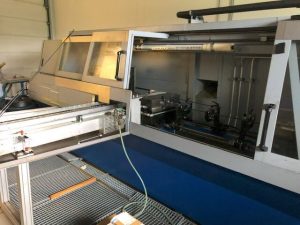
- Heated, double- glazed viewing window has an edge heater to prevent fogging.
2) Temperature control
- Cooling: Vapor-compression refrigeration (single or cascade for deep-cold). Components include compressor(s), condenser (air- or water-cooled), evaporator coil in the plenum, expansion device (EEV/TEV), and hot-gas bypass for fine modulation.
- Heating: Stainless-sheathed electric heaters (NiCr elements) in the supply airstream.
- Sensors & control: Class-A PT100/RTD or precision thermistor; closed-loop PID keeps setpoint and ramps at defined rates.
3) Humidity control
- Humidification:
- Most chambers use a steam generator/boiler to inject saturated steam into the airstream (fast response, sterile).
- Alternatives: ultrasonic atomizers (low-energy) or spray nozzles (less common in precision test).
- Dehumidification:
- Sub-dewpoint cooling over the evaporator condenses moisture (primary method).
- Some systems add a desiccant wheel or dry-air purge option for very low RH.
- Sensing: Capacitive RH probe (temperature-compensated); high-precision systems add a chilled-mirror dew-point reference. Control may be by dew point rather than RH to avoid psychrometric coupling errors.
- Water quality: DI/RO water (e.g., conductivity <5–50 µS/cm) to prevent scaling in the steam generator; level and dry-run protections included.
Typical capability (varies by model/size)
- Temperature range: −70…+180 °C (common); high-temp limited by materials and safety.
- Humidity range: 10…98 % RH (typical control band) within +10…+95 °C; below ~+10 °C precise RH control is impractical due to ice/frost.
- Change rates: 1–10 K/min (standard chambers); high-rate options available.
- Performance: Stability ±0.2…±0.5 °C, ±1.5…±3 %RH; spatial uniformity ±1…±2 °C, ±3…±5 %RH.
- Recovery time: Minutes after door open or load heat step.
- Volumes: ~50 to >1,500 L; payload shelves with defined mass/heat-load ratings.
Construction & interfaces
- Interior: Seam-welded AISI 304/316 stainless steel liner; rounded corners for drainage and cleaning.
- Insulation: High-density polyurethane or vacuum-insulated panels to limit heat leak and condensation.
- Door seal: Heated, vapor-tight gasket; safety pressure relief.
- Ports: Cable/pass-through (e.g., Ø50–125 mm) for powering DUTs and running sensors.
- Controller: Touch HMI with profile programmer (steps: ramp, soak, loop, jump, conditional end); data logging to USB/Ethernet; protocols like Modbus/TCP, Ethernet/IP, RS-485.
- Lighting: LED chamber light; window heater anti-fog.
- Safety: Over-temperature limiter (thermal cutoff & software), refrigerant HP/LP switches, steam boiler level/overheat, door interlock.
Common test modes & standards
- Damp heat steady state / cyclic: e.g., IEC 60068-2-78, IEC 60068-2-30.
- High/low temperature storage/operational: IEC 60068-2-1/-2, MIL-STD-810 501/502.
- Humidity (bias) for electronics: MIL-STD-810 Method 507, JEDEC JESD22-A101 (THB/HAST variants use pressure ovens).
- Automotive: ISO 16750 / LV124 climate profiles.
Integration & calibration
- Load heat handling: Specify DUT self-heating (W) and max allowable air velocity across sensitive parts.
- Sensor calibration: Annual calibration against certified references (RTD & RH/dew-point); map-based uniformity adjustments stored in controller.
- Condensate management: Sloped floor and drain; external trap; corrosion-resistant fittings.
Selection checklist (what to specify)
- Useful T/RH envelope (especially low-RH at elevated T and high-RH at mid-T).
- Ramp rate and recovery with your test payload (mass & heat load).
- Volume & geometry (fixture space, pass-through size, shelving).
- Water system (DI tank, automatic refill, drain, maintenance access).
- Condenser type (air-cooled vs water-cooled) and facility utilities.
- Controller features (profile steps/loops, remote control, data export, alarms).
- Compliance with the specific test standards you must run.
- Serviceability (steam generator descaling, filter access, RH probe replacement).
Why humidity matters technically
Moisture accelerates electrochemical migration, corrosion, swelling of polymers, and adhesive creep. Coupling RH with temperature exercises diffusion and sorption phenomena; controlling by dew point stabilizes absolute moisture content even as temperature ramps.