What are Switchgears & Switchboards used for Industrial Automation Technology?
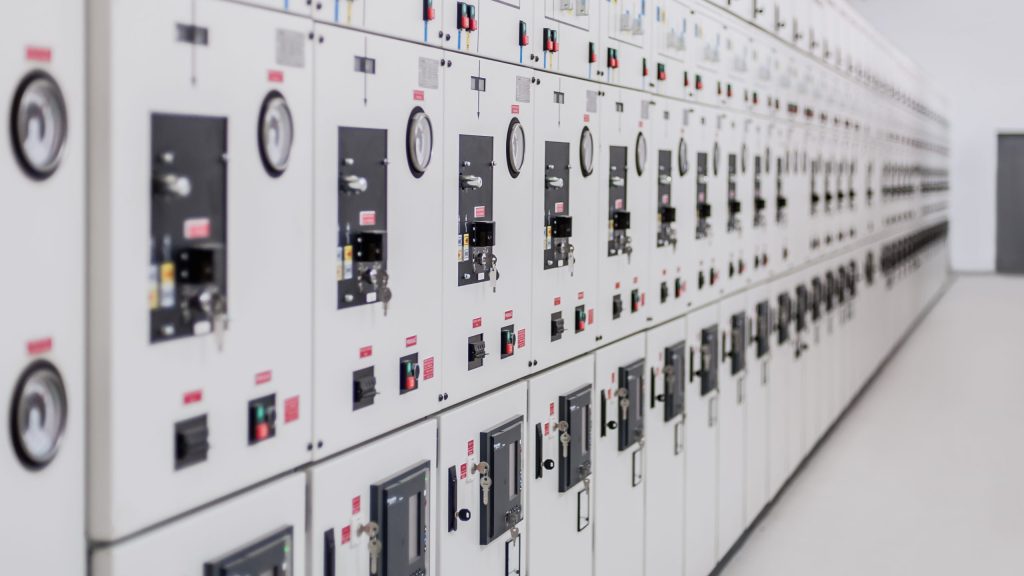
Switchgear & Switchboards in Industrial Automation — Technical Overview
Purpose:
Provide safe isolation, switching, protection, metering, and distribution of electrical power to automation loads—PLC/IO racks, motion systems (VFDs/servos), robots, machine tools, heaters, and auxiliaries (UPS, compressors, HVAC).
What they are (and how they differ)
- Switchgear (LV or MV):
Metal-enclosed assemblies built around high-interrupting power circuit breakers (ACB/MCCB at low voltage; vacuum/SF₆-free VCB at medium voltage). Typically draw-out breakers, shutters, grounded bus compartments, and compartmentalization for maintainability and arc-flash mitigation. Standards: IEC 61439-2 (LV), IEC 62271 (MV); UL 1558/UL 1066 (LV), ANSI C37 (MV). - Switchboard (LV):
Front-access distribution with fixed-mounted ACB/MCCB/fuse devices, simpler construction, usually lower short-circuit ratings than metal-clad switchgear. Standards: IEC 61439-1/2, UL 891. Ideal for plant main distribution and large sub-distribution where draw-out isn’t required.
In practice: MV switchgear (3.3–36 kV) feeds unit substations/transformers → LV switchgear/switchboards (400/480/690 V) → MCCs and control panels powering the automation loads.
Core functions & components
- Incoming & tie sections: main breakers, ATS or manual tie, synch-check for generator paralleling.
- Busbars: copper/aluminum, rated for current & short-time withstand (Icw 1 s/3 s); insulated or bare; optional A/B dual bus for redundancy.
- Feeder compartments: ACB/MCCB/fused switches sized to load; selective coordination upstream–downstream.
- Protection & control: digital relays (overcurrent, ground-fault, differential, arc-flash detection), ZSI (zone-selective interlocking), maintenance-energy switch.
- Measurement & PQ: meters for V/I/PF/THD; PQ analyzers; PFC (capacitor banks) or active harmonic filters for VFD-heavy lines.
- Automation interfaces: IEDs with Modbus-TCP/EtherNet/IP/PROFINET or IEC 61850 GOOSE (MV), status/alarms to SCADA/DCS.
- Safety: interlocked shutters, key interlocks, voltage presence indicators, earthing switches, arc-resistant plenums.
- Environment: NEMA/IEC enclosure type, IP degree, heaters/space thermostats, dust and corrosive protection.
In the automation stack
- MCC (Motor Control Center): often downstream of switchboard; houses breakers + contactors/VFDs/soft starters, motor relays, and field I/O.
- Control power: redundant 24 VDC PSUs, control transformers, UPS for PLCs/HMIs; segregated from power bus.
- Interlocks: E-stop chains, safe torque off (STO) for drives, feeder permissives, trapped-key systems for machine access.
Key engineering parameters (what to specify)
- System data: voltage (e.g., 400/480/690 V LV; 6/11/15/33 kV MV), frequency, earthing scheme (TN-S/TN-C-S/IT), ambient temp/altitude.
- Fault level at point of installation: utility + generator contributions → select kAIC and Icw; verify withstand & let-through on all devices.
- Bus rating & temperature rise: continuous current, diversity, future growth, bus bracing (peak Ipk).
- Protection settings & coordination: time-current curves, selectivity with downstream MCCs/panels; ground-fault coverage; arc-flash labels (incident energy, working distance).
- Form of separation / accessibility: IEC Form 2b/3b/4b; front vs. rear access; draw-out vs. fixed.
- Arc-flash mitigation: arc-resistant type testing, fiber-optic detection, high-speed earthing switch, ZSI, maintenance mode.
- Power quality & harmonics: VFD population → THDi/THDv limits, filters or 12/18-pulse/AFE drives, PFC sizing and detuning.
- Reliability & topology: single bus, dual A/B bus with bus-tie, sectionalizers, ATS logic for utility/GEN/UPS, feeder priority load-shedding.
- Communications & time sync: network type, PTP/NTP, SCADA tags, SOE logging, cyber-hardening.
- Compliance & testing: routine/type tests (dielectric, insulation resistance, temperature rise, short-circuit withstand), FAT/SAT, primary/secondary injection for relays, VT/CT class and burden.
Typical ratings (guidance)
- LV switchgear/switchboards: 1–6 kA bus; breakers 25–100 kA@480 V; ingress IP31–IP54; seismic bracing as needed.
- MV switchgear: 7.2–36 kV, 25–50 kA short-time 1 s, vacuum breakers 1,500–10,000 A frames; metal-clad, arc-resistant options.
Good practice in automated plants
- Keep ducts and cable entries segregated (power vs control), maintain minimum creepage/clearance.
- Use current-limiting fuses for transformer secondaries feeding big rectifiers/servo supplies to cap let-through.
- Prefer magnetically levitated/withdrawable feeders in high-uptime areas to service under energized bus (with safety procedures).
- Provide spares and 20–30% space for future feeders; document single-line, protection study, and settings files.
- Implement condition monitoring (breaker operations count, contact wear, temperature via IR/RFID sensors) into CMMS/SCADA.
Bottom line
Switchgear and switchboards are the electrical backbone of industrial automation: they condition and protect incoming power, segment it into selective, maintainable feeders, and expose the states/measurements your SCADA needs. Correct fault-level sizing, protection coordination, PQ control, and communications are what make an automated factory electrically safe, reliable, and measurable.