03/09/2025
What is Bookbinding Machine?
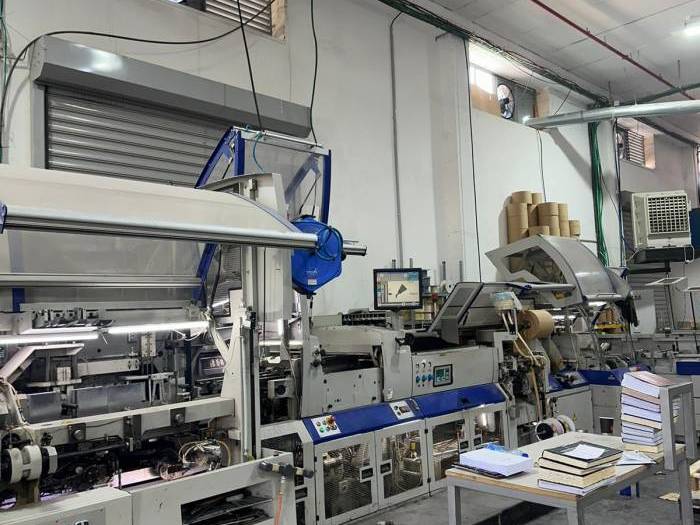
A bookbinding machine (or “binding line”) assembles printed sheets into finished books by collating/gathering, preparing the book block, binding the spine (mechanically or with adhesive/thread), and trimming to final size. Lines are modular and may be inline (press → binder) or nearline.
Main binding processes & what the machine does
- Saddle stitching (stapled on the fold)
- Flow: signature feeders → saddle chain → jog/caliper check → stitch heads (wire 0.4–0.8 mm; loop or standard) → 3-knife trimmer.
- Use: magazines/catalogs 8–120 pp.
- Speeds: ~6,000–18,000 cph depending on pockets.
- Controls: ASIR/barcode signature verification, thickness calipers, miss/ double-feed eject.
- Perfect binding (softcover; EVA or PUR hotmelt)
- Flow: gatherer → clamps → spine milling/notching/roughening (0.5–1.5 mm) → adhesive application (EVA 160–180 °C; PUR 120–140 °C; side-glue unit) → nipping station with creased cover feeder → 3-knife trimmer.
- Ranges: thickness 1–60 mm; formats from A6 to >A3 (varies by model); 1-clamp (short-run) to 30-clamp carousels (up to ~18,000 bph).
- Notes: PUR yields highest page-pull and temperature/moisture resistance; EVA sets faster but is less durable. Lay-flat/Otabind variants add spine gap control and gauze/lining.
- Sewn binding (Smyth sewing)
- Flow: gatherer → sewing of folded signatures with thread → back-glue/lining → case-in or softcover.
- Use: premium books, textbooks; best durability, opens flat.
- Case binding (hardcover)
- Modules: case maker (board + cover material), rounding/backing press, endpapering, casing-in, joint forming/building-in press, headbanding, jacket/ shrink-wrap.
- Outputs: square or rounded backs; library grade durability.
- Mechanical bindings (punch & bind: Wire-O®, coil/spiral, comb)
- Modules: high-tonnage punch (die pitch e.g., 3:1 or 2:1) → closer/crimper → 3-side trim optional.
- Use: manuals, notebooks; full lay-flat.
Critical subsystems (common to modern lines)
- Gathering/feeding: signature/stack feeders with barcode/OCR for integrity.
- Book-block prep: joggers, spine saws, rougheners, side-millers.
- Adhesive units: open-pan or closed-tank; metered coat thickness ~0.3–0.8 mm; temperature & viscosity control; PUR nitrogen-blanketed tanks.
- Nippers/presses: servo-set clamp pressure & dwell to square the block.
- Cover/liner handling: inline creasing/scoring, hot-melt backlining, gauze application.
- Trimming: three-knife trimmer or 4/5-knife for flaps; CIP-set sizes.
- Controls: PLC with recipe memory, JDF/JMF connectivity, power meters, pull-test sampling, waste eject, thickness monitoring.
- Safety: interlocked guards, fume extraction (especially for PUR/isocyanates), dust removal.
How to select a bookbinding machine (technical criteria)
- Product mix
- Format window: min/max trim size, cover flap options, bleed.
- Block thickness: min sheets to max mm; for thin books ensure low-profile clamps and fine nipping control.
- Durability & opening behavior
- Adhesive choice:
- PUR for coated/digital stocks, high pull strength, temperature/moisture cycling; requires 8–24 h cure.
- EVA for cost and speed; avoid for heavy-ink/varnish or extreme climates.
- Thread-sewn when maximum life and lay-flat are mandatory.
- Target page-pull / flex: specify acceptance criteria (e.g., page-pull N/ cm for A4).
- Paper & print process
- Grain direction parallel to spine, moisture balance, ink/toner type (some digital toners need plasma/primer or PUR).
- Coated stocks benefit from spine notching, primer, or PUR.
- Throughput & changeover
- Required cph/bph, number of feeders/pockets, auto-setup (motorized format, auto-scoring, glue gap setting), barcode-driven makeready.
- For short runs, prefer 1-clamp/4-clamp with <5 min changeovers; for long runs, carousel lines.
- Quality controls
- Signature verification, thickness calipers, glue-line/temperature sensors, real-time reject.
- For case binding: joint width, hinge strength, case squareness monitors.
- Finishing integration
- Inline cover creasing, lamination, foil, dust-jacket, shrink-wrap, stacking; logistics (palletizers/robots).
- Utilities & materials
- Electrical kW per module, compressed air, vacuum.
- PUR requires dry nitrogen and dedicated cleanup protocols; EVA uses less demanding housekeeping.
- Maintenance & TCO
- Open vs closed glue systems (char/skin control), easy-change saws and rougheners, belt/knife life, remote diagnostics, spare parts availability.
Typical numbers (guidance; check OEM data)
- Saddle stitchers: 6k–18k copies/h; 1–6 mm caliper range.
- Perfect binders: 300–18,000 books/h; spine 1–60 mm; milling 0.5–1.5 mm; nipping 1–5 kN.
- Case binders: 500–3,000 books/h depending on rounding/casing options.
Bottom line: a bookbinding machine is a modular, servo-controlled production system that transforms gathered sheets into finished books via stitching, adhesive binding, sewing, and trimming. Selecting the right one means matching binding method + format window + substrate + required durability while engineering glue, mechanics, quality control, and changeover to your run profile.