24/08/2025
What is Frame Style 4-Post 250 Ton Forming Press?
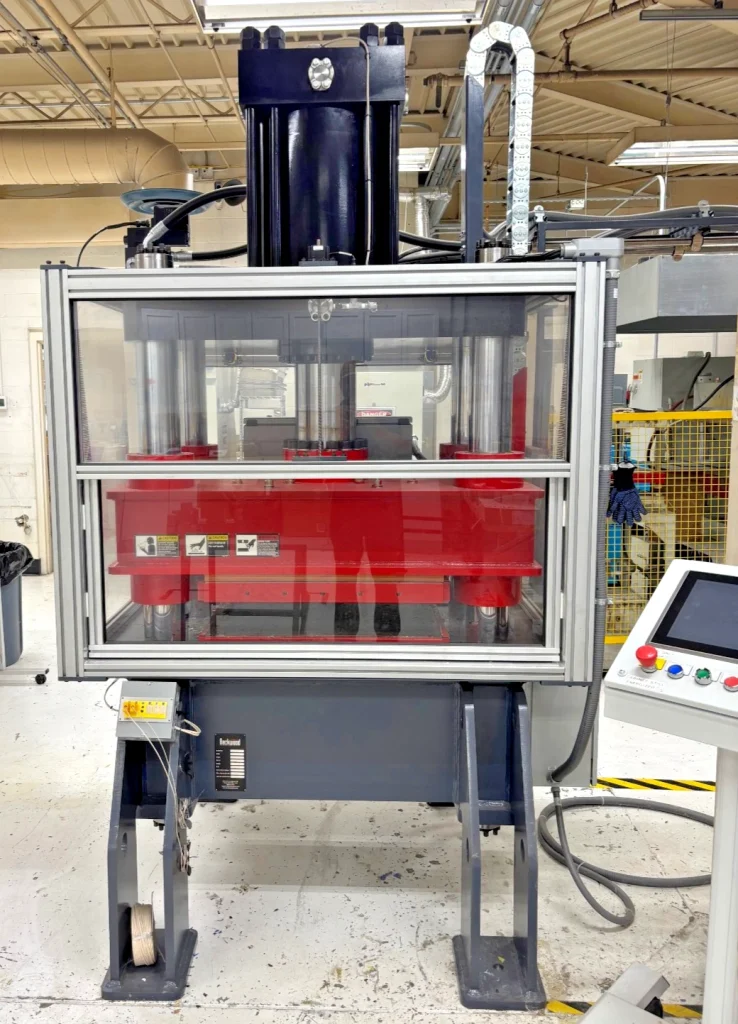
A 4-post press (also called a four-column press) is a hydraulic forming press whose moving platen (ram/slide) is guided on four vertical columns (posts). The columns tie the crown (top) to the bed (base) and provide guidance and preload (via tie-nuts) so the upper and lower platens stay parallel under load.
250 ton is the rated forming force — about 2.22 MN (≈2,224 kN or 500,000 lbf) — available at the tool at the specified rating point (manufacturer defines where in the stroke and at what system pressure).
Major assemblies (and why they matter)
- Frame & posts: Two heavy plates (bed/crown) tied by four ground columns with long bronze or composite bushings in the moving platen. Tie-nuts are torqued to put the structure in compression for rigidity and to limit elastic deflection.
- Hydraulic group: One or more main cylinders mounted in the crown (or bed for up-acting designs). Force = pressure × piston area; e.g., at 3000 psi a ~14.6″ bore yields ~250 ton. Servo-valves or proportional valves control approach speed, pressing speed, dwell, and return.
- Platens / bolster: Precision-machined, T-slotted surfaces for die mounting. Parallelism and flatness of these faces are critical for even forming and tool life.
- Guidance & alignment: Column spacing and bearing length are sized to resist tipping from off-center loads common in irregular sheet-metal tools.
- Controls: PLC/HMI with position, pressure, and time recipes. Modes typically include position control, force (pressure) control, pressure-with-dwell, and kiss-block forming.
- Options for sheet metal: Die cushion/blank-holder in the bed (hydraulic or nitrogen) for deep drawing; ejectors/knock-outs; heated platens; in-die sensing; light curtains and perimeter guarding.
Key specs you’ll see on a datasheet
- Tonnage: 250 ton rated at a defined stroke position and system pressure.
- Daylight: Max open distance between platens (accommodates tool height + part + cushion).
- Stroke: Travel of the ram; with programmable slow-down and dwell.
- Shut height: Tool “closed” height at bottom of stroke.
- Bed/ram size: Effective bolster and slide dimensions and T-slot layout.
- Guidance accuracy: Parallelism and repeatability (often in the hundredths of a mm range on quality builds, tool-dependent).
- Speed profile: Fast approach, controlled press speed (for material flow), decompression, return.
- Cushion force & stroke (if fitted): Typically 10–30% of main tonnage for drawing.
Why choose a 4-post frame for sheet-metal work?
Advantages
- Full, 360° tool access for die mounting and maintenance.
- Excellent platen parallelism and good rigidity for most forming, blank-holding and laminating tasks.
- Cost-effective versus a straight-side for the same daylight/bed size.
- Easy integration of large or tall tools thanks to generous daylight.
Trade-offs
- For very high off-center or side-load conditions (e.g., long progressive dies), a straight-side press may resist lateral deflection better. 4-post machines handle this with larger columns, longer bushings, and centering practices.
Typical sheet-metal applications
- Shallow/medium draw operations with a cushion/blank-holder.
- Embossing, coining, beading, flanging, panel straightening, and corrective forming.
- Bonding/laminating and press-fit assembly where precise pressure/dwell are needed.
- Tryout and die-spotting (with low-speed, pressure-limited control).
Process notes for metal formers
- Tonnage calculation: Deep draw and flanging tonnage are driven by material tensile strength, thickness, and perimeter contact. A common planning approach is pressure-controlled forming with displacement monitoring, then back-solving to verify margin against the 250-ton rating.
- Blank-holder sizing: Start with ~15–25% of main tonnage as a cushion target for low-carbon steel draws; tune to suppress wrinkling without tearing.
- Tooling care: Keep punch-die alignment within the press’s parallelism capability; use shut-height stops (kiss blocks) so forming depth is position-controlled, not seal-compression-controlled.
- Foundation & alignment: Level the bed, verify ram-to-bed parallelism under a proving load, and map deflection so tools are shimmed correctly.
What to specify when you RFQ a 250-ton 4-post
- Required daylight, stroke, shut height, bed/ram size and T-slot pattern.
- Max tool weight and desired approach/press/return speeds.
- Die cushion tonnage/stroke/ports if drawing.
- Accuracy targets (parallelism, repeatability) and load case (centered vs. eccentric).
- Safety/standards (CE/UKCA, light curtains, two-hand, guarding).
- Controls (recipe storage, pressure/position graphs, in-die sensors, analog outputs to MES).