23/08/2025
What Should We Consider When Purchasing a CNC Lathe Machine capable of Ultra Precision Turning Hard Parts up to 60HRC hardness?
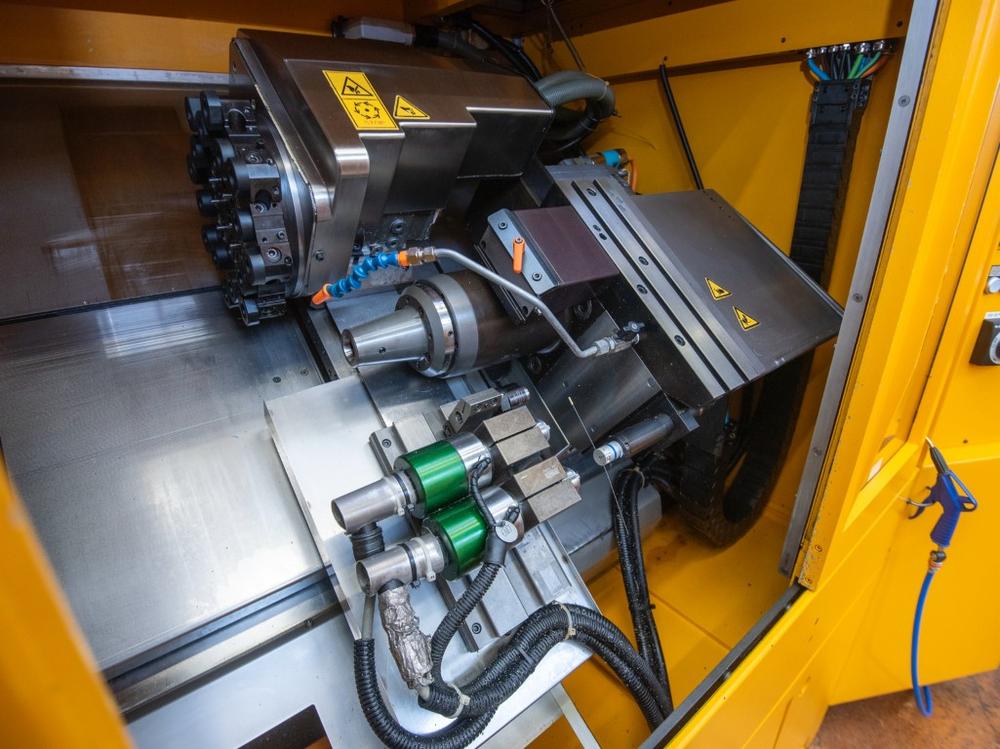
Below is a practical, technical checklist for buying a lathe intended for ultra-precision hard turning (~58–60 HRC steels).
1) Target capability (define up front)
- Geometry & finish goals: e.g., roundness ≤ 2 µm, cylindricity ≤ 3 µm, size Cpk≥1.33, surface finish Ra 0.05–0.2 µm on bearing seats/lands.
- Allowable cycle & DOC: finishing DOC often 0.02–0.10 mm, feeds 0.02–0.08 mm/rev; confirm machine’s stability at these chip loads with CBN.
- Work envelope & workholding style: collet vs. diaphragm/air chuck, tailstock/steady rest, sub-spindle needs.
2) Base, ways, and mechanical stiffness
- Structure: slant-bed or box-type cast iron with high damping; premium machines use hydrostatic ways for near-zero stick–slip and sub-micron contouring.
- Thermal symmetry: mirrored bed/spindle centerlines; isolated ballscrew/linear-motor heat; ribbed casting; verified warm-up drift < 2–3 µm.
- Axes: preloaded ballscrews with dual-nut or linear motors; direct-drive turrets (BMT/HSK/Capto) to avoid indexing error.
- Feedback: glass scales on X/Z with 0.05–0.1 µm resolution; ISO 230 ball-bar/laser accuracy & repeatability reports supplied.
3) Spindle system
- Runout & stiffness: certified radial/axial ≤ 1 µm at gauge; high-precision angular-contact or hydrostatic spindle.
- Thermal control: chiller with oil/air-oil lubrication, thermal mapping & real-time compensation in the CNC.
- Speed/torque: finishing often at 120–300 m/min with PCBN; ensure torque is stable at low DOC to avoid “size push-off”.
4) Workholding and part support
- Concentricity: diaphragm/air chucks or collets with ≤ 2 µm TIR; fine-adjust masters; quick-change soft jaws.
- Axial control: true dead-length clamping to prevent length growth; draw-tube stiffness checked.
- Support: programmable tailstock or hydrostatic/roller steady rest for long slender parts.
5) Tooling & process for 60 HRC
- Inserts: PCBN (wiper geometry, honed/negative rake for interrupted cuts; sharp positive for continuous light finishing).
- Nose radius: typically 0.2–0.4 mm for fine form without chatter.
- Coolant strategy: dry/MQL or filtered oil; if wet, use fine filtration (≤ 5 µm) and temperature-controlled coolant.
- Balance: shrink-fit or precision collet toolholders; tool length kept minimal; turret face runout ≤ 2 µm.
6) CNC control features (ultra-precision)
- High-resolution interpolation (nano-interpolation), look-ahead, and spline/NURBS support for form turning.
- Thermal error comp, pitch-error maps, straightness & squareness comp, and volumetric compensation loaded from factory.
- In-process gauging: spindle probe or post-process closed-loop size control with automatic wear comp.
7) Environment & installation
- Temperature control: hold shop at 20 °C ±1 °C; machine has fully enclosed guarding and laminar airflow (avoid drafts).
- Foundation: leveled on specified points; consider isolation pads; verify ball-bar immediately after install and after 24-h soak.
- Cleanliness: mist extraction; magnetic/.paper filtration to protect slides & scales.
8) Automation & peripherals
- Bar feeder / parts catcher sized to bar quality & straightness; measure bar whip limits at your rpm.
- HP coolant, through-tool oil, chip conveyor, and part washing if required for bearing surfaces.
9) Documentation, proof, and support
- Run-off on your parts meeting your print (size, form, finish) with a signed capability study.
- Factory certs: ISO-230 accuracy charts, spindle runout cert, scale resolution, turret index repeatability.
- Service: availability of CBN application engineers, spindle/chiller service, spare parts lead time, training.
Quick buyer’s checklist
- Flatness/stability of base and hydrostatic/box-way option
- Glass scales on X/Z, 0.1 µm or better; compensation tables loaded
- Spindle runout ≤ 1 µm, active thermal control
- Workholding TIR ≤ 2 µm; dead-length clamping
- Proven PCBN process window on 58–60 HRC with your material
- Environment controlled to ±1 °C; fine coolant filtration ≤ 5 µm
- Signed run-off hitting roundness/cylindricity/finish targets