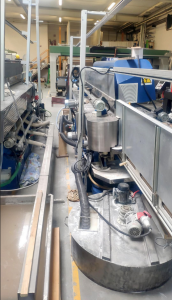
What is a Multi-Needle Embroidery Machine?

A multi-needle embroidery machine is a CNC textile machine with several needle bars per head (typically 6–15) that share one X-Y motion system (“pantograph”). The controller selects a needle/color automatically and drives the needle (Z) and hoop (X-Y) in tight synchronization to place stitches according to a digital stitch file.
Two common configurations
- Single-head, multi-needle: 6–15 needles on one head; ideal for small-batch, on-demand, and varied garment types.
- Multi-head, multi-needle: 2–30 heads in a line, each head with 6–15 needles; all heads run the same job for volume production.
Core Mechanics & Mechatronics
- X-Y Pantograph: Servo/stepper-driven carriage that moves the hoop/frame. Travel defines the sewing field (e.g., 360×500 mm flat; smaller on cap drivers). Resolution is typically 0.1 mm per step or better.
- Z/Needle Drive: Crankshaft or cam converts motor rotation to vertical needle motion. A rotary hook (below) catches the needle loop to form a lockstitch with the bobbin.
- Needle Case & Color-Change: A motorized turret indexes one of the multiple needle bars into the sew position; each bar has its own upper thread path and tensioning.
- Thread Trimmer & Jump Control: Solenoid/pneumatic trimmers cut upper/lower thread at color changes and jumps; controller inserts tie-in/tie-off micro-stitches to lock.
- Tensioning Path: Pre-tension, tension discs, take-up lever, check spring; bobbin case tension is set separately. Many modern units offer active/automatic tension.
- Hooping Systems:
- Tubular/cylinder arm for shirts, hoodies, bags (material wraps around the arm).
- Flat table for patches, panels.
- Cap driver (curved gauge) for 270° cap embroidery with reduced max speed.
- Sensors & Safety: Upper/lower thread break detection, cover interlocks, emergency stop, frame limit switches, needle-up/down homing.
- Lubrication: Rotary hook and needle bar bushings require periodic oiling; some machines have centralized oil reservoirs and wicks.
Stitching Fundamentals (What the CNC Actually Does)
- Stitch types generated in software, executed by the machine:
- Running stitch (walk/back-stitch for travel and outline)
- Satin stitch (columns; high gloss; typical for text/logos up to ~12 mm width)
- Fill/tatami stitch (area fills with controlled density/angle)
- Underlay (edge-run, center-run, zigzag) to stabilize fabric and improve coverage
- Key parameters: stitch length (mm), density (stitches/mm), angle, pull compensation, tie-in/tie-off strategy, trim/jump commands, sequencing (color order).
- Throughput: rated stitches per minute (SPM). Commercial single-head runs 800–1200 SPM flat, 600–900 SPM on caps.
- Job time ≈ total stitches ÷ SPM (plus color-change/trim overhead).
Typical Specifications (per head)
- Needles per head: 6–15 (commercial standard: 8, 12, or 15).
- Max SPM: 1000–1500 SPM (derated for heavy thread/caps/metallic).
- Sewing field: flat 300–500 mm in X, 200–400 mm in Y; cap field smaller (e.g., 70×360 mm).
- Needle system & sizes: DBxK5 / 134-35; sizes #65/9 to #90/14 for 40 wt polyester/rayon; heavier for twill/denim.
- Hook: Rotary hook (large-capacity bobbin common on production heads).
- Memory/Networking: USB, LAN, job queue; reads common stitch formats (DST, DSB, PES, EXP, JEF, etc.). DST/EXP are coordinate-level with color-change/trim commands.
Materials, Threads & Stabilization
- Threads: 40 wt polyester (general), rayon (high sheen, lower strength), metallic (requires lower speed & longer stitches), woolly nylon for stretch/overedge looks.
- Tensions (typical starting points): upper ~80–120 cN for 40 wt; bobbin 18–25 g pull (spring scale). Adjust to get a clean lock point ~1/3 up from fabric underside.
- Stabilizers (backings): Cut-away for knits, tear-away for wovens/twill, water-soluble for lace/toppings on pile (terry, fleece).
- Fabric Control: presser-foot height and underlay strategy counter push/pull so finished dimensions match art.
Why Multi-Needle vs Single-Needle?
- Instant color change (no manual rethreading), enabling complex logos without operator intervention.
- Repeatability: Per-needle tensions set once; consistent results across runs.
- Cap/tubular versatility: dedicated drivers and jigs.
- Scalability: add heads for parallel output with the same operator.
Process Engineering Tips
- Digitizing for production: add pull compensation (0.1–0.4 mm typical), choose underlay per substrate (edge-run + zigzag on knits), keep satin columns ≤12 mm or split.
- Density: start ~0.4–0.5 stitches/mm for satin and 0.35–0.45 for fills; reduce on heavy threads or dense twill.
- Speed management: slow to 600–800 SPM for caps/metallic thread; keep stitch length ≥0.8–1.2 mm to avoid thread fray and heat.
- Hoop torque: hoop taut, not stretched; add topping on pile so satin sits on the surface.
- Quality checks: bobbin balance (T-test), thread path lint cleaning, hook clearance (timing gauge), presser-foot height uniformity.
What to Specify in an RFQ
- Heads × needles/head (e.g., 6-head × 15-needle) and max SPM.
- Sewing fields for flat and cap; table/arm type and included frames.
- Active tensioning, auto-thread trim, thread break detection, laser crosshair for alignment.
- Networking & format support (DST/EXP, job queue, barcode loading).
- Accessories: cap driver (270°), border frame, pocket frames, magnetic hoops, stand, smoke extractor if using heat-bond films.
- Compliance & safety: CE/UKCA, guards, e-stop, light curtain (for industrial cells).
Bottom Line
A multi-needle embroidery machine is a CNC lockstitch platform optimized for color-rich, repeatable decoration on garments and panels. Multiple needles per head give automatic color changes, while the shared X-Y pantograph and precise Z-hook timing deliver accurate satin and fill stitches at industrial speeds. For textile plants, it’s the right choice when you need fast changeovers, consistent quality, and the ability to scale from on-demand runs to multi-head mass production.