What is Dry air dryer that is specifically designed for supplying dried plastic granulate for many different plastics processing applications.
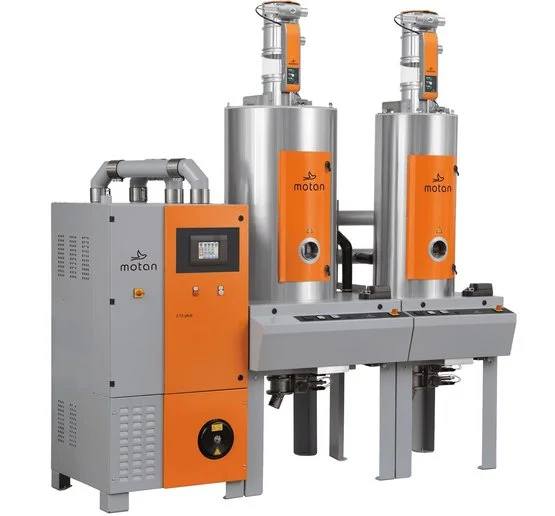
What is a Dry-Air Dryer for Plastics Processing?
A dry-air dryer (dehumidifying desiccant dryer) supplies low-dew-point, heated air to a material hopper to remove absorbed (hygroscopic) moisture from plastic granules before molding or extrusion. It is essential for materials like PET, PA (nylon), PC, PBT, TPU, ABS—where moisture causes hydrolysis, splay, bubbles, loss of strength and poor surface.
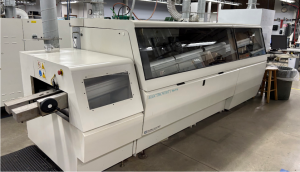
The unit in your photo appears to be a central, twin-hopper system (e.g., Motan LUXOR-A style) that can feed multiple machines.
How it works (process loop)
- Desiccant drying: Ambient air is pulled through a desiccant bed (molecular sieve or honeycomb rotor) to reach a dew point typically ≤ –40 °C (–40 °F) or better.
- Heating: The now “dry” air is electrically heated to the resin’s setpoint (~60–180 °C, resin-dependent).
- Hopper flow: Hot, dry air flows up through a stainless, insulated drying hopper via an air-distribution cone, sweeping moisture from pellet surfaces and from inside the polymer.
- Return & regeneration: Moist air returns to the dryer. One desiccant bed adsorbs while the other regenerates (heated purge) and then cools before switching. In rotor types, a single wheel continuously cycles through dry/regen/cool zones.
- Closed system: Sealed piping prevents re-absorption; many systems extend the dry-air circuit to conveying (dry-air conveying) so pellets stay dry until the machine throat.
Key components
- Process blower (often VFD) and process heater
- Desiccant module(s): twin-tower or rotating wheel, with regeneration heater and after-cooler
- Filters: pre-/return filters to keep dust out of beds and machines
- Drying hoppers: insulated, mass-flow geometry, sight glass, drain, temperature probes, level sensors
- Controls: PID temperature, dew-point sensor, hopper timers, recipe management, conveying integration
What “good” looks like (targets by resin)
- Dew point: ≤ –40 °C; PET or very moisture-sensitive grades often target ≤ –50 °C.
- Drying temperature & time (typical ranges):
- PET: 160–180 °C, 4–6 h
- PC: 120–130 °C, 3–4 h
- PA 6/66: 75–90 °C, 3–5 h
- ABS: 80–85 °C, 2–3 h
(Always use the resin supplier’s datasheet.)
Why it matters
- Prevents hydrolytic chain scission → preserves IV/MFR, tensile/impact properties.
- Improves cosmetic quality (no splay, bubbles, silver streaks).
- Stabilizes part dimensions and process window (lower variation in viscosity/pressure).
- Protects tooling & hot runners from steam and plate-out.
Energy & control features (modern systems)
- Variable-speed blowers and dew-point-dependent regeneration (“demand drying”) cut kWh.
- Heat recovery from return air; fully insulated hoppers.
- Closed-loop conveying so re-moisture does not occur between dryer and machine.
- Central drying with multiple hoppers (as in the photo) to serve several presses/extruders from one dryer.
Sizing & setup checklist
- Airflow sufficient for hopper size and resin (vendor charts): don’t starve the bed.
- Residence time in hopper ≥ datasheet requirement at set temperature.
- Sealed path from silo → dryer → hopper → machine (gaskets, proportioning valves, loaders).
- Sensors: exhaust dew point, hopper-outlet temperature; alarms for low dew point, high return humidity.
- Maintenance: keep filters clean; verify desiccant condition; calibrate dew-point sensor; periodically sanitize hoppers.
Bottom line
A dry-air desiccant dryer delivers hot, ultra-dry air in a closed loop to pull both surface and internal moisture out of hygroscopic plastics. Correct dew point, temperature, airflow, and residence time ensure mechanical properties, surface quality, and process stability in injection molding, extrusion, and blow molding—especially for aerospace/automotive-grade parts.