What is Drum Sander?
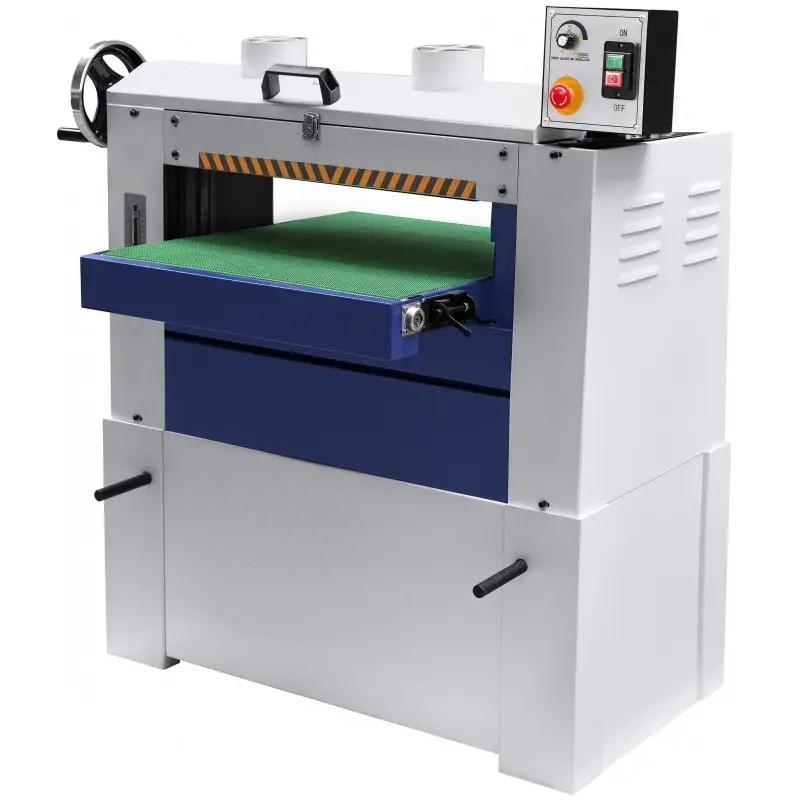
A drum sander is a power-driven woodworking and finishing machine designed to produce smooth, uniform surfaces on wood, composite boards, plastics, and sometimes soft metals. It achieves this by rotating an abrasive sanding belt or sheet around a cylindrical drum, which presses against the workpiece under controlled feed conditions.
Let’s break down the technical aspects:
1. Mechanical Structure
- Drum Assembly
- The drum is a precisely machined, balanced steel or aluminum cylinder.
- Diameter typically ranges from 100 mm to 200 mm (4″–8″).
- It is covered with abrasive material (sandpaper roll or continuous belt).
- The drum is dynamically balanced to minimize vibration.
- Frame and Bed
- A rigid cast-iron or welded steel frame provides vibration-free operation.
- The workpiece is carried on a flat feed bed (often adjustable in height).
2. Drive System
- Motor:
- Industrial drum sanders use 2–10 HP AC motors depending on drum size.
- Direct drive or belt drive transmits power to the drum.
- Feed Motor:
- A secondary motor controls conveyor feed speed, typically variable (0–10 m/min).
- Feed rate is critical for surface finish and to avoid burning.
3. Sanding Media
- Abrasive Wrap / Belt:
- The drum is wrapped with abrasive cloth backed sandpaper.
- Grit sizes vary: coarse (24–60 grit) for stock removal, fine (120–220 grit) for finishing.
- Attachment:
- Spring-loaded or hook-and-loop clamps secure the abrasive to the drum.
- Cooling Considerations:
- Some machines integrate dust extraction and airflow channels to dissipate heat and prevent clogging.
4. Workpiece Feeding & Control
- Conveyor Bed:
- Rubberized conveyor belts move the workpiece at controlled speeds.
- Height adjustment screws or hydraulic systems set the sanding thickness.
- Pass Depth Control:
- Usually adjustable in increments of 0.05–0.1 mm.
- Prevents overloading the motor or burning the wood.
5. Dust & Heat Management
- Dust Collection Ports:
- Drum sanders generate fine dust; most machines have 100–150 mm extraction ports.
- Ventilation:
- Proper air circulation prevents excessive heating of the drum and abrasive surface.
6. Variants
- Single-Drum Sanders: One drum; simpler design, lower cost.
- Double-Drum Sanders: Two drums in sequence (coarse grit first, fine grit second) for faster processing.
- Open-Ended Drum Sanders: Allow sanding of workpieces wider than the drum (requires two passes).
- Closed-Ended Drum Sanders: Offer more rigidity, handle maximum workpiece width in one pass.
7. Technical Applications
- Dimensioning: Reducing thickness of boards to precise measurements.
- Surface Finishing: Achieving a smooth, uniform texture before lacquering or painting.
- Calibration: Used in cabinetmaking, flooring, and panel production for accurate thickness control.
- Material Compatibility: Primarily wood, but also MDF, plywood, plastics, and aluminum with correct abrasives.
In summary:
A drum sander is an abrasive machining system that combines a high-speed rotating drum with a controlled feed conveyor. It ensures uniform stock removal and surface finish by balancing parameters such as grit size, drum speed, feed rate, and pressure. Its precision makes it indispensable in furniture production, flooring, and panel manufacturing where consistent thickness and smoothness are required.