29/08/2025
What is Cutting Benche/Table for Float ,Monolitic, jumbo Glass?
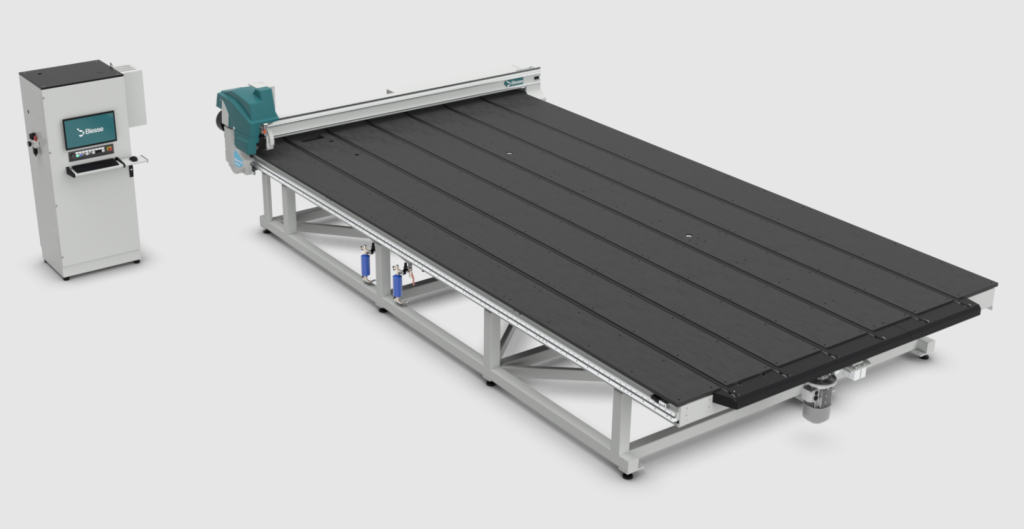
Cutting Bench/Table for Float (Monolithic/Jumbo) Glass — a Practical, Technical Explainer
What it is:
A cutting bench (a.k.a. CNC glass cutting table) is a flat, air-float workstation with a servo-driven cutting bridge that scores float glass and then breaks it to size. “Monolithic” just means single-pane (not laminated). “Jumbo” refers to large stock sheets (typically 3210×6000 mm, and up to 3300×8000 mm “mega-jumbo”).
How it works (score → break workflow)
- Load & position
- The table tilts up to ~85° to accept a sheet from an A-frame/loader.
- Air cushion turns on (thousands of holes in the felted top), so the glass “floats” with near-zero friction.
- Squaring stops and edge sensors square the sheet; cameras can read actual sheet edges.
- CNC scoring
- A gantry/bridge with a 360° rotary cutting head runs along linear guides (rack-and-pinion or linear motors).
- A tungsten-carbide wheel (e.g., 2–6 mm radius) presses with programmable force via a proportional valve.
- Cutting oil (very light kerosene-type) is micro-dosed on the score line.
- For low-E glass, a coating deletion wheel or belt removes the coating along the seal edge before scoring.
- Break-out
- Pop-up H-breakers (for longitudinal breaks) and Z-breakers (transverse) open the score.
- For tricky shapes, an air-knock or manual pliers assist.
- Finished parts slide via the air cushion to an off-load/break-out table or conveyor.
Main modules you’ll see on a modern cutting table
- Air-float table top: steel honeycomb or plenum with felt; high-flow blower(s) + regulator.
- Cutting bridge: servo axes (X/Y), rotary head (C), height sensor, and auto-zero.
- Lubrication: pressurized micro-oiler; recipe-based flow.
- Low-E edge deletion (option): synchronized with the cut plan.
- Break-out hardware: H/Z bars, pop-up pins, pneumatic fingers.
- Controls & software: nesting/optimization, remnant management, barcode/inkjet marking, and ERP/MES links (OPC/REST).
- Safety: light curtains, two-hand jog, vacuum/air interlocks, tilt locks, and anti-crush edges.
What changes for Jumbo sheets
Handling and dynamics dominate:
- Size/weight: glass ≈ 2.5 kg per mm per m².
Example: 10 mm × 3210×6000 mm → area 19.3 m² → ~480 kg per sheet. - Stronger structure: boxed frame, wider bridge, higher moment stiffness to keep score depth uniform.
- Bigger air system: more blower capacity and zoned air so parts don’t skate during break-out.
- Powerful drives: higher torque/accel with jerk control to avoid over-scoring at corners.
- Assists: automatic sheet squaring, edge cameras, and vacuum hold-down zones for small pieces after break.
Typical performance (good industrial range)
- Cut speed: 120–200 m/min (straight lines); 60–100 m/min on shapes.
- Acceleration: 8–15 m/s² with jerk limiting.
- Repeatability: ±0.10–0.20 mm on 3.2×6.0 m.
- Glass thickness: 2–19 mm (monolithic); heavy lines may go to 25 mm with larger wheels.
- Low-E deletion width: 8–15 mm typical, recipe-controlled.
Utilities & installation
- Electrical: 3-phase 400–480 V, 10–25 kVA for table (excl. loader/conveyors).
- Air: clean/dry 6–8 bar, ~300–800 NL/min depending on breaker usage; separate blower(s) for the cushion.
- Footprint: allow an L-line (loading → cutting → break-out) with operator aisles; floor must be flat and level.
- Environment: 18–30 °C, low dust; oil disposal container for cutting fluid.
Choosing options (quick guide)
- Mostly rectangles, high tonnage: strong H/Z breakers, fast straight-line acceleration, robust air zoning.
- Many shapes/nesting: high-accuracy bridge, good CAM, inkjet/barcode for piece ID.
- Low-E dominant: built-in deletion with fume capture.
- Thin glass (≤3 mm): smaller wheel radius, lower force, very smooth felt, precise air control.
- Thick glass (≥12 mm): larger wheel, higher scoring force, slower corners, stronger breakers.