What is an ICM Impact Classifier Mill used for the Fine and Ultrafine Grinding of Brittle Materials?

Impact Classifier Mill (ICM) — a practical, technical explainer
What it is:
An ICM is a single machine that grinds and classifies at the same time. Inside one housing you have:
- a high-speed impact rotor (pins/beaters) that breaks brittle material, and
- a dynamic classifier wheel that immediately separates fines from coarse particles.
If the particle is fine enough it leaves with the process air; if not, it’s thrown back to the rotor for another hit. That’s why an ICM can push to fine (d97 ≈ 20–80 µm) and finest (d97 ≈ 5–20 µm) ranges with tight tops.
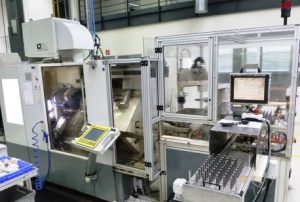
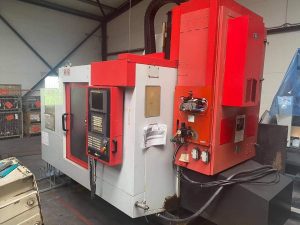
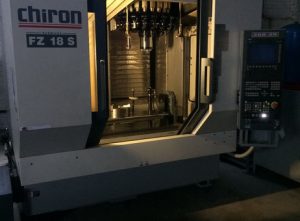
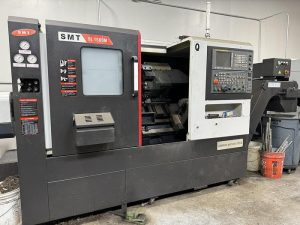
In the screenshot you can see the typical layout: front swing-open door exposing the pin disc/rotor; behind it sits the classifier section driven from the top or side. The closed unit on the right shows the discharge/air outlet and feed port.
What’s inside (and why it matters)
- Feed & dosing: screw or rotary valve meters powder into the rotor eye. Steady feed = stable PSD.
- Impact rotor: pin disc or plate beater on a stiff shaft. Tip speeds 60–120 m/s are common. Brittle particles shatter on pins, liner, and each other (autogenous component).
- Liner/track: hard steel or ceramic; shape sets turbulence and residence time.
- Dynamic classifier wheel: a bladed wheel creates a centrifugal cut.
- Higher wheel rpm → finer cut (smaller top size).
- Lower wheel rpm → coarser cut (higher throughput).
- Process air: pulls product through the wheel, cools the mill, and carries fines to a cyclone + filter.
- Reject loop: anything that can’t pass the wheel is flung back toward the rotor—automatic recirculation.
- Drive(s): rotor and classifier can be co-axial with separate VFDs (best control).
- Access: large hinged door for tool swap and quick clean—exactly what the open machines in your image show.
How you run it (simple control logic)
- Set classifier speed for the target top cut (e.g., aim d97=10 µm).
- Set rotor speed high enough for fresh fracture, not just de-agglomeration.
- Set air volume to balance transport and load (more air helps pull fines out, too much can broaden PSD).
- Start dosing; trim feed so mill ΔP and motor loads sit steady.
- Tune:
- Too coarse? Raise wheel rpm first; then bump rotor rpm.
- Too much fines carryover (pressure drop high)? Reduce feed or air; check filter.
What it’s good at
- Brittle materials: minerals (CaCO₃, talc, baryte, quartz), chemicals, salts, sugars, pigments, battery precursors, flame retardants.
- Tight tops without sieving: dynamic cut prevents “overs” in the final bin.
- One-pass operation: no external classifier loop needed.
Typical numbers (good industrial ranges)
- Capacity: ~10 kg/h → 5 t/h (material & fineness dependent).
- Fineness: d50 ≈ 3–40 µm, d97 ≈ 5–100 µm adjustable by recipe.
- Moisture: best < 1–2 % free moisture; pre-dry sticky feeds.
- Energy: 15–150 kWh/t from “easy” to “hard” minerals at fine cuts.
Options you’ll actually use
- Wear protection: hardfacing, tool steel, ceramic-lined housings for silica/quartz.
- Cooling: jacketed body or chilled air for heat-sensitive products.
- Inerting/ATEX: N₂ purge, O₂ monitoring, explosion vents for organic dusts (starch, sugar, pigments).
- Tooling swap: pin disc ↔ plate beater to suit fragility vs. toughness.
- Easy-clean designs: smooth internals, quick-release classifier, CIP spray nozzles for color changes.
- PSD analytics: inline sizers or sample ports for SPC.
System layout (from feed to bag)
Feeder → ICM → cyclone → filter/HEPA → product rotary valve → bin/big-bag.
A recirculating fan keeps the air loop tight; add a small condenser or dryer if your material is hygroscopic.
When not to pick an ICM
- Gummy or plastic materials that smear when warm (use cryo or a jet mill).
- High moisture or fibers that bridge in the classifier.
- Ultrafine < 3 µm d50 with very hard minerals—jet mills still win there.
Maintenance that pays off
- Track tip speed vs. wear—worn pins need more rpm to hold spec (energy up, yield down).
- Watch classifier hub clearance; a few tenths of a mm drift will leak overs to product.
- Balance the rotor after tool changes; vibration kills bearings and PSD.
- Keep filters healthy; rising ΔP → broader PSD and hot product.
Bottom line
An Impact Classifier Mill is your “two-in-one” fine grinder: the rotor creates fresh fracture surfaces, and the variable-speed internal classifier locks in the top size. With the right tooling, airflow, and recipe control, it delivers repeatable 5–100 µm product on brittle feeds, in a compact, easy-access package like the units shown in your screenshot.