What is Cut to Length Lines with Coil Reel, Uncoiler, Leveler, Shear,Coil Cart used for Cutting for Special Coils Stainless Steel, Aluminum, Copper, Chrome Coated, Brass, Bronze materials?
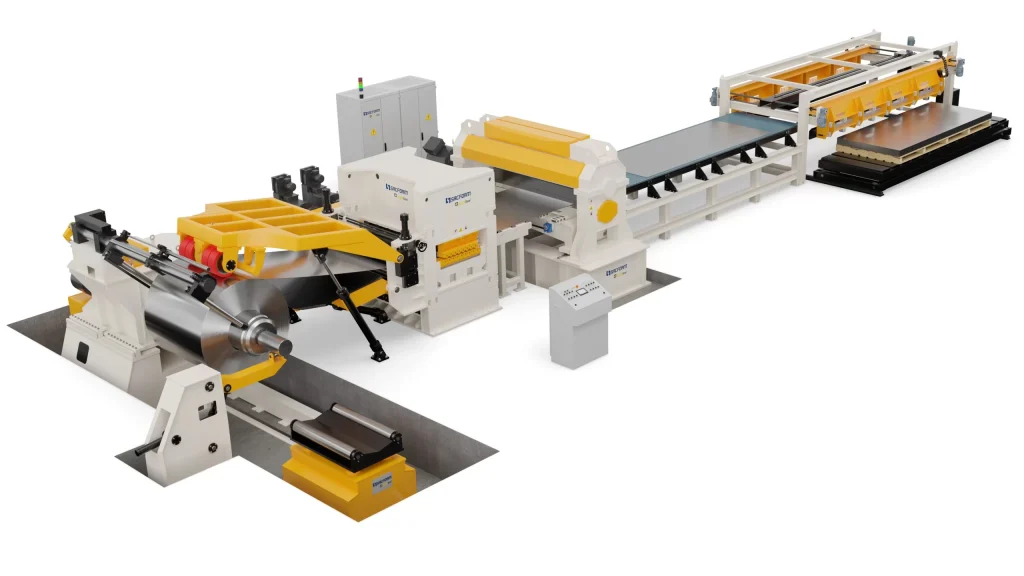
In the sheet metal sector, Cut-to-Length (CTL) lines are specialized automated processing systems designed to convert large master coils of sheet metal into precise, flat rectangular sheets or blanks of specified lengths. These lines are essential for industries such as automotive manufacturing, appliance production, construction, electronics, and aerospace, where high-precision flat sheets are required for forming, stamping, welding, or further fabrication. The system you described—incorporating a coil cart, coil reel (uncoiler), leveler, and shear—is a standard configuration for CTL lines, optimized for handling special coils made from materials like stainless steel, aluminum, copper, chrome-coated (e.g., galvanized or chromate-passivated) metals, brass, and bronze.These materials are often “special” due to their unique properties: stainless steel and aluminum offer corrosion resistance and lightweight strength; copper, brass, and bronze provide excellent electrical conductivity, ductility, and machinability; chrome-coated variants add protective layers for enhanced durability. CTL lines for these materials must accommodate challenges like varying hardness, surface sensitivity (to avoid scratches or coating damage), and thermal expansion coefficients, which can affect flatness and cut accuracy. Typical specifications include coil widths up to 2,200 mm, thicknesses from 0.1 mm to 25 mm, and coil weights up to 25 tons, with length tolerances as tight as ±0.5 mm and flatness deviations under 0.5% of the sheet width.The primary purpose is to minimize material waste, reduce manual handling, and ensure consistent quality by processing coils inline in a continuous or semi-continuous workflow. This results in flat, burr-free sheets ready for downstream operations, improving efficiency and reducing secondary processing costs. Below, I’ll explain the technical function of each component and the overall process, focusing on adaptations for these special materials.Key Components and Their Technical Functions
- Coil Cart:
- Technical Role: The coil cart is a motorized or hydraulic platform used for loading and unloading heavy master coils onto the uncoiler mandrel. It operates on rails or a track system, with capacities typically ranging from 5 to 30 tons. The cart hydraulically lifts the coil (via a V-shaped cradle or arms) to align its inner diameter (ID, usually 508–762 mm) with the uncoiler’s mandrel, preventing misalignment that could cause coil collapse or uneven unwinding.
- Adaptations for Special Materials: For softer or coated metals like chrome-coated steel, aluminum, or brass, the cart includes padded or non-marking contact surfaces (e.g., polyurethane rollers) to protect delicate finishes. In high-precision setups, sensors (e.g., laser alignment systems) ensure centric loading, critical for materials prone to work-hardening like stainless steel, where off-center loading could induce uneven stresses.
- Process Integration: After loading, the cart retreats, allowing the uncoiler to expand into the coil’s ID. This step is crucial for safety and efficiency, as manual handling of heavy coils (e.g., 10–20 tons of copper) is impractical and hazardous.
- Coil Reel (Uncoiler):
- Technical Role: The uncoiler, often a single- or double-mandrel reel, holds the master coil and feeds the strip material into the line at controlled speeds (up to 100–300 m/min, depending on line type). The mandrel expands hydraulically or pneumatically via segmented jaws to grip the coil’s ID securely. A back-tension system (e.g., via brake pads or servo motors) maintains strip tension (typically 5–50 kN) to prevent telescoping (uneven unwinding) or slack, ensuring smooth payoff. Expansion forces can reach 100–200 kN to handle heavy coils without slippage.
- Adaptations for Special Materials: For non-ferrous metals like aluminum or copper, which have lower yield strengths (e.g., aluminum ~70–500 MPa vs. steel ~200–1,000 MPa), the uncoiler uses adjustable tension controls to avoid over-stretching, which could cause thinning or cracking. For coated materials (e.g., chrome-coated), anti-scratch guides and low-friction mandrel segments prevent surface abrasion. Double-mandrel designs allow seamless coil changes, minimizing downtime in high-volume production of stainless steel sheets.
- Process Integration: As the strip uncoils, it passes through entry pinch rolls (driven rollers applying 10–20 kN pressure) to initiate feeding and maintain tension, transitioning to the leveling stage.
- Uncoiler (Often Synonymous with Coil Reel in This Context):
- Note: In your query, “Uncoile” likely refers to the uncoiling action or a redundant emphasis on the uncoiler. Technically, it’s integrated with the coil reel as described above. If distinct, it could denote auxiliary uncoiling supports like hold-down arms that prevent coil “bird-nesting” during startup.
- Leveler:
- Technical Role: The leveler (or straightener) is the core flattening device, using a series of offset work rolls (typically 13–21 rolls in a 4-high or 6-high configuration) to impart corrective plastic deformation. Rolls are arranged in alternating top/bottom banks with precise gaps (adjusted via hydraulic cylinders to 0.01 mm accuracy). As the strip passes through, it undergoes repeated bending (yield-point flattening), reducing flatness defects like coil set (curvature from winding) or crossbow (edge waviness). Leveling force can exceed 500 kN, with roll diameters of 50–150 mm for fine control. Advanced systems incorporate edge trimmers or deburrers to remove mill edges.
- Adaptations for Special Materials: For harder materials like stainless steel (high work-hardening rate), heavy-duty levelers with crowned rolls compensate for elastic recovery. Softer metals like aluminum or brass require lighter pressures (e.g., 100–300 kN) and servo-driven roll positioning to avoid over-leveling, which could cause oil-canning (surface buckling). For copper and bronze, which are highly ductile, stretch-leveling variants apply up to 1–2% elongation via gripper jaws before the rolls, achieving flatness better than 3 I-units (ASTM standard for waviness). Coated materials use non-marring rolls (e.g., rubberized or chrome-plated) to preserve surface integrity. HiCap®-style high-performance levelers integrate for thicknesses up to 25 mm.
- Process Integration: Post-leveling, the strip enters a looping pit or accumulator to buffer speed differences between uncoiling (variable) and shearing (cyclic), ensuring continuous flow. Loop depth is controlled by sensors to maintain 5–10 m of slack.
- Shear:
- Technical Role: The shear cuts the leveled strip transversely (cross-cut) into sheets of programmed lengths (0.5–12 m, with ±0.1–0.5 mm tolerance). Common types include:
- Stop-Start Shear: Strip stops momentarily for guillotine-style cutting (suitable for thicknesses >3 mm, speeds up to 50 m/min).
- Flying Shear: Blades move with the strip for continuous cutting (up to 150 m/min, ideal for thinner sheets).
- Rotary Shear: Rotating dies provide burr-free cuts at high speeds (200+ m/min) with minimal shear marks, using tilting die-holders for automatic changes. Shear force ranges from 200–1,000 kN, with blade angles (1–3°) optimized to reduce distortion.
- Adaptations for Special Materials: For stainless steel and chrome-coated sheets, rotary shears with hardened tool steel or carbide blades prevent work-hardening at cut edges. Aluminum and non-ferrous metals like copper/brass benefit from flying shears to minimize burring, as these materials have lower shear strength (e.g., copper ~200–300 MPa). Bronze, being more brittle, requires precise blade clearance (0.05–0.1 mm) to avoid cracking. Electronic length detection (via encoders or lasers) ensures accuracy, critical for high-conductivity materials in electronics.
- Process Integration: After shearing, sheets are conveyed (via roller tables) to a stacking system (e.g., magnetic, vacuum, or air-float stackers) for bundling, often with auto-unloading for weights up to 5 tons per bundle.
- Technical Role: The shear cuts the leveled strip transversely (cross-cut) into sheets of programmed lengths (0.5–12 m, with ±0.1–0.5 mm tolerance). Common types include:
Overall Process Workflow and Technical ConsiderationsThe CTL line operates as an integrated, PLC-controlled system (e.g., Siemens or Allen-Bradley) with HMI interfaces for parameter setting (length, speed, tension). Workflow:
- Coil cart loads the master coil onto the uncoiler.
- Uncoiler pays out the strip under tension, feeding it through pinch rolls.
- Leveler flattens the strip, correcting defects from coiling stresses.
- Accumulator buffers the strip.
- Shear cuts to length based on encoder feedback (e.g., measuring strip travel at 0.01 mm resolution).
- Sheets are stacked, inspected (via vision systems for defects), and packaged.
For special coils:
- Material-Specific Challenges: Stainless steel requires oil-free processing to avoid contamination; aluminum demands humidity control (<50% RH) to prevent oxidation; copper/brass needs anti-static measures to avoid adhesion. Chrome-coated materials prioritize surface protection with edge guides and non-contact sensors.
- Precision and Efficiency: Lines achieve 95–99% uptime, with waste <1% via nesting optimization. For thin gauges (e.g., 0.1 mm foil in copper), rotary shears ensure clean edges without delamination.
- Safety and Standards: Complies with CE/UL norms, including interlocks for coil expansion and emergency stops. Energy use is optimized via regenerative drives.
In summary, this CTL configuration transforms coiled sheet metal into production-ready blanks, enhancing yield and quality for demanding applications in the sheet metal sector. For custom setups, factors like line speed (50–300 m/min) and automation level (e.g., Industry 4.0 integration) are tailored to material properties.