What is Convection Soldering Machine?
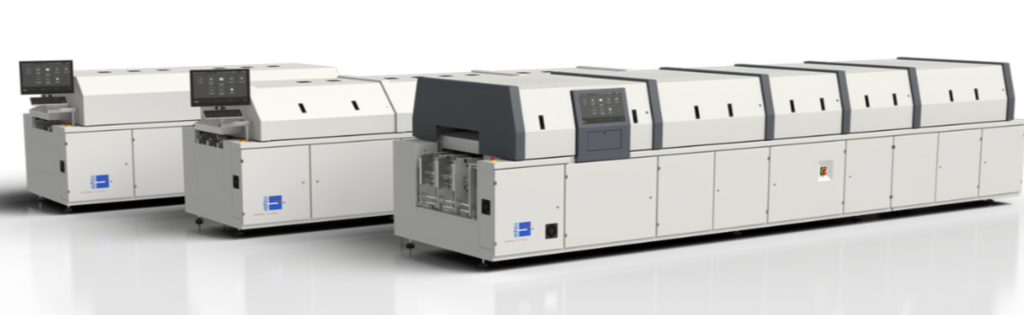
A Convection Soldering Machine — often called a reflow soldering oven — is a precision-controlled industrial system used to solder electronic components onto printed circuit boards (PCBs) using heated air (convection) as the primary method of heat transfer.
It’s one of the most critical machines in modern electronics assembly lines, especially in Surface Mount Technology (SMT) production.
Let’s go through a comprehensive technical explanation covering its principle, construction, process, and performance parameters.
1. Definition and Core Principle
Convection soldering uses forced hot air circulation to uniformly heat the entire PCB and its components until the solder paste melts (reflows) and forms reliable electrical and mechanical joints.
Unlike older infrared (IR) reflow systems — which heated unevenly due to varying emissivity of components — convection systems ensure homogeneous temperature distribution by circulating pre-heated air or nitrogen gas throughout the heating chamber.
2. Major Components of a Convection Soldering Machine
| Component | Function |
|---|---|
| Conveyor System | Transports PCBs through different temperature zones at a precisely controlled speed (usually 0.5–2.0 m/min). |
| Heating Zones | Divided into multiple top and bottom zones (typically 8–12), each with independent temperature control (e.g., 120–250 °C). |
| Cooling Zones | Rapidly cools the PCB after solder reflow to solidify solder joints and prevent defects like grain coarsening or voids. |
| Blowers / Fans | Circulate hot air to ensure uniform convection across the PCB’s surface. |
| Temperature Sensors (Thermocouples) | Continuously monitor the air and board temperature for precise closed-loop control. |
| Nitrogen System (optional) | Provides an inert atmosphere to minimize oxidation and improve solder wetting quality. |
| Controller and HMI Panel | Digital interface for recipe setup, PID tuning, conveyor speed adjustment, and real-time temperature profiling. |
3. Operating Process and Thermal Profile
A convection soldering machine executes a multi-stage heating profile, typically following four zones:
Preheat Zone
- Gradually warms up the PCB and components from room temperature to ~150 °C.
- Heating rate: 1–3 °C/sec to prevent thermal shock.
- Purpose: Evaporates volatile solvents from solder paste.
Soak Zone
- Temperature: 150–180 °C for 60–120 seconds.
- Purpose: Activates flux, ensures uniform temperature across board and components.
Reflow Zone (Peak Zone)
- Temperature peaks at 230–250 °C (depending on solder alloy, e.g., SAC305 for lead-free solder).
- Duration above liquidus (~217 °C): 30–90 seconds.
- Purpose: Solder paste melts and reflows to form solid interconnections.
Cooling Zone
- Cooling rate: 3–6 °C/sec to quickly solidify solder joints.
- Prevents grain growth and reduces formation of intermetallic layers.
4. Heat Transfer Mechanism
In convection soldering:
- Forced air convection dominates (over 90% of total heat transfer).
- High-speed fans blow heated air (or nitrogen) through perforated nozzles.
- The air stream transfers heat efficiently via convection currents to all PCB surfaces.
- This ensures minimal ΔT (temperature difference) across components — usually within ±2–3 °C.
By comparison:
- Infrared (IR) systems rely on radiative heat transfer — prone to uneven heating.
- Vapor phase reflow uses boiling fluid vapors — uniform but expensive and slower.
- Hence, convection soldering is the industry standard for high-volume SMT lines.
5. Technical Performance Parameters
| Parameter | Typical Range | Significance |
|---|---|---|
| Heating zones | 8–12 (top & bottom) | Allows fine temperature gradient control |
| Max temperature | 300 °C | Supports lead-free and high-melting alloys |
| Conveyor speed | 0.5–2.0 m/min | Determines exposure time |
| Air velocity | 0.5–2.5 m/s | Ensures even convection heating |
| ΔT uniformity | ±2 °C | Critical for solder joint consistency |
| Nitrogen purity (if used) | ≥99.99% | Reduces oxidation and dross formation |
| Cooling rate | 3–6 °C/sec | Influences joint microstructure |
6. Advantages
- ✅ Uniform temperature distribution — even on densely populated boards.
- ✅ High throughput and automation compatibility.
- ✅ Easy profiling and repeatability — programmable thermal profiles.
- ✅ Suitable for lead-free soldering (which requires higher peak temps).
- ✅ Less oxidation and solder spattering (especially with nitrogen).
7. Challenges and Considerations
- Requires precise temperature profiling — wrong parameters can cause tombstoning, bridging, or insufficient wetting.
- Nitrogen systems increase cost and maintenance.
- Flux residue management is essential — excessive residues can affect reliability.
- PCB warpage may occur if heating is not uniform across zones.
8. Applications
- SMT assembly lines in electronics manufacturing (smartphones, automotive ECUs, PC motherboards).
- Automotive and industrial electronics where solder joint reliability is critical.
- Prototype PCB manufacturing for design validation (desktop reflow ovens).
9. Leading Manufacturers
Some well-known manufacturers of convection soldering (reflow) systems include:
- ERSA GmbH (Germany)
- Rehm Thermal Systems (Germany)
- Heller Industries (USA)
- Vitronics Soltec (Netherlands/USA)
- BTU International (USA)
- SMT Wertheim / Kurtz Ersa Group
Summary
A Convection Soldering Machine is an advanced, multi-zone reflow system that uses forced hot air (and optionally nitrogen) to heat solder paste and components on PCBs in a precisely controlled temperature profile.
It ensures reliable, uniform, and repeatable solder joints — a cornerstone of modern Surface Mount Technology (SMT) production lines.