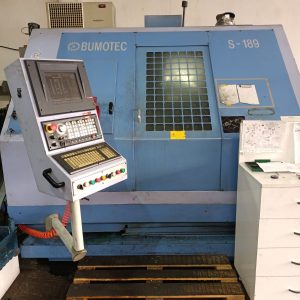
From Inspection to Installation: What to Verify Before Buying a Pre-Owned, Used, Secondhand, Surplus Bumotec S-189 CNC Lathe made in Switzerland
If you’re considering buying a pre-owned (used / second-hand / surplus) Bumotec S-189 CNC lathe (Swiss-made), here’s a comprehensive inspection-to-installation checklist to help you verify condition, compatibility, and readiness. While this is somewhat generic for used CNC machines, it’s tailored with lathe/turn-mill centres in mind and reflects best-practice advice from the industry.
1. Pre-Purchase: Documentation & History
Before even seeing the machine in person, request and review documentation and ask key questions.
What to verify:
- Manufacturer / Model: Confirm that it is indeed the S-189 model.
- Serial number, year of manufacture, country of origin (Switzerland).
- Maintenance / service records: When was it last serviced, any major repairs, spindle rebuilds, controls upgraded, etc. As one guide says: “Get access to maintenance history records to check if any maintenance procedures were performed on the machine.”
- Operating hours / load history (if available): How many “cutting” hours vs just powered on? The “hours” metric is often used, but one must interpret carefully.
- History of use (what work it did) and environment: Was it in a clean environment, heavy debris, lots of coolant, or corrosive conditions?
- Check whether the CNC control, tool-changer, spindles, turrets, etc are original or upgraded.
- Availability of spare parts for this model (especially Swiss-made machines may have good reputation but parts lead-times matter).
- Check any modifications: e.g., aftermarket chuck, bar-feeder, tooling, automation — are these properly integrated and maintained?
Why this matters: A well-documented machine often means better maintained, lower risk of hidden issues. Lack of records is a red flag. Several sources emphasise knowing the age + hours + service history.
2. Visual & External Condition Inspection
When you go see the machine, do a detailed visual/physical inspection. Many guides list this as Step 1.
What to look for:
- Exterior condition: rust, corrosion, damage to the machine body, panels, covers, way-cover damage. Signs of neglect = higher risk.
- Bed, ways, guide-rails: Are they clean, free from damage, filling with chips? On a lathe/turn-mill the bed’s integrity is critical.
- Check for signs of crash damage: mis-alignment, welding, repaired panels, visual distortions.
- Condition of covers, seals, way-covers: A missing or damaged way-cover can allow chips/coolant to damage guideways.
- Leakage: coolant, hydraulic, pneumatic. Check the chip-tray, coolant tank for sludge, contamination.
- Spindle taper, tool‐holder socket: Inspect for excessive wear, damage, scoring. For lathes especially the spindle/axis interface is key. (One forum says: “Check the spindle taper for scoring & excessive wear.”)
- Tooling accessories / chucks / holders: Are they included? Are they in good condition? Missing tooling means additional cost.
- Cleanliness: A machine that has been cleaned and maintained regularly is a good sign.
3. Mechanical / Motion / Precision Testing
Once you’re on site, run the machine through motions and inspect mechanical systems.
Spindle & bearings:
- Run spindle at various speeds (both no-load and under light load) and listen for unusual noise or vibration. Guides say: “Operate the spindle and listen for unusual noises that can tell you where you might have a worn bearing.”
- Check for spindle wobble/play: use dial test indicator if possible.
- Check tool-change mechanism (if applicable): Is it fast, precise, does it mis-seat tool holders?
Axes, ball screws, guideways:
- Jog each axis through full travel: look for smooth motion, no binding, no excessive backlash.
- Check ball screws/gibs for wear, listen for whine or noise when axis moves. One engineer says: “Run tool changes, move the axis in all directions and listen for excessive noise… the most expensive fixes… spindle, gearbox, vector drive, ball screw replacements…”
- Check backlash: Move axis back and forth, measure difference.
- Check guide-rail condition: Inspect for scratches, wear marks, or chips lodging in covers.
Accuracy / Repeatability Check:
- If possible, run a test cut or ask to see one: Check for dimensional accuracy, finish, repeatability. One “14 Tips” guide says: “Mount a dial gauge in the spindle, position over the centre of the cylinder … The cylinder should show round, not oval…”
- Use edge of bed or known reference to measure deviation, if you bring a precision indicator.
Auxiliary systems:
- Check chuck/clamp system: Is it aligned, does it hold securely, chuck jaws in good condition?
- Bar-feeder or auto-feeder (if fitted): Operates reliably?
- Coolant system: Pump works, hoses intact, coolant concentration, cleanliness. From checklist: “Check the coolant level… Inspect hoses and fittings for leaks or damage.”
- Lubrication system: Are lubrication points accessible and serviced? Any signs of insufficient lubrication?
4. Electrical / Controls / Software
Your machine is only as good as its control and electrical condition.
- Check the CNC control panel: buttons, touchscreen (if any), redundant alarms, look for error codes/history.
- Ensure control software version is suitable for your work/parts: One guide: “Confirm that the used machine operates on the present software or integrates smoothly with existing workflows.”
- Ask about network/USB connectivity, post-processor compatibility, if you have your own CAM system.
- Check wiring, connections: Look for frayed wires, loose connectors, corrosion in electrical cabinet.
- Emergency stop, interlocks, safety guards: Are they functional and compliant. From checklist: “Test emergency stop buttons … Check interlocks and safety guards.”
- Check servo drives, vector drives, motors for any faults/errors or replacements.
5. Operational / Fit-for-Purpose Check
Ensure the machine can meet your parts, capacity and workflow needs.
- Verify that machine specifications match your requirements (swing, capacity, axis travels, turret size, spindle speed/torque). For S-189, for example, check its specs document.
- Check tooling compatibility: Does it support the tooling you use (collets, chucks, bar feeders) and are extras included or available?
- Check throughput/productivity: If you plan high-volume, ensure setup/unload, tool change times, chip-removal capacity are good.
- Floor space / facility / utilities: Check electrical requirements (voltage, phase), air supply, floor loading capacity, coolant mist extraction. One article: “The floor structure needs evaluation … install an adequate ventilation system … air system delivering … clean dry air.”
- Spare-parts availability & cost: Swiss machine parts may have longer lead times or higher cost; ensure you can source critical parts (spindle bearings, drives, CNC board, turrets) and confirm price.
- Ask about consumables: Are turret tool-holders, collets, chucks, coolant pumps in good shape or will you need to invest?
6. Installation / Relocation Considerations
Once you decide to buy, you must plan for installation and setup.
- Transport & rigging: The machine is likely heavy; ensure you know how it was removed and how it will be installed in your facility. Guards should be intact.
- Foundation requirement: Does it need special pad, anchoring, leveling? One guide emphasises floor loading.
- Utilities: Confirm power (voltage, phase), compressed air, coolant supply, chip conveyor disposal, mist extraction.
- Leveling & alignment: When installed, the machine must be leveled, aligned to ensure accuracy.
- Calibration & test-cut: After installation, perform a calibration / test-piece to verify the machine meets spec. The “setup” checklist emphasises calibration etc.
- Training and documentation: Ensure you get manuals, control documentation, maintenance logs, service contact for the brand.
- Warranty/Service contract: For used machines it’s unlikely to have full new warranty, but check whether seller offers a short warranty or support.
7. Commercial / Deal Terms
Don’t overlook commercial factors.
- Price vs comparable machines: Check the market price for the S-189 or similar machines (age, hours, condition).
- As-is vs reconditioned: Is the machine sold “as is” or has it been refurbished? If refurbished, what was done?
- Return/test period: Can you inspect and test the machine in your facility before final purchase?
- Written condition report: It’s wise to get a signed condition report documenting what was inspected, any issues.
- Transport & installation cost: Include those in your cost calculation (moving, leveling, connecting utilities).
- Risk of downtime: Buying used means risk; budget for possible repair/upgrades. Several guides warn of “hidden costs” when buying used.
- Ownership transfer, import duties (for your location), shipping from Europe/Switzerland, taxes etc.
8. Specific to the Bumotec S-189
Since the model in question is the S-189, Swiss-made by Bumotec, note:
- Verify the documented specifications from its datasheet (travel axes, C-axis, turret, spindle rpm/torque) to ensure machine matches your process. For example the document on Scribd shows some dimensions for S-189.
- Swiss machines are often high precision, so any deviation from expected precision should be flagged.
- Because it’s a higher-end Swiss machine, asking for proof of original service by Bumotec (or authorized service) could be worthwhile.
- Spare part availability: Swiss machines might have smaller distribution outside Europe; check local service capability in your country or nearby countries.
- Since you are in (your region), check import/logistics of a Swiss-machine — shipping, customs, installation, service contract for such equipment.
9. Summary – Key “Red Flags”
Here are things that should raise concern:
- No maintenance history or service records.
- Excessive hours / unknown hours – especially if spindle bearings or drive components likely approaching end-of-life.
- Poor external condition: rust, damaged way-covers, leaks, obvious abuse.
- No test/cut demonstration or inability to inspect machine under power.
- Spindle noise or vibration, excessive backlash in axes.
- Control system outdated, no spare parts, incompatible with your workflow.
- Heavy modifications without documentation (might invalidate service history or make parts harder).
- Transport/installation not properly planned (foundation, utilities).