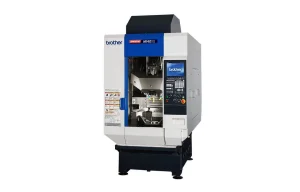
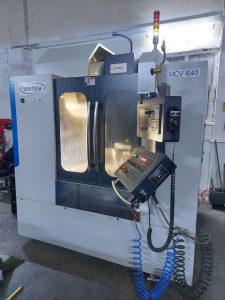
What is CNC Skiving + Turning + Milling + Drilling + Deburring Machining Center All-in-one machining in Gear Production?

It’s a multi-technology CNC platform that combines power-skiving for gears/splines with full turning–milling capabilities in one machine and (ideally) one chucking. The goal is to rough/finish the blank (turning, drilling, milling), cut the gear (power skiving), and finish edges (deburr/chamfer) without moving the part to other machines—maximizing accuracy and throughput.
1) Process at a Glance (single setup)
- Blank prep (Turning): Face, OD/ID turn, bore, groove; establish datum faces.
- Feature machining (Milling/Drilling/Tapping): Bolt circles, keyways, oil holes, threads, flats.
- Gear cutting (Power Skiving): Cut internal or external gears/splines using a skiving cutter.
- Edge finishing (Deburring/Chamfering): Remove burrs on tooth tips/flanks; add controlled chamfers.
- In-process verification: On-machine probing, radial/axial runout checks; optional gear measurement cycles.
2) What is Power Skiving (a.k.a. “gear skiving”)?
Power skiving is a synchronized, continuous cutting process for gears/splines that uses:
- A rotating skiving cutter and a rotating workpiece whose axes are set at a small crossing angle (typically ~10–30°).
- A precise electronic gear mesh (kinematic coupling) between the cutter spindle and the work spindle.
- A feed (usually axial for internal gears) that advances the cutter through the gear face width; radial feeds are also used for stock distribution or finishing passes.
Because both tool and work rotate with a controlled ratio, each tooth on the cutter progressively generates the conjugate gear tooth form. Compared with shaping, power skiving achieves much higher material removal rates; compared with broaching, it eliminates dedicated broach tooling and long lead times, and it can handle varying modules/widths without new broaches.
Use cases: Internal ring gears (planetary carriers, e-axles), sun gears, pump gears, shaft splines, robotics reduction stages, couplings.
3) Machine Architecture & Axes
An all-in-one skiving center typically integrates:
- Work spindle (C-axis): High-precision, with encoder feedback for phase synchronization.
- Tool spindle: High-speed milling spindle that can hold a disc-type or shank-type skiving cutter.
- Tilting/rotary axis (B and/or A): To set the skiving crossing angle.
- Linear axes (X/Y/Z): For cutter positioning, radial offsets, and axial feed through the gear face width.
- Turning capability: Either with the same C-axis and turret/milling spindle, or with a second opposed spindle.
- Tool magazine/ATC: Holds turning tools, drills/taps, end mills, and skiving cutters.
- Probing & metrology: Touch probe, scanning probe, sometimes laser tool setters and built-in gear check routines.
- Automation: Bar feeder or gantry/robot loader; pallet systems for high mix/high volume.
The control kernel must support hard real-time spindle-to-spindle synchronization (electronic gearing) with dynamic phase shifts and feed superposition.
4) Tooling & Cutting Strategy
- Skiving cutters:
- Disc-type for larger modules/face widths; shank-type for smaller diameters/internal gears with tight access.
- Typical coatings: AlCrN, TiAlN, AlTiN; micro-geometry tuned for the material and module.
- Cut data & strategy:
- Multiple passes: roughing (higher chip load), semi-finish, finish with reduced stock.
- “Radial chip-thinning” and axial feed are tuned to keep chip thickness stable across the face.
- Lead correction, crowning, tip/root relief can be programmed for noise/load behavior.
- Collision/access checks:
- Internal gears are limited by tool outside diameter vs. bore, crossing angle, and root clearance.
- CAM must simulate interference at entry/exit and guard against cutter shank collisions.
5) Deburring / Chamfering On-Machine
- Options: Form tools, 5-axis milling, abrasive brushes, or special chamfer hobs/cutters.
- Targets: Tooth tip chamfer, flank edge break at root fillets, controlled burr roll-over direction.
- Benefit: Eliminates separate bench deburr ops, keeps edges consistent and traceable.
6) Accuracy & Quality
- One-chucking advantage: Datum alignment is preserved from turning through gear cutting → lower runout and better concentricity.
- Typical quality: With proper setup and finishing passes, DIN 6–8 (or AGMA equivalent) is common directly after skiving; tighter grades may require final grind/hone.
- Key influencers: Machine thermal stability, encoder resolution, synchronization fidelity, tool wear control, and in-process probing.
7) Coolant, Chip & Thermal Control
- High-flow, fine-filtration coolant (≤20 µm, often 5–10 µm) to evacuate chips from internal gears and protect cutter edges.
- Through-tool coolant preferred for shank-type cutters.
- Thermal control: Spindle chiller and smart warm-up cycles stabilize geometry before quality-critical cuts.
8) Software / CAM Requirements
- Gear/skiving cycles accept gear macro data: module, tooth count, pressure angle, helix angle, profile shift, addendum/dedendum, crowning, taper, etc.
- Controller manages electronic gear ratio, phase offset, and synchronized feed.
- CAM or native cycles must implement tool engagement limits, lead corrections, collision checks, and multi-pass stock removal with verified chip thickness.
9) Where It Beats Traditional Routes
- Vs. shaping: Much higher productivity; better suited to short/medium runs than broaching; handles helical gears more easily.
- Vs. broaching: No expensive dedicated broach; faster changeover; internal helical gears feasible; lower WIP.
- Vs. multi-machine flow: One setup improves concentricity/positioning and slashes handling time, WIP, and floor space.
10) Practical Limits & Considerations
- Internal gear constraints: Minimum feasible bore depends on cutter OD and crossing angle; very small modules demand very high spindle speeds and rigid tooling.
- Material & hardness: Excellent for steels up to ~35–45 HRC in rough/finish; case-hardened finishing also possible with optimized cutters; hard finishing to top grades may still need grind/hone.
- Tool life monitoring: Use tool load, spindle power, acoustic emission, or wear counters with auto-offset compensation.
- Fixturing: Stiff, accurate, thermally stable chucks/mandrels; ensure face/ID datums are clean to avoid axial runout.
11) Typical Capability Envelope (indicative, varies by builder)
- Modules: ~0.3–6 mm (larger on heavy machines)
- Gear types: Internal/external, spur/helical, splines (involute/straight-sided)
- Face width: Up to ~60–120 mm common; more on larger platforms
- Crossing angle: ~10–30° adjustable
- Quality: Up to DIN 6–8 after skiving; finer with post-finish
12) Selection Checklist
- Part family: internal vs external, module range, face width, helical angles.
- Required gear quality (as-skived vs with post-finish).
- Workholding concept and automation (gantry/robot, bar work, pallets).
- Controller’s skiving package maturity (sync bandwidth, phase control, measurement cycles).
- Tooling support (cutter suppliers, resharpening logistics, coatings).
- Coolant/filtration capacity and chip management for internal gears.
- Metrology integration (on-machine probing, optional gear inspection routines).
- Service/retrofit path for future modules or larger diameters.
Bottom line
An all-in-one skiving center turns, mills, drills, skives, and deburrs gears/splines in one clamping with electronically synchronized kinematics. You get broach-free internal gears, higher productivity than shaping, tight datum control from blank to gear, and dramatically reduced handling/WIP—ideal for modern e-axle, transmission, pump, and robotics production cells.