What is Centerless Valve Grinder?

A centerless valve grinder is a specialized centerless-grinding machine used to finish engine poppet valves—primarily the stem OD (diameter, roundness, surface finish) and often the tip end—at high throughput and accuracy. Unlike collet or between-centers valve refacers, the workpiece is not clamped; it is supported and driven centerless between a high-speed grinding wheel and a slower “regulating” (control) wheel while resting on a fixed work-rest blade.
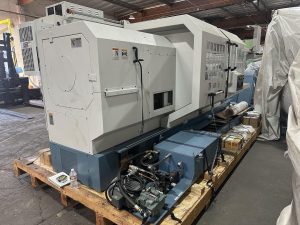
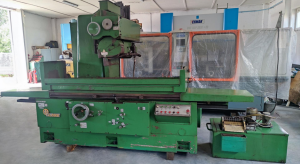
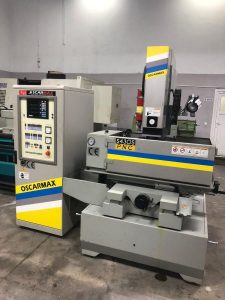
The unit in your photo is a Sunnen-style machine of this class.
1) Kinematics & Workholding
- Grinding wheel (GW): Vitrified-bond Al₂O₃/ceramic wheel running ~25–40 m/s surface speed removes material from the valve stem.
- Regulating wheel (RW): Rubber/resinoid-bond wheel running slowly (~10–120 rpm) sets the rotation of the valve and, with a small inclination angle (typically 2–5° for through-feed), provides axial feed.
- Work-rest blade: Hardened, precisely ground blade supports the stem slightly above the wheel centerline (≈0.02–0.05 mm, 0.001–0.002 in) to control roundness and geometry.
- Backstop/end stop: Used for plunge (in-feed) grinding of a fixed land or for tip-end grinding.
- Dressers: Single-point or cluster diamonds (or rotary dressers) true and dress both wheels to restore geometry (GW flat/crowned as needed; RW crowned for stable tracking).
Two operating modes:
- Through-feed: RW is angled; the valve passes across the wheels to size a length of stem.
- In-feed (plunge): RW is parallel; GW feeds radially to size a localized feature or to square/finish the tip end.
2) What gets ground on a valve?
- Stem OD sizing & finishing: Achieves tight stem diameter, roundness, and surface finish for proper guide clearance and oil control.
- Tip end squaring/length: Plunge-ground to final overall length and a flat, hardened tip for rocker/bucket contact.
- (On some machines) Face refacing is done on a separate head/spindle; the centerless section still handles stem/tip work.
3) Performance & Typical Numbers (indicative)
- Diameter tolerance: ±2–5 µm (0.00008–0.0002 in) common in rebuild/production.
- Roundness: ≤2–3 µm achievable with correct blade height and wheel condition.
- Surface finish (stem): Ra 0.2–0.4 µm typical.
- Cycle time: Often 2–10 s per stem section in production; tip plunge a few seconds.
- Concentricity: Stem to face runout after full process typically ≤10 µm when face is refaced on the same machine setup.
4) Why centerless for valves?
- No collets, no bending: The stem is supported along a line, so slender valves are less prone to chatter or bend from clamping forces.
- Fast changeover & high throughput: Only blade height, RW angle/speed, and GW in-feed are set—ideal for batches.
- Consistency: Electronic/servo in-feed with spark-out produces repeatable size and finish; dressing maintains wheel form.
5) Coolant, Filtration, & Thermal Stability
- Oil or soluble coolant with fine filtration (≤10–20 µm) carries swarf, cools the grinding zone, and protects guides.
- Wheelhead thermal control and short spark-out prevent burn (tempering colors) on hardened tips or Stellite-faced areas.
6) Wheels & Parameters (guidelines)
- Stem OD: Vitrified Al₂O₃/ceramic 46–80 grit, hardness J–N; RW ~60–90 Shore A with slight crown.
- Hardened tip / Stellite areas: Finer grit or CBN/alumina per supplier recommendation; keep aggressiveness low to avoid micro-cracking.
- Setup keys:
- Dress both wheels true; verify RW crown.
- Set blade height just above wheel centerline.
- For through-feed, set RW angle (≈2–5°) for desired feed rate; for plunge, set 0°.
- Establish in-feed rate and a short spark-out dwell for size stability.
7) Process Control & Gauging
- In-process: Wheel power/load monitoring, part rotation observation, and coolant flow at the contact.
- Post-process: Air gauge or micrometer for stem OD; dial indicator for runout; go/no-go for length; surface finish checks as needed.
- Tooling wear: Track dresser wear offsets; replace/flip the work-rest blade before a wear land develops.
8) Advantages vs. Alternatives
- Vs. collet-type refacers: Avoids collet runout/maintenance and size drift; better for long, thin stems.
- Vs. between-centers grinding: Faster for OD sizing/tips, simpler loading; centers not required (useful on used valves with damaged ends).
- Limitations: Requires careful alignment; very short grip lengths or large head overhangs may limit through-feed; complex face angles still need a dedicated refacing spindle.
9) Buying/Setup Checklist (used machines)
- Spindle bearings (axial/radial play), RW spindle smoothness, dresser slides backlash.
- Condition of work-rest blade (no notches), availability of spare blades.
- Coolant pump & filtration, guards, and electrics.
- Demonstrate a test grind: look for ≤5 µm roundness and burn-free surface.
Bottom line
A centerless valve grinder is a high-precision, high-throughput solution for finishing valve stems and tips. Using a grinding wheel, a regulating wheel, and a work-rest blade—no centers and no collets—it delivers micron-level size and roundness with excellent surface finish, ideal for engine rebuilders and production lines handling large mixes of valve sizes and materials.