26/08/2025
What is Portable DCC CMM?
What it is
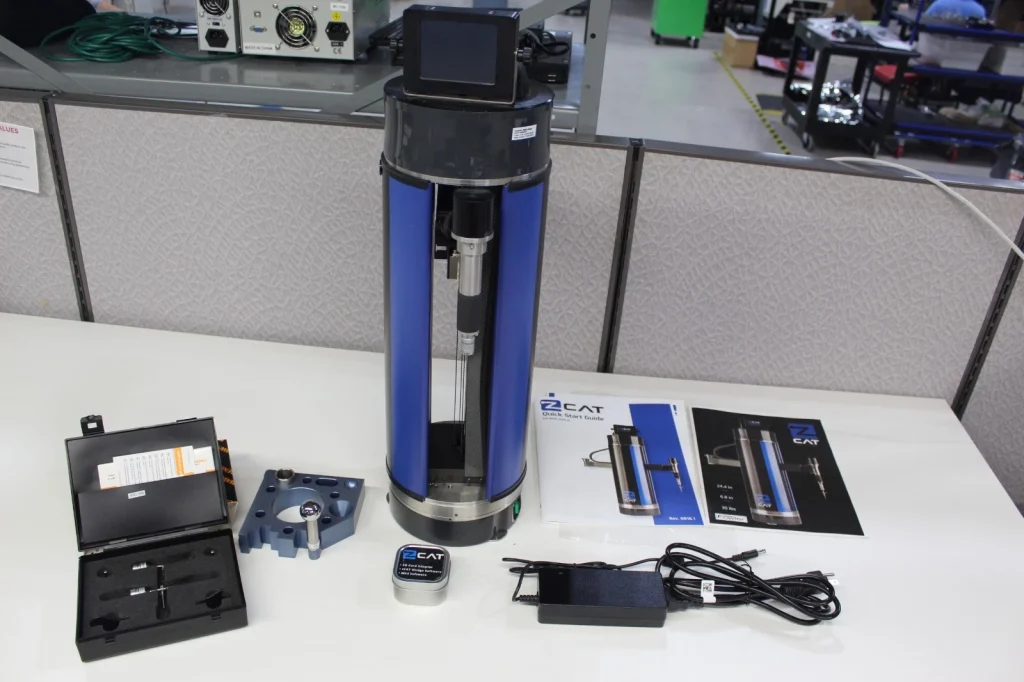
Portable DCC CMM = a Coordinate Measuring Machine whose 3 axes are motorized and run under Direct Computer Control (DCC/CNC), but whose mechanical package is light/robust enough to be moved around the shop (often on a mobile stand or a self-contained base). It brings automated, program-driven metrology to the part instead of moving the part to a fixed lab CMM.
Core architecture
- Structure/kinematics: typically a compact bridge (occasionally horizontal-arm). Frame in granite/ceramic/aluminum; mechanical or air bearings on precision linear guides.
- Drives & scales: servo motors with closed-loop control from linear encoders (optical/laser interferometric in higher-end units). Motion planner uses accel/jerk limits for path accuracy.
- Controller (DCC): executes part programs (DMIS/I++ DME compatible) to automate moves, probe hits, and scanning paths; joystick for manual jog/teach.
- Probes:
- Touch-trigger (e.g., TP20/TP200) for discrete points.
- Analog scanning (e.g., SP25/SP80 class) for continuous profiles.
- Laser line scanners for dense point clouds; often with dynamic temperature compensation.
- Software: CAD-based inspection, feature extraction (GD&T), best-fit alignments, error mapping, offline programming, and SPC output.
“Portable” in practice
- Monolithic/mobile base with vibration damping; can be rolled or forklifted between cells.
- Shop-floor hardened: sealed ways, thermal sensors and models for on-machine compensation, runs without a metrology lab. Often no facility air required.
- Setup: quick artifact calibration (gauge block/sphere) after relocation; warm-up and level check integrated.
Accuracy & verification
- Stated per ISO 10360 (e.g., MPE_E = A + B·L µm). Portable DCC CMMs usually sit between fixed bridge CMMs and manual arms: better than manual portable arms on larger volumes, not as tight as a top-end granite bridge in a climate lab.
- After movement, a short volumetric check (ball-bar/step gage) is recommended.
Where it fits
- Automated, repeatable inspection near production: first-article, in-process checks, fixtures, or large/awkward parts that are costly to move.
- Lights-out routines: because it’s DCC, you can run fully unattended cycles with interlocked enclosures.
- Data flow: outputs to SPC/MES; common I++ DME interface allows mixing software and hardware vendors.
Pros vs. alternatives
- Vs. manual portable arms / trackers: automated, more repeatable, program-driven probing; less operator bias.
- Vs. fixed DCC bridge: lower installation overhead and bring-machine-to-part flexibility, at some cost in ultimate accuracy and environmental sensitivity.
Practical spec checklist (what to ask vendors)
- Measurement volume, MPE_E / MPE_P (ISO 10360) and thermal range.
- Bearing type (air vs. mechanical) and relocation procedure.
- Probe ecosystem (touch, analog scanning, laser) and quick-change modules.
- Compensation pack: temperature sensors, volumetric error map, rotary-table mapping if present.
- Integration: I++ DME, DMIS, PLC/IO, barcode/RFID.
- Power/air needs, vibration isolation, and transport method (casters/fork pockets).
In one line: a Portable DCC CMM is a relocatable, shop-floor-ready, CNC-controlled coordinate measuring machine that executes programmed inspection cycles with lab-like rigor, close to where you manufacture.