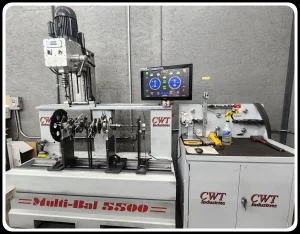
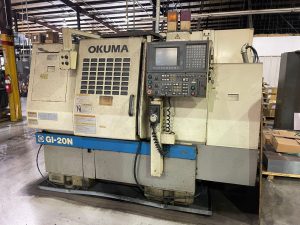
What is CNC Head & Tip Whirling Machine?

this is a high-precision, high-speed machining process often used for manufacturing screw-type, helical, and threaded components such as ball screws, bone screws, worm shafts, and lead screws. Let’s go through it technically and in depth, covering the working principle, machine structure, process dynamics, applications, advantages, and comparison with thread grinding and thread milling.
1. Technical Definition
A CNC Head & Tip Whirling Machine (also called a CNC thread whirling lathe or CNC whirling lathe) is a dedicated CNC machine tool that uses a rotating cutting head (whirling head) containing multiple carbide inserts, inclined at a specific angle relative to the workpiece axis, to machine helical profiles (threads) in a single pass.
The term “Head & Tip” refers to:
- Whirling Head: The high-speed spindle that holds and rotates the cutting inserts around the workpiece.
- Whirling Tip (Insert): Each small carbide cutting edge that does the actual cutting, forming the thread geometry.
So, unlike normal turning or thread cutting, where the tool or workpiece rotates in one axis only, whirling involves a compound rotation:
the whirling head spins at high rpm (e.g., 3,000–12,000 rpm) while the workpiece rotates slowly in the opposite direction (e.g., 20–200 rpm).
2. Working Principle
The basic motion system includes:
| Axis | Function |
|---|---|
| C-axis | Workpiece rotation (low speed) |
| B-axis | Whirling head tilt angle (thread lead angle control) |
| X-axis | Radial feed (controls depth of cut) |
| Z-axis | Axial feed (controls thread pitch/lead) |
Step-by-step process
- Setup:
The workpiece (usually a long screw shaft) is clamped between centers or by a collet. - Whirling Head Rotation:
The whirling head spins rapidly, carrying multiple inserts arranged circularly. - Inclination Angle:
The head is tilted by an angle equal to the thread helix angle. This ensures each insert cuts along the thread profile instead of interfering. - Feed & Cutting:
The workpiece rotates slowly while being fed axially. The inserts “trace” the helical path, removing material continuously along the entire thread. - Cooling & Chip Evacuation:
Because of the open cutting geometry and high cutting speed, chips are evacuated efficiently, and the heat is mainly carried away by chips — keeping the workpiece relatively cool. - Result:
A fully formed thread with excellent surface finish and accuracy, often without the need for post-grinding.
3. Machine Structure
A modern CNC Whirling Machine consists of:
- Main bed / slide unit (granite or cast iron for vibration damping).
- Work spindle (low-speed, torque-controlled, synchronized with CNC control).
- Whirling head spindle (high-speed motor spindle up to 12,000 rpm).
- Whirling head assembly with 6–12 inserts mounted in a circular pattern.
- B-axis tilting mechanism to set the helix angle.
- Servo axes (X, Z) for precise radial and axial feed control.
- Optional C-axis synchronization for complex multi-start threads.
- Automatic lubrication, chip evacuation, and coolant system.
4. Process Parameters
| Parameter | Typical Range | Notes |
|---|---|---|
| Whirling head speed | 3,000–12,000 rpm | Determines surface speed and chip load |
| Workpiece speed | 20–200 rpm | Controlled by CNC for pitch accuracy |
| Feed rate | According to thread lead | e.g., 1–10 mm/rev |
| Cutting depth | 0.1–0.3 mm/pass | Usually single-pass if carbide inserts used |
| Tilt (helix) angle | 2–20° | Matches thread lead angle |
| Surface finish | Ra 0.4–0.8 µm | Excellent, often no grinding needed |
| Pitch accuracy | ± 0.02 mm or better | High repeatability |
5. Applications
Whirling is used in medical, aerospace, and precision mechanical industries, where high lead accuracy and surface quality are required.
| Industry | Example Components |
|---|---|
| Medical | Bone screws, orthopedic implants, dental implants |
| Aerospace | Actuator screws, worm shafts |
| Automation | Ball screws, lead screws |
| Optics / Robotics | Micro screws, fine-pitch threads |
6. Comparison: Whirling vs Other Thread Processes
| Feature | CNC Thread Whirling | Thread Grinding | Thread Milling | Single-point Thread Turning |
|---|---|---|---|---|
| Cycle time | Fast (single pass) | Slow | Medium | Slow |
| Surface finish | Excellent (Ra ≤ 0.8 µm) | Best (Ra ≤ 0.2 µm) | Good | Medium |
| Material removal | High efficiency | Low | Medium | Low |
| Heat generation | Low (chips carry heat) | High (requires coolant) | Medium | High |
| Setup complexity | Medium | High | Medium | Low |
| Tool cost | Moderate (multi-insert) | Very high | Moderate | Low |
| Suitable for | Long, slender screws | High-precision hardened threads | Small batch/thread forms | General threading |
| Accuracy | ± 0.02 mm | ± 0.01 mm | ± 0.05 mm | ± 0.1 mm |
7. Example: Bone Screw Whirling (Medical Industry)
In bone screw manufacturing:
- Material: Titanium Ti-6Al-4V (hard, gummy).
- Traditional turning → multiple passes, long cycle time, risk of workpiece heating and bending.
- Whirling enables:
- Thread generation in one pass, without coolant flooding.
- Shorter chips, low heat transfer.
- Better concentricity between core and thread.
- Surface roughness ~ Ra 0.4 µm, no polishing required.
Machines used: Leistritz LWN 90, Index MS22, Tornos Whirling Unit, LMT Tools Whirling Head, Harrison Alpha Whirling CNC, etc.
8. Advantages
✅ High productivity – one-pass cutting of entire thread.
✅ High precision – lead and profile accuracy under 0.02 mm.
✅ Excellent surface quality – suitable for implant or motion screw surfaces.
✅ Reduced heat distortion – chips carry heat away.
✅ Long tool life – inserts distribute wear evenly.
✅ Ideal for hard-to-machine materials like titanium, stainless steel, Inconel.
✅ Compact setup – no special thread grinding setup required.
9. Limitations
❌ Limited mainly to external threads (internal threads need different process).
❌ High initial tooling cost (whirling head + insert set).
❌ Not ideal for short, stubby threads (tool clearance issue).
❌ Requires accurate synchronization between head and workpiece rotation.
❌ Geometry limited by head size (small threads may need micro whirling heads).
10. Example Technical Specification (Typical CNC Whirling Machine)
| Item | Value |
|---|---|
| Model | LWN 90 or similar |
| Max. workpiece diameter | Ø25 mm |
| Max. workpiece length | 250 mm |
| Whirling head speed | up to 12,000 rpm |
| Workpiece spindle speed | 100–200 rpm |
| Number of inserts | 6–12 |
| B-axis tilt | ± 25° |
| Repeatability | ± 0.005 mm |
| CNC control | Fanuc / Siemens / Heidenhain |
| Coolant system | optional oil mist or air blast |
| Weight | ~2,500 kg |
11. Summary
A CNC Head & Tip Whirling Machine is a specialized high-speed CNC lathe designed to cut threads or helical forms using a rotating inclined cutting head instead of a static tool. It combines the efficiency of milling with the accuracy of grinding — ideal for precise, long-pitch, fine threads where speed, accuracy, and finish are critical.