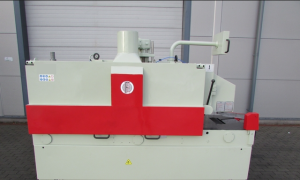
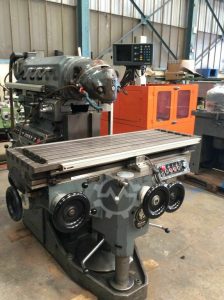
What is CNC Gear Shaving Machine?
A CNC Gear Shaving Machine is a high-precision finishing machine tool used in the gear manufacturing industry to improve the surface quality, dimensional accuracy, and noise behavior of gears after they have been rough-cut (by hobbing, shaping, or broaching). It is one of the final mechanical finishing processes before heat treatment or grinding. Let’s go deep into the technical details:
Principle of Gear Shaving
- Purpose: Gear shaving removes fine amounts of material (usually 0.01–0.03 mm per flank) from the gear teeth to correct errors and smooth the tooth surface.
- Tool: The shaving cutter (a hardened, serrated gear-like tool) meshes with the workpiece gear.
- Process: While in rolling contact, a relative sliding motion between cutter and gear, combined with the tool serrations, produces a micro-cutting action. This removes material in a controlled way.
- Benefits: Improves gear tooth geometry, reduces lead and profile errors, lowers noise, and prepares the gear for hardening.
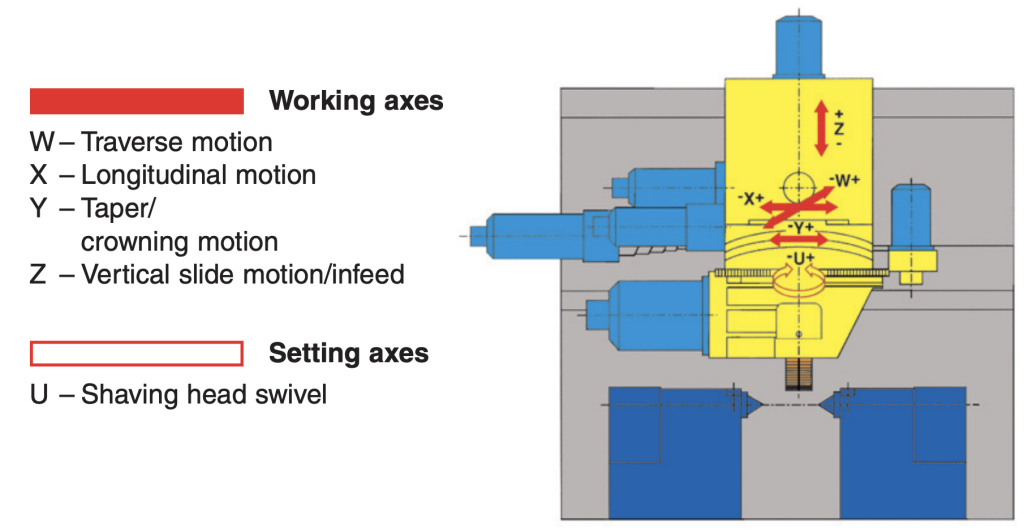
CNC Control & Axes
Modern CNC gear shaving machines employ multi-axis numerical control for accuracy and repeatability:
- W-axis (Traverse motion): Side-to-side movement of the cutter relative to the gear.
- X-axis (Longitudinal motion): Linear positioning along the workpiece axis.
- Y-axis (Taper/crowning motion): Provides taper or crowning corrections by tilting/offsetting the cutter.
- Z-axis (Vertical slide motion / infeed): Controls depth of cut and radial positioning.
- U-axis (Setting axis – shaving head swivel): Swivels the shaving cutter head to set the diagonal cutting angle.
The combination of these controlled axes allows lead correction, crowning, taper adjustment, and helix angle compensation.
Process Variants
- Conventional Shaving: Cutter and gear rotate in mesh, with diagonal sliding movement.
- Plunge Shaving: Cutter plunges straight into the gear without traverse—used for small modules.
- Diagonal Shaving: The cutter is set at an angle; produces better flank quality.
- Underpass Shaving: Cutter passes below the gear axis; used for special corrections.
Technical Advantages
- High Accuracy: Achieves profile and lead corrections within microns.
- Surface Finish: Reduces roughness (Ra ≈ 0.8–1.6 µm), important for quiet gear operation.
- Versatility: Can correct distortion from previous operations (hobbing/shaping).
- Productivity: Faster than gear grinding for soft gears.
- Pre-hardening step: Often used before case-hardening and grinding to minimize stock removal during hard finishing.
Applications
- Automotive gears (transmissions, differential gears).
- Industrial gearboxes.
- Machine tool drives.
- Aerospace and defense gears where quiet running and accuracy are required.
Comparison with Other Gear Finishing
- Gear Shaping/Hobbing: Rough cutting processes; leave tool marks and slight errors.
- Gear Shaving (CNC): Semi-finishing; fast and economical for soft gears.
- Gear Grinding: Final hard finishing; achieves highest accuracy, but slower and more expensive.
✅ In summary:
A CNC Gear Shaving Machine is a precision finishing machine that uses a serrated shaving cutter in controlled rolling motion with the gear to remove small amounts of material. With multi-axis CNC control (W, X, Y, Z, U), it corrects tooth geometry errors (profile, lead, taper, crowning) and improves surface finish. It is a critical step in high-volume gear production for automotive and industrial applications, ensuring gears run quietly, efficiently, and with long service life.