What is Linear Magnetic Scales?

A Linear Magnetic Scale is a high-precision position feedback device widely used in CNC machine tools to measure linear displacement and provide closed-loop control for accuracy, repeatability, and process stability.
Here is a detailed technical explanation, specifically in the context of the CNC sector:
1. Working Principle
- Magnetic Encoding: The scale consists of a magnetic strip (magnetized with alternating north and south poles at a defined pitch) and a magnetic read head (sensor).
- Signal Generation: As the read head moves along the magnetic strip, it detects changes in the magnetic field and generates incremental or absolute position signals.
- Interpolation: These signals are interpolated to achieve very fine resolution, often down to sub-micron levels.
- Output Interface: The signals are transmitted as digital pulses (TTL, HTL, RS-422) or serial protocols (BiSS, EnDat, SSI) for CNC control integration.
2. Key Components
- Magnetic Scale (Tape or Rod): Encoded with magnetic poles, mounted directly to the machine axis.
- Read Head / Sensor: Detects the magnetic transitions; can be contactless, reducing wear.
- Electronics / Interpolator: Converts the raw signals into high-resolution digital output.
- Protective Housing: Often enclosed in aluminum extrusion with sealing lips to protect against oil, chips, and coolant in harsh CNC environments.
3. Technical Advantages in CNC Machine Tools
- Accuracy & Resolution: Enables positioning accuracy in the micron range, depending on interpolation.
- Closed-Loop Feedback: Provides real-time position to CNC control, essential for compensating screw pitch errors, thermal expansion, and backlash.
- Harsh Environment Resistance: Magnetic scales are more tolerant to oil, dust, and vibration compared to optical glass scales, making them suitable for heavy CNC machining.
- Long Measuring Lengths: Can cover lengths from a few millimeters to several meters without losing accuracy.
- Compact Design: Easy integration into machine axes (X, Y, Z, linear slides, or long travel axes).
4. Applications in CNC Machines
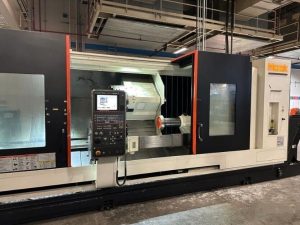
- CNC Lathes and Turning Centers: Ensures precise carriage and cross-slide movement.
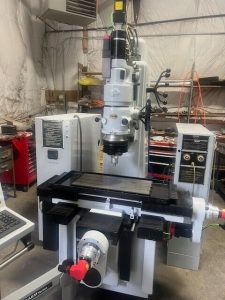
- CNC Milling and Machining Centers: Provides feedback on long travel axes, maintaining tight tolerances.
- Grinding Machines: Critical for sub-micron accuracy in precision surface and cylindrical grinding.
- EDM Machines: Maintains stability in dielectric environments where optical systems fail.
- Press Brakes & Sheet Metal Machines: Controls ram position for accurate bending angles.
5. Comparison with Optical Linear Scales
| Feature | Optical Scale (Glass) | Magnetic Scale |
|---|---|---|
| Accuracy | Higher (±1–2 µm typical) | Moderate (±5–10 µm typical) |
| Environmental Resistance | Sensitive to dust, oil, coolant | Resistant to harsh environments |
| Length Capability | Limited, fragile | Long travel possible, robust |
| Cost & Maintenance | Higher, fragile | Lower, rugged, minimal maintenance |
6. Why Magnetic Scales for CNC?
- In large CNC machine tools where environmental contamination, vibration, and long travel distances are common, magnetic linear scales provide a robust and reliable solution.
- They may not reach the ultra-high accuracy of glass optical scales but are excellent for durability, easier installation, and long-axis measurement in industrial machine tools.
In summary:
A Linear Magnetic Scale is a precision measurement device that converts linear displacement into digital signals for CNC control. It is based on magnetic pole encoding and non-contact readout, providing reliable, resistant, and cost-effective position feedback in machine tools such as lathes, milling machines, grinders, EDMs, and press brakes. It enhances accuracy, stability, and repeatability, especially in environments where optical scales are impractical.