06/09/2025
What is Arbor Press Compound Leverage 12-ton Floor Type?
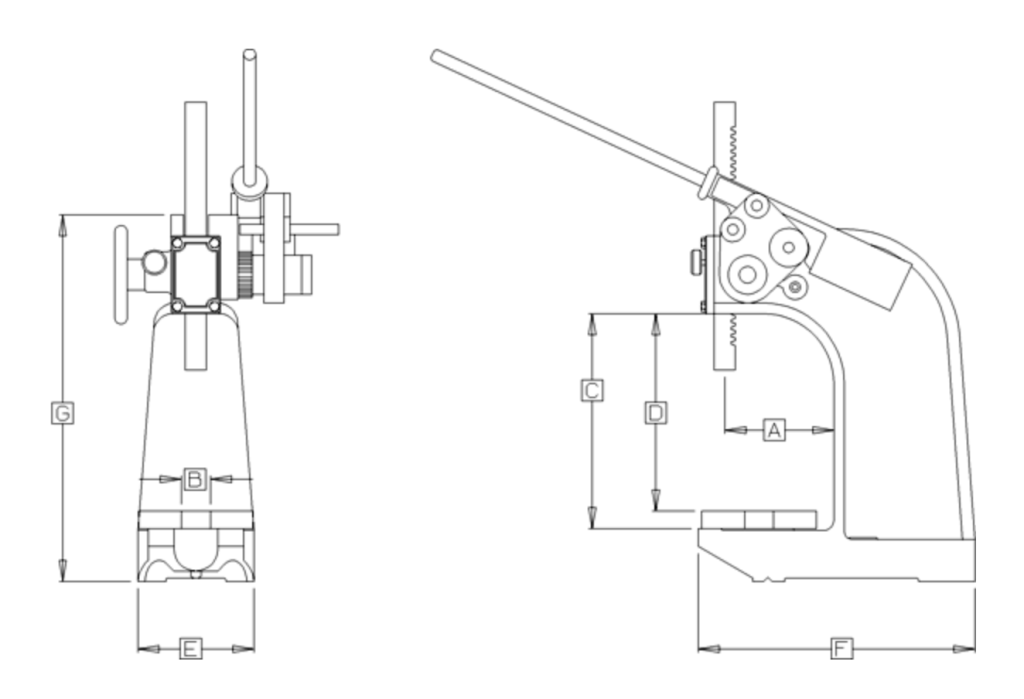
An Arbor Press Compound Leverage 12-ton Floor Type is a heavy-duty mechanical press designed for applying high linear force with minimal operator input. Let me explain it technically:
Construction & Layout
- Frame: Made from rigid cast iron or steel, bolted to the floor for stability. The tall frame gives clearance for large workpieces.
- Ram (Plunger): A vertically sliding hardened steel ram transmits force to the workpiece.
- Leverage System: Instead of a single lever arm, it uses a compound leverage mechanism—multiple pivoting links and gears that multiply the applied input force progressively as the handle moves downward.
- Handle: Long operating handle provides ergonomic leverage and attaches to the compound linkage.
Technical Working Principle
- Operator Input: The user applies a moderate force to the handle.
- Force Multiplication: Through the compound linkage (two or more fulcrums + gear segments), the input force is magnified multiple times before reaching the ram.
- Pressing Stroke: The ram delivers up to 12 tons of force in a controlled downward motion.
- Return Mechanism: A spring or counterweight retracts the ram when the handle is released.
Key Parameters (often specified with letters in drawings)
- Throat Depth (A): Distance from ram centerline to frame, dictates maximum workpiece reach.
- Ram Size (B): Width of the ram face, affects pressing surface.
- Max Opening / Height (C, D, G): Vertical clearance for workpiece + tooling.
- Base Dimensions (E, F): Support size and stability on the shop floor.
Typical Applications
- Press-fitting gears, bearings, bushings, and pins.
- Riveting, staking, crimping, broaching, and light bending operations.
- Precision assembly where controlled pressing force is required.
- Toolrooms, maintenance shops, and light production environments.
Why Compound Leverage?
- A standard arbor press is limited to the mechanical advantage of its single lever and gear.
- A compound leverage press provides a nonlinear increase in mechanical advantage—as the ram approaches bottom dead center, the force dramatically increases, allowing high-tonnage pressing without requiring hydraulic systems.
- This makes it safer, cheaper, and maintenance-free compared to hydraulics, while still achieving 12-ton capacity.
✅ In summary:
An Arbor Press Compound Leverage 12-ton Floor Type is a floor-mounted mechanical press that uses a multi-linkage compound leverage system to achieve up to 12 tons of pressing force. It is optimized for precision assembly, press-fitting, and light forming operations, combining high tonnage capacity with manual operation efficiency.
Technical Comparison — Standard vs. Compound Leverage Arbor Press
| Feature / Parameter | Standard Arbor Press | Compound Leverage Arbor Press |
|---|---|---|
| Force Transmission | Single lever and gear, linear mechanical advantage | Multi-linkage (compound) mechanism, nonlinear mechanical advantage |
| Maximum Force Capacity | Typically 1–5 tons (depending on size) | Can reach up to 12 tons (or more) manually |
| Operation | Direct handle force applied through rack & pinion | Handle force progressively multiplied through compound linkage |
| Force Curve | Constant ratio across the stroke | Force increases significantly near bottom dead center (higher pressing power at the end) |
| Control & Precision | Good for light press-fit, staking, or small work | Better control with heavy press-fit operations and larger components |
| Applications | Riveting, staking, light press-fitting | Heavy press-fitting of bearings, gears, bushings, broaching, light forming |
| Maintenance | Very low, minimal moving parts | Still low, but more linkages and pivots require occasional lubrication |
| Cost & Size | Cheaper, lighter, often bench-mounted | More expensive, heavier, usually floor-mounted for stability |
| Operator Effort | Requires higher manual effort for heavy jobs | Lower operator effort for same or higher output force |
| Best Use Case | Small shops, light assembly, educational use | Industrial workshops, toolrooms, and maintenance requiring high force without hydraulics |
✅ Summary:
- A Standard Arbor Press is simple, economical, and suitable for light to medium pressing tasks.
- A Compound Leverage Arbor Press provides significantly higher pressing capacity (up to 12 tons) with the same operator input, making it ideal for industrial and precision applications where hydraulic presses are not desired.