What is Two-Stage Steam Fired Absorption Water Chiller?
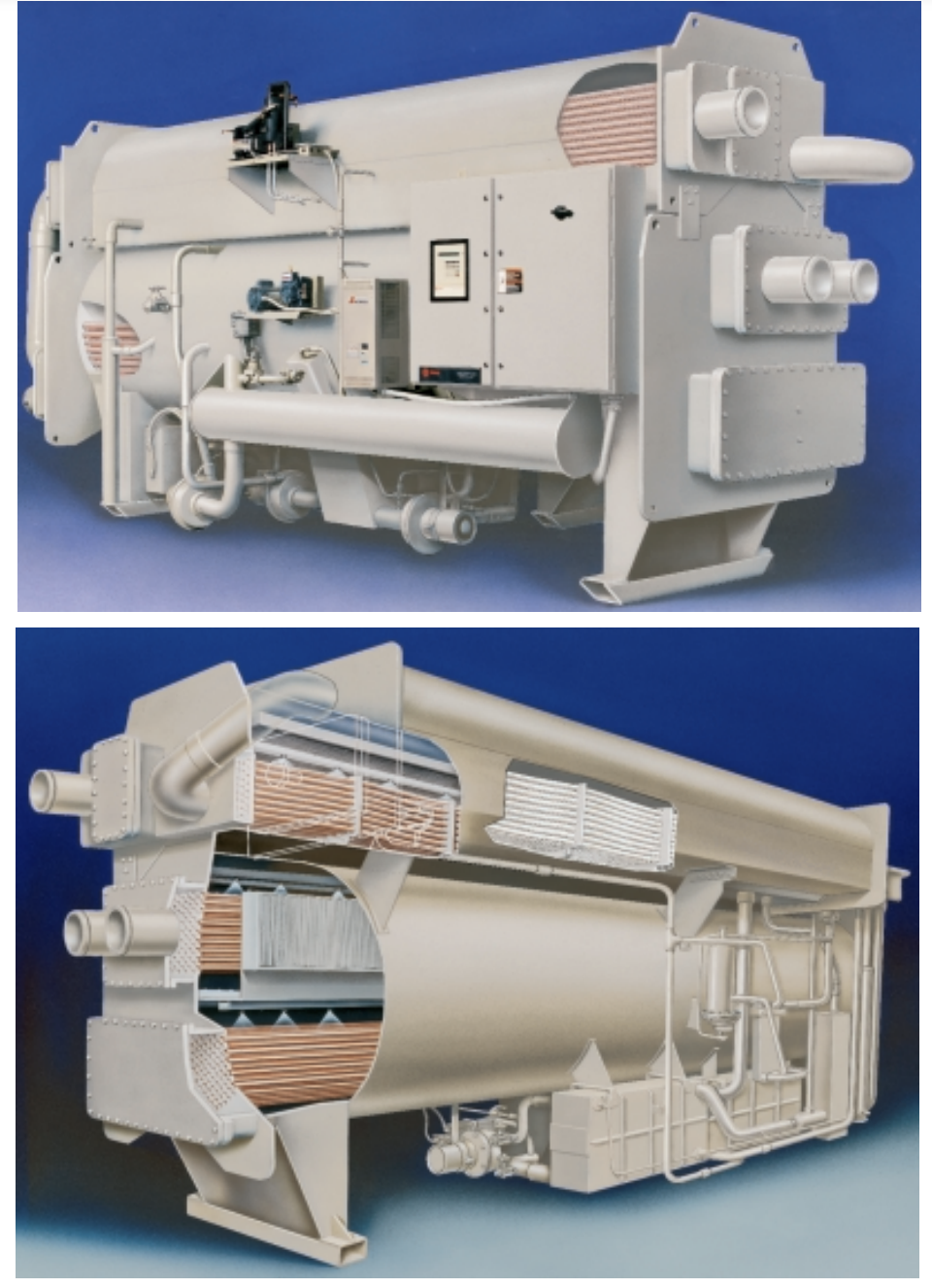
A two-stage steam-fired absorption water chiller is a type of industrial/commercial cooling machine that uses steam as its driving energy source instead of electricity-driven compressors. It operates based on absorption refrigeration cycle principles, specifically designed to improve efficiency compared to single-stage chillers.
🔧 Technical Explanation
1. Working Principle
- Unlike conventional chillers (which use a mechanical compressor), absorption chillers use thermal energy (here, steam) to drive the refrigeration cycle.
- The system consists mainly of:
- Absorber
- Generator
- Evaporator
- Condenser
- Refrigerant: Usually water.
- Absorbent: Usually Lithium Bromide (LiBr), which has a strong affinity for water vapor.
2. Two-Stage Steam-Fired Design
- Single-stage absorption chillers operate at one generator temperature level, typically with lower efficiency (COP ~0.65–0.75).
- Two-stage absorption chillers use a high-temperature generator and a low-temperature generator, connected in series:
- Steam (at higher pressure/temperature) enters the high-temperature generator, releasing refrigerant vapor.
- The leftover weak solution is then further processed in the low-temperature generator, extracting additional refrigerant vapor using the same energy input.
- This staged process increases efficiency (COP ~1.0–1.2).
3. Major Components & Process Flow
- Evaporator:
- Chilled water is produced here.
- Refrigerant water evaporates under vacuum, absorbing heat from the chilled water loop.
- Absorber:
- Water vapor from the evaporator is absorbed by concentrated lithium bromide solution.
- Heat of absorption is removed by cooling water (usually a cooling tower).
- Generator (Two Stages):
- High-temp generator: Steam input heats the LiBr-water solution, driving off refrigerant vapor.
- Low-temp generator: Reuses part of the thermal energy for further refrigerant vapor extraction.
- Condenser:
- Refrigerant vapor is condensed back into liquid form by cooling water.
- Solution Heat Exchanger:
- Improves cycle efficiency by preheating weak solution using hot concentrated solution.
4. Technical Advantages
- Higher COP (Coefficient of Performance) compared to single-stage units, thanks to staged utilization of steam.
- Efficient use of high-pressure steam in industrial plants (common in refineries, chemical plants, or steel mills).
- Eco-friendly: Uses water as refrigerant (no CFCs/HFCs).
- Stable operation: Well-suited for continuous large-scale cooling loads.
5. Applications
- Industrial facilities with available steam (chemical, petrochemical, steel, textile).
- District cooling systems where central plants distribute chilled water to multiple buildings.
- Cogeneration (CHP) plants where waste steam from power generation is used for cooling.
- Hospitals and universities with large central boiler systems.
✅ In summary:
A two-stage steam-fired absorption water chiller is a high-efficiency cooling system that uses steam energy and lithium bromide-water absorption cycle to produce chilled water. The two-stage generator design allows it to extract more refrigerant vapor per unit of steam, achieving significantly higher efficiency than single-stage chillers, making it ideal for large-scale industrial and district cooling applications.