What is CNC Double Bending Folding Machine?
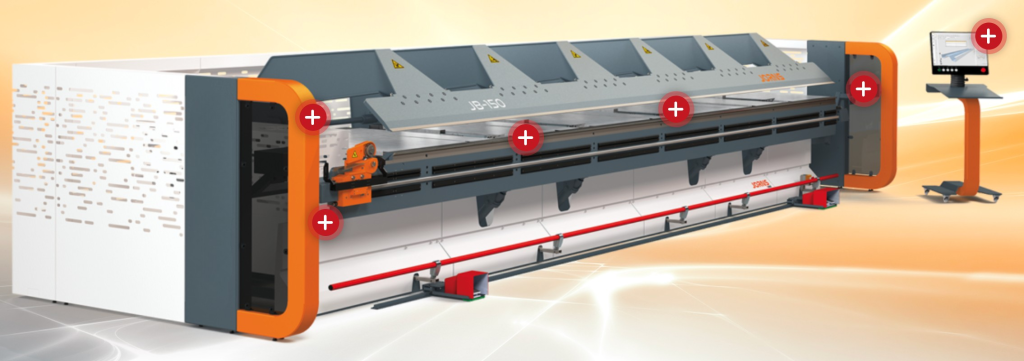
A CNC Double Bending Folding Machine (also called a CNC double folder or CNC dual bending machine) is a computer-controlled sheet metal forming system designed to bend and fold metal sheets automatically from both directions — up and down — without manual repositioning.
It represents one of the most advanced technologies in modern metal forming, used in HVAC duct production, cabinet manufacturing, façade systems, roofing panels, electrical enclosures, and precision sheet metal components.
Let’s break it down in detail:
1. Definition and Core Function
A CNC double bending folding machine is a numerically controlled (CNC) press-type system that performs metal folding operations on flat sheet material.
Unlike a traditional press brake, which only bends downward using a punch and die, this machine has two folding beams (upper and lower) that can move both upwards and downwards, enabling bi-directional bending — hence “double folding.”
This configuration eliminates the need to flip or rotate the workpiece between bends, dramatically improving efficiency, accuracy, and ergonomics.
2. CNC Control and Automation
At its core, the machine is driven by a CNC controller that precisely manages:
- Backgauge positioning (the reference system for part dimensions)
- Clamping beam movement
- Upper and lower folding beam angles
- Automatic tool positioning and clearance adjustment
- Sequencing of bends to minimize interference and repositioning
The CNC control software calculates the bending sequence and folding angles, compensating automatically for:
- Material springback
- Thickness variations
- Radius requirements
- Fold order and collision prevention
Most high-end machines use graphical 3D programming interfaces where the operator can visualize the entire folding sequence and simulate bending in real time.
3. Key Mechanical Components
| Component | Function |
|---|---|
| Clamping Beam | Holds the sheet securely during bending. Equipped with segmented tooling. |
| Upper & Lower Folding Beams | Perform upward and downward bends respectively, each driven by servo or hydraulic actuators. |
| Backgauge System | Positions the sheet precisely under the folding line; usually CNC-controlled with multiple stops. |
| CNC Controller | Calculates folding angles, sequences, and beam positions automatically. |
| Tooling Segments | Interchangeable segments allow forming complex geometries, box-type parts, or offset profiles. |
| Servo Drives | Ensure precise, repeatable motion of all axes for accuracy and high productivity. |
4. Single Folding vs. Double Folding
| Feature | Single Folding Machine | Double Folding Machine |
|---|---|---|
| Bending Direction | One direction (usually upward or downward) | Both up and down |
| Workpiece Handling | Requires flipping or rotating part | No flipping — fully automatic |
| Cycle Time | Longer | Up to 50% faster |
| Operator Workload | Higher | Lower |
| Accuracy & Repeatability | High | Even higher |
| Applications | Simple folds | Complex parts with inward/outward flanges |
In a double folding system, the sheet remains stationary while the beams move — this minimizes marking, distortion, and handling errors.
5. Advantages of CNC Double Bending Folding Machines
- Higher Productivity
- Both upward and downward bends are performed automatically without manual repositioning.
- Ideal for large batches and mixed small-lot production.
- Superior Accuracy
- CNC feedback control ensures ±0.2° bending angle precision.
- Consistent part geometry over long production runs.
- Material Surface Protection
- No tool-slide friction on the visible side of the sheet (unlike press brakes), ideal for stainless steel, aluminum, painted, or coated sheets.
- Reduced Operator Skill Requirement
- Fully automated sequences reduce dependency on experienced press brake operators.
- Improved Ergonomics & Safety
- Operator does not need to lift, flip, or reposition large sheets manually.
- Energy Efficiency
- Servo-electric models use less energy than hydraulic press brakes, with quieter and cleaner operation.
- Flexibility
- Handles complex geometries, box shapes, offset bends, and variable radius folds.
6. Technical Specifications (Typical)
| Parameter | Typical Range |
|---|---|
| Max. Working Length | 2,000 – 6,000 mm |
| Max. Sheet Thickness (Steel) | 2.0 – 4.0 mm |
| Max. Bending Angle | 0°–145° (variable programmable) |
| Folding Speed | 60–120°/s (depending on model) |
| Backgauge Axes | 2–8 CNC-controlled axes |
| Drive Type | Servo-electric or hydraulic |
| Control System | Siemens / Delem / Beckhoff / ESA / Cybelec |
| Accuracy | ±0.2° bending angle, ±0.1 mm positioning |
| Tooling System | Segmental clamping and folding tools, quick-change design |
7. Applications
- Architectural façade panels and cassettes
- HVAC duct and air handling units
- Electrical cabinets and control enclosures
- Elevator and escalator claddings
- Roofing and gutter systems
- Automotive body panels
- Furniture and kitchen stainless parts
8. Example Workflow
- CNC Program Creation: The operator inputs part dimensions or imports a DXF/STEP file.
- Automatic Bending Simulation: The control software determines the bend order, directions, and angles.
- Sheet Loading: Operator places the sheet onto the backgauge fingers.
- Automatic Clamping: The clamping beam fixes the sheet.
- Bending Sequence: The lower beam folds up for positive angles, the upper beam folds down for negative angles.
- Automatic Unloading (optional): Robots, gantry, or conveyor unloads the finished part.
9. Leading Manufacturers
- Ras Systems (Germany) – RAS XXL-Center, Multibend-Center
- Thalmann Maschinenbau (Switzerland) – TZ, TD series
- Schechtl (Germany)
- Salvagnini (Italy) – P4Xe, L5 lines
- MetalForming Inc. (USA distributors)
- LVD (Belgium) – Easy-Form and Dyna-Fold series
10. Summary
| Feature | Description |
|---|---|
| Purpose | Automated up/down folding of sheet metal without repositioning |
| Technology | CNC-controlled servo-electric folding beams |
| Advantages | Speed, precision, reduced handling, surface protection |
| Applications | Complex, multi-bend sheet metal parts |
| Controls | Siemens / Delem / Beckhoff / MAPPS / Fanuc |
| Future Trends | Full robotic loading/unloading, adaptive angle measurement, AI-based bending compensation |