01/09/2025
What is a Emerson Electric AMS 2140 Machine Health Analyser that provides the earliest and simplest indication of bearing failure and its severity using a vibration analyser?
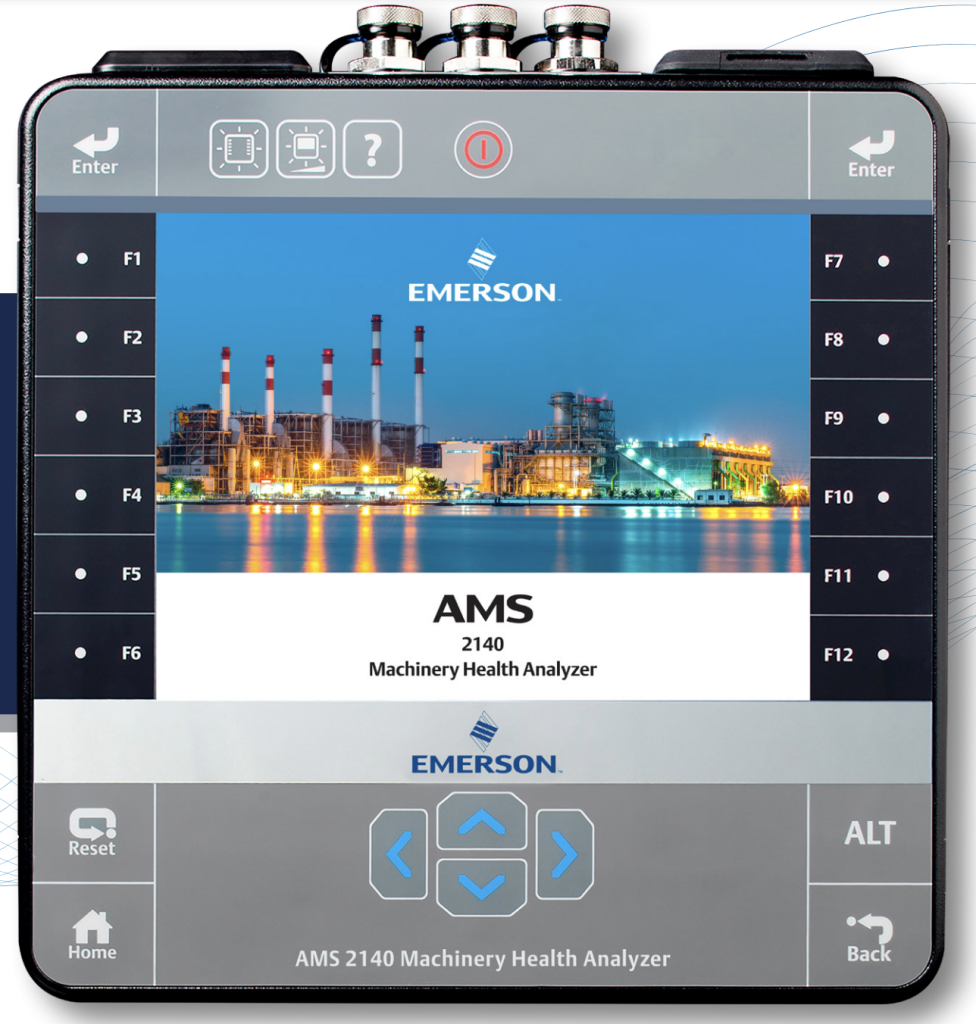
The Emerson AMS 2140 Machinery Health Analyzer is a multi-channel, portable instrument for vibration-based condition monitoring of rotating assets (bearings, gears, pumps, fans, motors, spindles, etc.). Its claim to provide the “earliest and simplest indication of bearing failure” comes from combining standard velocity/acceleration measurements with high-frequency impact techniques—classic envelope (demodulation) and Emerson’s PeakVue—in a single device.
How it works (technically)
- Sensor & acquisition chain: Accepts IEPE/ICP piezoelectric accelerometers; provides constant-current power, applies anti-aliasing filters, and digitises signals with a high-resolution ADC.
- FFT & order analysis: Time waveform → windowing (Hanning) → FFT to obtain velocity/acceleration/displacement spectra. With a tach/laser reference it performs order tracking and phase measurements (useful for balancing, coast-down tests, ODS/resonance work).
- Early bearing detection (PeakVue / Envelope): Early bearing defects create short-duration, high-frequency impacts. These excite structural resonances; long before overall vibration rises, envelope demodulation reveals repeating energy at bearing fault frequencies (BPFO, BPFI, BSF, FTF). PeakVue tracks this impact energy in a g-peak/energy metric, giving very early warnings.
- Low vs. high-frequency bands:
- Low–mid band (≈10–1,000/2,000 Hz, velocity RMS): imbalance, misalignment, looseness, structural issues.
- High band (≈500 Hz–20 kHz+, acceleration/envelope/PeakVue): bearing surface damage, micro-pitting, poor lubrication, gear impacts.
- Severity assessment: Overall values, trends, alarm/condition bands and symptom bands indicate growth rate and level. Crest factor and kurtosis help distinguish lubrication issues from surface damage.
Practical recipe for “early and simple” bearing indication
- Sensor mounting: Use a magnetic base on a clean, stiff point; use the same spot each time. Enter the correct sensor sensitivity (mV/g).
- Velocity check (ISO 10816/20816 range): Fmax ≈ 1 kHz, 1,600–3,200 lines → mm/s RMS to reveal imbalance/misalignment/looseness.
- Envelope/PeakVue: Set band-pass around bearing resonance (e.g., 500 Hz–20 kHz); record 1–2 s with ≥3,200 lines FFT.
- Add tach/laser and enable order tracking if speed varies.
- Interpretation:
- Rising PeakVue/envelope + lines at BPFO/BPFI/BSF/FTF → early bearing defect.
- High crest factor but normal overall velocity → lubrication problem / very early damage.
- Sidebands around defect lines → load/looseness modulation or inner-race issues.
- If the trend increases across 2–3 routes: relubricate → re-measure → plan bearing change at the next maintenance window.
Typical operating modes
- Route-based data collection: Pre-defined asset/point lists with consistent parameters to build reliable trends.
- Expert modules: High-resolution analysis, low-frequency (SST), PeakVue Bearing/Gear, laser speed detection, balancing, impact/resonance tests.
Why choose the AMS 2140?
- Portable, rugged, multi-channel hardware that unifies ISO velocity measurements with envelope and PeakVue.
- Early warning: Impact-based metrics flag problems before overall vibration rises.
- Clear severity & trends: Simple alarms for operators; deep FFT/order tools for analysts.
For CNC spindles, gearboxes, fans/pumps, using the correct bands and sampling, the AMS 2140 tracks the progression lubrication deficiency → micro-damage → surface degradation early, enabling confident maintenance planning.