31/08/2025
What is a Hermetic Press Paver Block machine used to produce terrazzo tiles, paving blocks and slabs, decorative/grooved tiles?
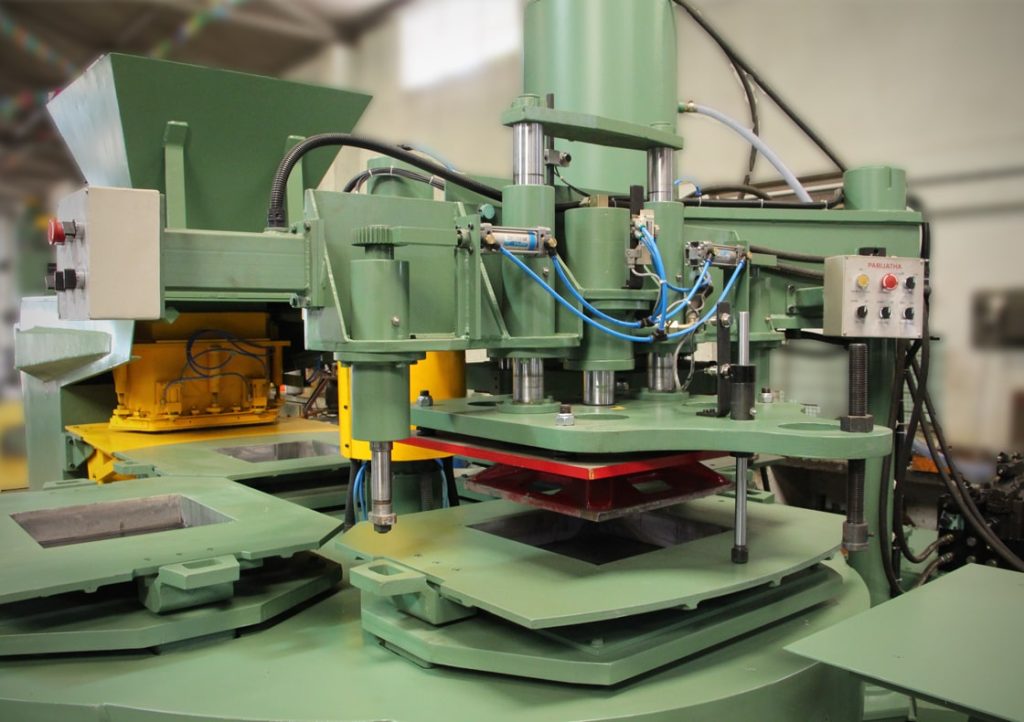
What it is
A hermetic-press is a high-pressure, hydraulically driven tile/paver press that compacts low-moisture concrete or terrazzo face-mix inside a closed (hermetic) die cavity. By sealing the cavity around the punch and applying controlled pressure (often with vibration and/or vacuum de-airing), the mix is densified to very low porosity, producing smooth, hard-wearing tiles, slabs and interlocking pavers with sharp edges and optional grooves or textures.
Machine architecture
- Feeding & dosing: separate hoppers for face mix (marble chips/pigmented cement for terrazzo) and backing/base mix (structural concrete). Servo/weight-controlled distributors spread each layer.
- Pressing unit: heavy hydraulic cylinder(s) with a precision top punch and a bottom die/mould; a floating sealing ring or close punch-to-die clearance creates the hermetic effect (air exclusion & lateral confinement).
- Vibration / vacuum (options): bottom or table vibration to mobilize particles; vacuum ports for de-airing the face layer before final press.
- Indexing table / rotary carousel: multi-station layout (e.g., fill → pre-press → final press → demould) for high throughput.
- Demould & handling: ejector/push-up, take-off board, palletizer/rack system; curing chamber interface.
- Control: PLC/CNC recipes (tile size, layer thickness, pressure ramp, vibration time, demould height, cycle timing); closed-loop pressure and position control.
Process sequence (typical)
- Face-mix spread into the die and lightly vibrated to level.
- Pre-press / vacuum (optional) removes air and locks the decorative aggregate.
- Base-mix backfilling to the programmed thickness.
- Final hermetic press: pressure ramp to target compaction; vibration can be superimposed.
- Demould to a take-off board → curing (24–72 h, controlled humidity/temperature).
- Finishing (if terrazzo): calibration, grinding, and polishing to expose aggregate.
What it makes
- Terrazzo tiles/slabs: single- or double-layer; smooth, polishable face with very low absorption.
- Paving blocks & slabs: interlocking or flat flags, with integral grooves/reliefs machined into the mould.
- Decorative tiles: multi-colour face mix, inlays, logos, and surface textures.
Technical capability (typical, model-dependent)
- Sizes: 200×200 up to 600×600 mm (larger slabs with multi-cylinder presses).
- Thickness: ~15–70 mm (tiles) and 40–120+ mm (pavers/slabs).
- Cycle time: ~10–25 s (pavers) / 20–40 s (terrazzo double-layer).
- Compressive strength: ≥45–70 MPa after cure (mix-dependent).
- Water absorption: typically <6% for pavers; terrazzo face <3% achievable.
- Dimensional tolerances: planarity & edge ±0.3–1.0 mm with calibrated moulds.
Why “hermetic” matters
- Sealed cavity + high specific pressure minimize entrapped air, force paste migration, and close the surface, yielding:
- higher density and strength,
- crisp edges and well-defined grooves,
- low water absorption and excellent wear resistance,
- superior finish ready for polishing (terrazzo).
Advantages vs. wet-cast or standard vibropress
- One machine covers decorative terrazzo and structural pavers with quick mould change.
- Lower cement per unit at a given strength due to higher compaction efficiency.
- Highly repeatable colour/texture with recipe-driven dosing.
- Integrates grooves/textures in the die—no secondary routing.
Selection checklist
- Required format range (max area & thickness), press force, and table size.
- Face/base dual-layer capability, multi-colour dosing.
- Vibration type (table vs. tamper), vacuum de-airing, pressure ramp control.
- Mould system & quick-change, demould height, board size, curing logistics.
- Compliance targets: EN 1339 (concrete paving flags), ASTM C936/C140 (pavers), EN 13748 (terrazzo tiles).