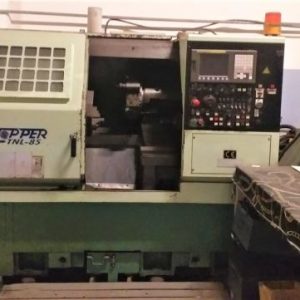
What Industry Experts Recommend Before Purchasing a Pre-Owned / Second-Hand / used Topper TNL-85A?
Here’s what industry experts recommend you check before buying a used Topper/Tongtai TNL-85A CNC Lathe. I’ll include the known specs & what “healthy” means, a detailed inspection checklist, red flags, questions to ask, and economic/logistic considerations.
What We Know: Baseline / Typical Specs for the TNL-85A
Having the correct spec baselines helps you judge whether the machine is in acceptable condition or whether it’s too worn or underspecified for what you need. For the Topper (Tongtai) TNL-85A, here are several published specifications:
| Specification | Value / Range |
|---|---|
| Max Swing (over bed) | ~ 370 mm (≈ 14.6 in) |
| Chuck size | 8″ (≈ 200-210 mm) |
| X-axis Travel (turret) | ≈ 150 mm |
| Z-axis Travel (turn between center / over turret) | ≈ 400 mm |
| Spindle Nose | A2-6 |
| Max Spindle Speed | ~ 4,800 rpm |
| Tool Turret | 12 fixed tool holders in 1 turret (fixed tools) |
| Bar capacity (inner bore / bar feed) | ~ 42 mm (≈ 1.65 in) in some listings; also “bar capacity/in bore” around 1.7 in reported in abcd listings |
| Guideway Type | LM / Linear Motion Guides on X and Z axes in many spec sheets |
These are baseline. When inspecting a used unit, expect some wear, but severe deviation from these suggests major refurb cost.
What Experts Recommend Checking / Verifying
Here is a detailed checklist, by subsystem, of what to inspect, test, and measure.
Mechanical / Structural Checks
- Bed / Base / Slant Bed Structure
- Check the condition of the bed: are there visible cracks, deformation, warping, evidence of previous weld repairs (which might have introduced distortions)?
- Inspect the slant bed (if applicable) for sagging or misalignment under the saddle & turret.
- Check cleanliness & protection (way covers, chip shields).
- Guideways, Linear Motion (LM) Rails, Slideways
- Examine X & Z axis guides / rails: wear, pits, scoring, rust.
- Test the movement in both directions; check for binding, stick-slip, or rough spots.
- Inspect backlash: move axis one way then back, see how much lost motion. Excessive backlash adds to error in machining.
- Ball Screws (if used) / Leadscrews / Transmission
- Check ball screws (if fitted) for backlash, wear, noise. Also check the nut, connections, lubrication.
- If the TNL-85A uses larger diameter or precision screws, see whether these are original, maintained.
- Spindle / Headstock
- Run spindle at various RPMs to detect noise, vibration.
- Test radial and axial run-out: with test bar, dial indicator; ensure it’s within acceptable tolerance for your parts.
- Check bearing condition (do they generate heat, oil leakage?)
- Spindle nose and taper: inspect for wear or damage (chips, dents). If worn, tool holding precision suffers.
- Tool Turret / Toolholders
- Check turret indexing: does it correctly and cleanly move to each tool station? Is there slop or play?
- Inspect toolholder seats, condition of holders, how tools are clamped.
- If there are driven tooling or live tools (if variant has them), check condition. But many TNL-85A are fixed tools only.
- Bar / Through-Spindle Capacity & Bar Feeder (if applicable)
- Check the inner bore diameter (through spindle) matches spec; check wear inside bore.
- If a bar feeder or guides are attached or used, test for feed smoothness, alignment, gripping quality.
- Axes Accuracy / Z / X Accuracy & Repeatability
- Measure travel distances: programmed vs actual travel (on both X and Z) at multiple points.
- Check repeatability: move to some point, come back, see how close you get.
- Warm up machine: run it some time and see whether thermal effects cause drift in alignment or positioning.
- Control System & Electronics
- Identify CNC control version (Fanuc OT, etc.) and check functionality of all displays, buttons, emergency stop etc.
- Check power and servo drives: do axis moves both under load and empty; are there oscillations/vibrations/noise from drives?
- Inspect wiring in control cabinets: heat damage, corrosion, modifications.
- Coolant / Lubrication / Chip Management
- Examine coolant system: tank, pump, filtration, hoses. Condition of coolant (clean, not full of chip debris or sludge).
- Lubrication: check that ways, spindle, slideways are being lubricated properly; oil supply, greasing etc.
- Chip conveyor or chip removal: is it present, in good order; are chips cleaned away or accumulating; risk of damaging slides etc.
- Accessories & Tooling
- What tooling is included? Chucks, collets, tool holders, fixtures, rest, etc. Are they in good condition?
- Check condition of chuck (jaws, plates), tailstock if present.
Red Flags & Warning Signs
Here are problems that frequently show up (or are hidden) in used TNL-85A machines and cost a lot to fix:
- Excessive run-out in the spindle or taper; often indicates bearing wear.
- Large backlash in axes (X or Z) – sometimes due to wear in guideways, screws, or lost adjustments.
- Significant wear / damage in the inner bore (if using through-spindle stock) → can cause vibration or chatter, restrict bar capacity.
- Worn or damaged ways, especially near the chuck / heavy cutting, which suffer more wear.
- Tool turret mis-indexing, loose toolholders, worn or inaccurate seating of tools.
- Control or electronics that are aged, with burned wires, missing fan or cooling, replaced with non-OEM parts.
- Coolant contamination, rust, chips in coolant, poor filtration → leads to spindle damage or corrosion.
- Machine has been poorly maintained or stored (e.g. left idle in damp conditions) → rust, seals dried, lubrication gaps.
- Missing safety guards, interlocks, or accessory items (like chucks, follower/rest, fixtures) which may be costly or hard to source.
Questions to Ask the Seller
These help you gather information often not visible at first glance:
- What is the year of manufacture and what version of the control (Fanuc OT or other) is fitted?
- How many hours or operating cycles has the machine had (spindle hours, axis hours if known)? What kinds of work has it mostly done (materials, heavy vs light cutting)?
- Has any major maintenance been done: spindle bearing replacement, guideway refurbishment, ball screw replacement, control upgrades?
- Has the machine been idle for long periods? If so, how was it preserved during idle time (lubricated, covered, humidity controlled)?
- What tooling is included (chuck, tool holders, fixtures, etc.) and what is their condition?
- Is a detailed maintenance record / service log available?
- Can the seller power up and run the machine and perform sample parts similar to what you intend to produce?
- Are there any known faults: vibration, overheating, spindle drift, drive issues, lost accuracy?
- What condition is the inner spindle bore (if used for bar work)?
- Are spare parts & support for the control system, drives, spindle, etc. still reasonably obtainable in your region?
Economic / Practical / Logistical Considerations
- Transport & Installation: Ensure the weight, size, and foundation requirements suit your facility. Rigging, leveling, alignment often costs more than expected.
- Power & Utilities: Voltage, phase, cooling, air supply (if needed), space.
- Tooling & Fixtures Costs: If required tooling, chucks, fixtures are not included or are worn, these can add significant cost.
- Spare Parts Availability: For Fanuc O-T and other OEM parts, see how easy/hard it will be to get spares locally. If machine is old, some parts may be obsolete or expensive.
- Wear / Refurb Cost: Based on your inspection, estimate cost of any refurbishment (guideways, spindle, electronics).
- ROI vs Alternative: Compare buying used + refurbishment cost vs buying newer or better supported machine.
- Training / Skill Level: Older machines may require more manual tuning, adjustment, maintenance knowledge; ensure your team has or can acquire that.