22/09/2025
What Industry Experts Recommend Before Purchasing a Pre-Owned / Second-Hand / used PROMAX GROUP PRM NCD-T6 Deburring Machine?
When considering buying a used PROMAX GROUP PRM NCD-T6 Deburring Machine, industry experts advise doing very thorough due diligence. These machines are relatively specialized (multi-axis deburring / finishing), so wear in mechanical, electrical, tooling, fixturing, control, etc., can all have big impacts. Below is a checklist of what to inspect, tests to run, questions to ask, and what to watch out for.
What We Know (Typical Specs / Good to Confirm)
From published material:
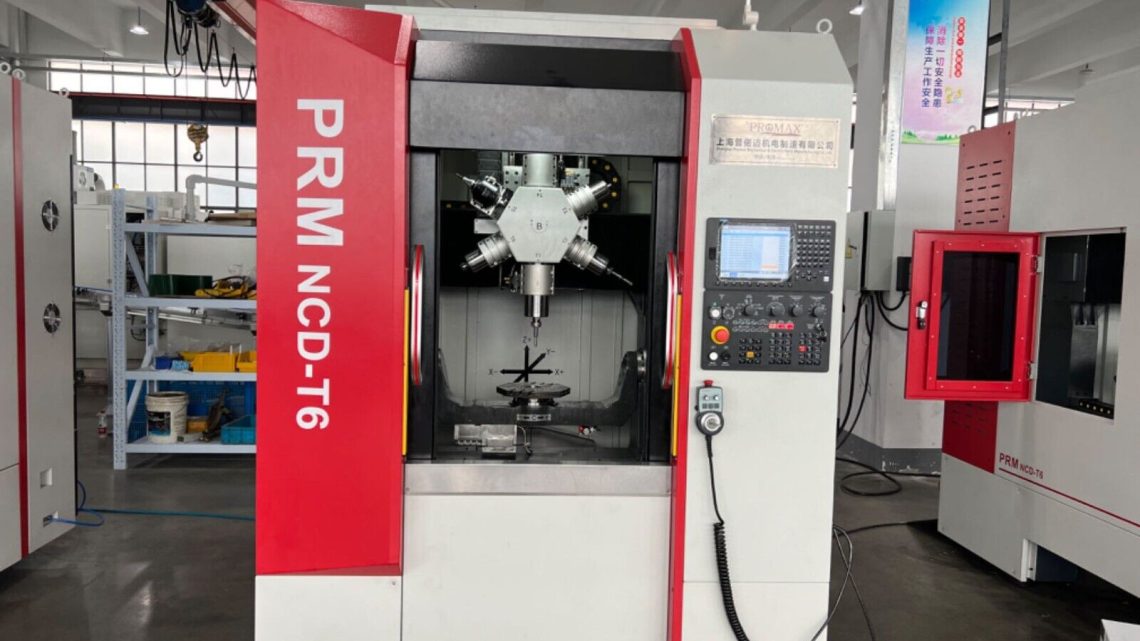
- The PRM NCD-T6 is a six-axis deburring machine from Promax.
- It has six electric spindles (about 4.5-7.5 kW each) operating up to very high RPM (for example ~40,000 rpm in their six-axis models).
- The axes include a cradle with ±110° swing and 360° rotation on the C-axis; a B or tool swing of ±180° etc.
- X, Y, Z travel is substantial (e.g. 650 × 550 × ~320-450 mm for comparable models) in many of Promax’s six-axis machines.
Knowing the nominal capabilities helps you spot where a machine may have degraded or been modified below spec.
What to Inspect / Test On A Used Unit
Here are what experts recommend you physically and operationally verify:
| Component | What to Look/Test |
|---|---|
| Spindles / Tool Heads | • Run each spindle (at various speeds) to listen for unusual noise, vibration, heat. • Check run-out of spindle taper or tool holder (axial / radial) • Check if speed droops under load • Condition of bearings; look for signs of overheating, discoloration, lubrication condition |
| Axes & Motion System | • Smooth motion in all axes (X, Y, Z, plus rotational axes). No binding, stiction, jerky moves • Check backlash, repeatability of movements: move to a point, move off, return • Verify that all axis motions are accurate and precise; may require dial indicators or laser measurement • Inspect guide rails, linear bearings, rotary joints for wear, rust, or looseness |
| Cradle / Multi-Axis Mechanics | • The cradle swing & C-axis rotation: check that rotations are clean, without wobble; check mechanical integrity of rotary bearings • Inspect any tilt mechanisms (B-axis or equivalent) for backlash, smooth movements • Verify that rotating joints are properly lubricated, sealed, no play or looseness |
| Tooling & Fixtures | • Check condition of tools used (deburring bits, soft & rigid tools, polishing tools). Are they worn? Are replacements available? • Fixture clamps / jigs: make sure the workpieces are held securely (clamping systems, fixtures, pneumatic/hydraulic clamps if present) • Check fixtures for correct alignment; misalignment in fixture leads to inconsistent finish or possible tool damage |
| Control / CNC / Software | • What controller is installed? Is it current or outdated? Are software updates still provided? • Check for error logs / alarms history • Touch screen / HMI, sensors, limit switches: do they function reliably? • Electrical wiring, connectors: any signs of overheating, corrosion, wear • Motor drives, servo amplifiers, variable frequency drives: do they respond smoothly, any fault or slip under load |
| Cooling / Lubrication / Auxiliary Systems | • Cooling for tool heads, spindles etc: is coolant or air cooling (or gas/liquid cooling) working correctly? • Lubrication for all moving parts: guide rails, rotary bearings, etc. • Auxiliary systems (chip removal, dust / debris collection, exhaust / mist capture) • Make sure filters, coolant lines, hoses are in good condition, not leaking or blocked |
| Wear / Damage Inspection | • Surface finish of work table or fixture plate: any gouges, corrosion, wear marks • Check enclosure, guards, access panels: are they intact, do they function properly • Inspect the tool changing or multi-spindle heads for damage, misalignment • Check for signs of overheating, metal discoloration, burnt zones especially around spindle motors or joint bearings |
| Operational Test / Sample Run | • Run the machine with a workpiece similar to what you plan to use (material, geometry, hardness) to check finish, burr removal, consistency • Test at various speeds: low, mid, high to see stability, finish, vibration • Time cycle for your real parts; sometimes used units may be slower than spec under real load • Check uniformity of deburring around edges, holes, recesses etc. • Inspect that finish / tolerances meet required spec (surface roughness, edge condition etc.) |
| Safety Systems | • Emergency stop buttons, interlocks, safety guards all present & working • Look for safety compliance: lights, covers, shields, etc. • Electrical safety: grounding, insulation, no exposed wiring • Operator access: safety of the path of motion of tool heads etc. |
Questions to Ask the Seller / Documentation to Acquire
To avoid surprises, ask for and verify:
- Age of machine; serial number; hours of use (spindle hours, operation hours)
- What types of parts / materials have been processed (e.g. steel / aluminum / castings / exotic materials)
- History of maintenance: tool replacement, spindle bearing changes, lubrication / cooling system servicing
- Any past repairs or damage (accidents / crashes / overloads)
- Software version, control firmware, updates
- Whether any parts have been modified or replaced; whether machine is as original spec
- Sample output: recent parts processed, with your kind of material if possible
- Spare parts availability and cost locally (spindles, tools, joints, bearings)
- Warranty or guarantee period (if any), or condition acceptance policies
- Is installation / alignment part of the price? What is needed at your site (power, ventilation, foundations etc.)
Key Risk Areas & Red Flags
These are things that more often than not become expensive issues in a used machine of this kind:
- Spindles with worn bearings (manifesting as noise / heat / vibration) will degrade finish or reduce speed & tool life
- Rotary / multi-axis joints (cradle / rotational axes) that have looseness or worn bearings — these degrade repeatability and finish quality
- Tool heads that are worn or misaligned; if tools are not accurate, your parts will have burrs, poor finish
- Cooling / lubrication neglected: can lead to overheating, damage to spindle motors or bearings
- Control / software obsolescence: replacement parts may be hard to find or expensive
- Fixtures / clamps that don’t hold work securely—slippage causes defects, possible damage
- Auxiliary systems under-specified (e.g. if the part has deep grooves, recesses, holes) – these are harder to deburr if tooling is not capable
- If machine has been idle for long time: seals may have deteriorated, lubrication dried, motion systems seized or sticky
How to Determine If Pricing & Condition is Acceptable
- Compare asking price vs market of comparable used machines + cost of needed repairs / parts
- Estimate what refurbishing might cost — bearings, tool heads, re-calibration, alignment
- Calculate your throughput: actual cycle time × number of parts / shift; see if machine can deliver what you need reliably
- Consider cost of downtime, spare parts, operator training