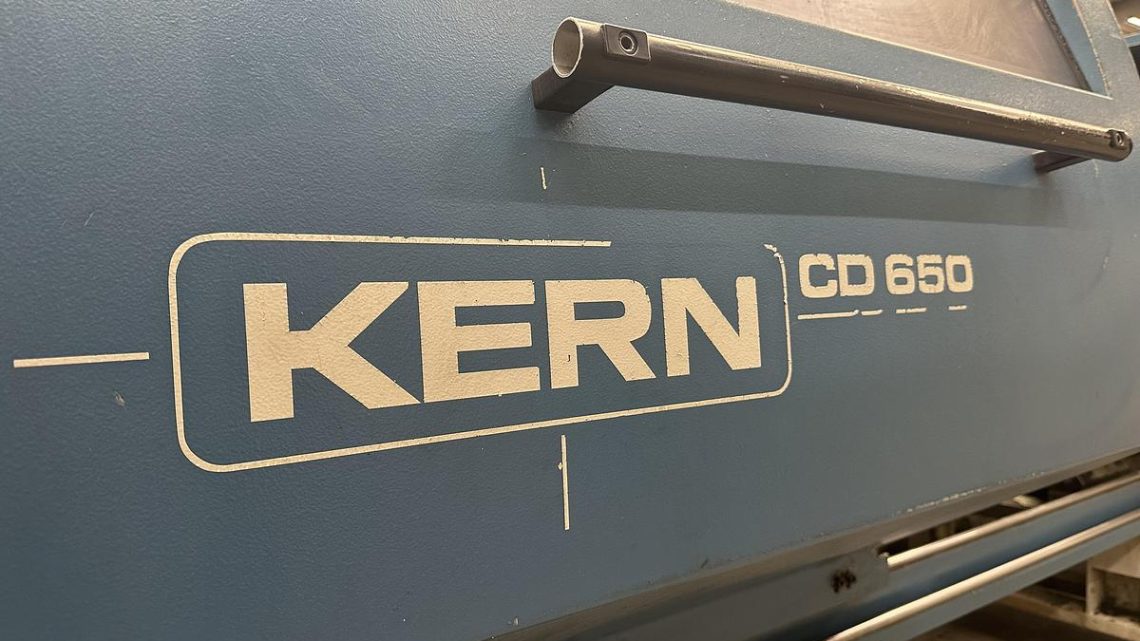
What Industry Experts Recommend Before Purchasing a Pre-Owned / Second-Hand / used KERN CD 650 CNC Lathe?
Here are what industry experts recommend you check before buying a pre-owned / used KERN CD 650 CNC / cycle / precision lathe. I’ll start with known specs & baseline expectations so you know what “healthy” looks like, then a detailed inspection & test plan, red flags, questions to ask, and economic/logistic considerations.
What is a Healthy KERN CD 650 — Key Specs & Expected Baseline Performance
Knowing what the machine should be able to do is crucial to spot deviations. The KERN (DMT-Kern) CD 650 is a heavy-duty CNC / cycle lathe with a good reputation. Here are its published / typical specs:
| Parameter | Typical Spec / Range |
|---|---|
| Turning diameter over saddle / bed slide | ~ 650 mm |
| Turning diameter over cross-slide / top slide | ~ 400-420 mm |
| Spindle bore | ~ 106 mm (for A8 spindle nose) |
| Spindle drive power | Direct drive, ~ 33 kW or combinations ≈ 22-33 kW depending on variant |
| Spindle speed | ~ 1-2,000 rpm in standard; optionally up to ~2,500 rpm in some versions. |
| Centre / between-centres length options | usually 1,000 / 1,500 / 2,000 / up to 3,000 mm depending on configuration. |
| Fast traverse (rapid feed) | X / Z axes fast moves around 5 / 10 m/min in some offers. |
| Tailstock quill travel | ~ 200 mm typical |
| Machine weight / footprint | Several tons, heavy base, size increases significantly with longer centres. |
These are the “factory spec” benchmarks; a used machine will rarely match perfectly, but knowing deviations helps you see how much work or refurbishment might be needed.
What Experts Recommend Checking / Testing
When inspecting a used KERN CD 650, go through the following checklist. Bring measurement tools (dial indicators, test bars, surface roughness meter, etc.), and ideally someone with experience in lathes.
Mechanical & Structural Inspection
- Bed, Ways, Saddles & Cross/Top Slide
- Inspect for wear on the guideways: flatness, smooth travel, no scoring, corrosion, pitting.
- Check alignment of the bed; any sagging or twist, especially in between centers (long beds) or over full travel.
- Spindle & Headstock
- Check spindle bearings: listen at various speeds for noise/vibration.
- Check radial and axial run-out using a test bar & dial indicator.
- Examine spindle bore: it must be clean, free of damage, round.
- Check for heat discoloration or oil leakage (may indicate bearing or seal problems).
- Tool Turret / Tool Post (if included)
- If the machine has an automatic turret, check indexing accuracy, backlash, firmness of clamps.
- Test tool changes. Check condition of tool holders, shanks.
- Tailstock (if present)
- Quill travel & condition; internal taper; alignment with the spindle centerline.
- Axes Movement (X & Z, possibly Y if fitted)
- Check for backlash in both axes, smoothness of movement, no binding.
- Fast traverse (rapids) must move without hesitation or mechanical “slop.”
- Coolant, Lubrication & Chip Management
- Condition of the coolant system: cleanliness, filtration, pump, hoses.
- Lubrication: way oiling, spindle lubrication, gearboxes etc. Are automatic lube systems working?
- Chip conveyor or removal system: does it work? Are coolant and chips being evacuated well?
- Electrical / Control Systems
- Control type (Siemens, etc.), year, software version. Are replacements / maintenance parts available?
- Wiring: look for signs of overheating, damage.
- All limit switches, safety interlocks, guards should be present and functioning.
- Precision & Performance Testing
- Run a test part: something requiring clean finish, big diameter + length. Measure dimensions, roundness, surface finish.
- Warm up the machine and check if dimensions drift.
- Check positional repeatability (move to a point, come back), check whether movement in reverse + direction changes introduces error.
- Auxiliaries & Accessories
- Check included tooling, chucks, steady/follow rest (if relevant). Are these in good condition?
- Check whether any attachments / added gear (e.g. DRO, power turret, extra axes) are included, and their condition.
Red Flags / Warning Signs
Here are issues that often lead to high cost / trouble later on:
- Spindle bearing noise or axial play (endplay) or wobble; indicates bearings nearing end of life.
- Worn or damaged spindle bore – worsened with bar work or long stock passing through.
- Significant wear on bed guideways; especially near chuck or frequently loaded areas. If ways are badly worn, replating / regrinding may be needed (expensive).
- Tool turret that mis-indexes, is sloppy, or with worn tool-holder seats.
- Control electronics or wiring that’s old, has modification, corrosion, or previous lightning/power surge damage.
- Coolant system clogged, rust or microbial growth, insufficient filtration – these degrade both parts and precision.
- Machine that has been idle for long periods without proper preservation (rust, lubrication failures).
- Missing or non-functional safety guards or interlocks – these can delay commissioning or violate regulations.
- Incomplete documentation: no manuals, parts list, service records, software backups.
What to Ask the Seller
To help expose hidden problems and better estimate remaining useful life, here are questions you should ask:
- What is the year of manufacture, model variant, and control system version?
- How many hours of operation (total, spindle hours, turret cycles)? What materials have been most frequently turned?
- What maintenance / service history is available: any overhauls, spindle bearing replacements, bed way refurbishments, etc.?
- Has the machine been used for heavy cuts / difficult materials (hardened steel, etc.)? How often?
- Has it been idle for any long period? How has it been stored when idle?
- Are all original parts intact? Any modifications (e.g. upgraded spindle, extra tooling, retrofitted controls, etc.)?
- Is the machine currently running? Can I see it under load making test parts?
- Are all safety guards, interlocks, limit switches functional and present?
- What tooling / attachments are included (chucks, steady rest, extra tool holders)? Are they in good condition?
- Are there alignment / test certificates, calibration data, run-out measurements, geometric tolerance verifications available?
Economic / Practical / Logistic Considerations
- Transport & Installation: The CD 650 is heavy; moving, rigging, foundation, leveling could be expensive.
- Power / Utilities: Ensure your shop has the correct power supply, cooling, compressed air (if needed), space.
- Spare Parts / Support Availability: How easy is it to get replacement parts for Kern / DMT-Kern for this particular variant (spindle bearings, turret, control electronics)?
- Expected refurbishment: Based on your inspection, estimate cost for worn parts (ways, spindle bearings, turret, etc.).
- Operating cost: consumables, tooling, coolant, energy.
- Production needs vs capacity: Make sure the machine’s size, spec, speed, precision suit what you actually need (batch size, tolerances, part dimensions).