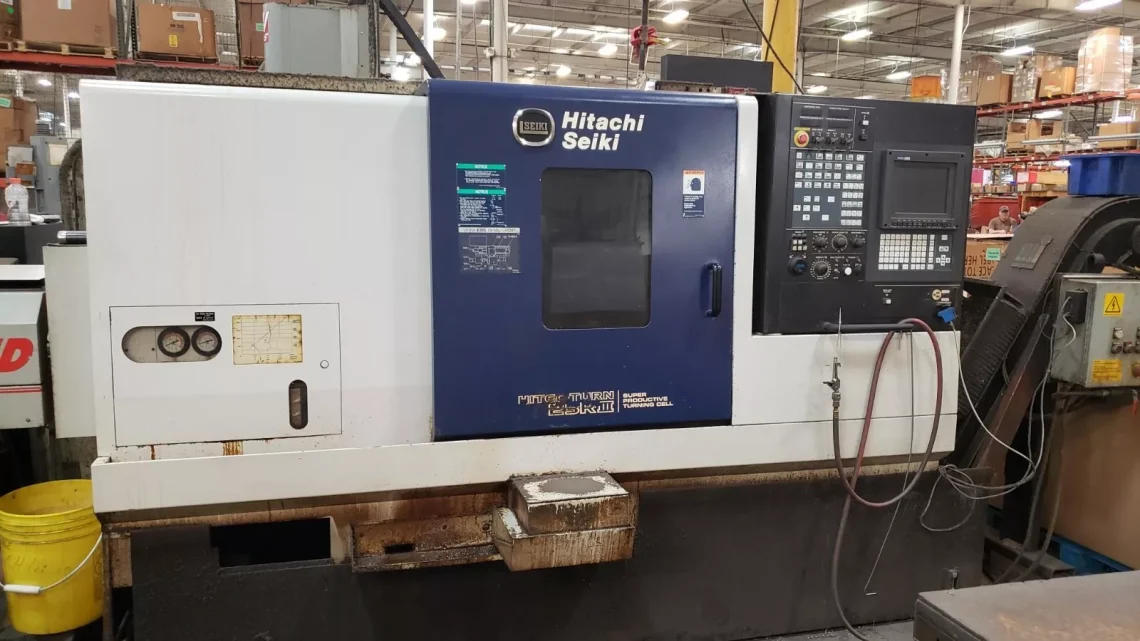
What Industry Experts Recommend Before Purchasing a Pre-Owned / Second-Hand / used Hitachi HITEC TURN 23RIII CNC Lathe with Lexair MultiFeed Bar Feeder?
Here’s a detailed guide (from industry experts) of what to inspect, test, and verify before buying a pre-owned Hitachi / Hitachi Seiki Hitec Turn 23RIII CNC lathe especially when it comes with a Lexair / MultiFeed bar feeder. I’ll also list the known specs of the 23RIII so you know what to compare against, plus red flags to watch out for.
Known / Typical Specs for the Hitachi HITEC-TURN 23RIII
These are the published specifications for this lathe from various sources, useful as baselines:
| Parameter | Value / Range |
|---|---|
| Maximum turning diameter (over bed) | ~ 450 mm |
| Maximum turning length (Z-travel between centers) | ~ 630 mm |
| Chuck size / maximum swing capacity | ~ 250-255 mm chuck; swing ~ 450 mm |
| Spindle bore (through hole for bar work) | ~ 65-78 mm |
| Spindle speed range | up to 4,000 rpm |
| Spindle power | ~ 15 kW (depending on variant) |
| Tool turret | 12-station turret (VDI-40 in many cases) |
| Rapid traverse (X & Z axes) | ~ 30 m/min |
What Experts Recommend Checking / Verifying Before Purchase
When a bar-feeder is added (e.g. Lexair / MultiFeed), it adds complexity — so the inspection has to cover both the core lathe and the feeder. Here are the critical evaluation points:
1. Machine History & Operational Usage
- Hours / cycles logged: total machine on-time, spindle hours, turret usage, etc. Excessive hours may mean worn components.
- Previous workload & materials: Have they run tougher steels, high‐volume bar work, long runs? Abrasive or hard materials accelerate wear in spindle bore, guides, slides, tool holders.
- Maintenance records: regular lubrication, coolant changes, cleaning, spindle maintenance, bearing replacements, bar feeder maintenance, etc. A machine with documented, thorough service history is far safer to buy.
- Idle time: Machines sitting idle may develop rust, seals might dry out, components seize, especially in slide ways, spindle bearings, bar feeder mechanisms.
2. Structural / Mechanical Condition of the Lathe
- Bed & ways: check for wear, scoring, flatness, straightness. For a machine with ~630 mm Z travel, alignment over full travel matters. Ensure no twist or sag in the bed.
- Headstock & spindle:
- Radial run-out & axial play: measure with indicator to see how much wobble exists under load.
- Spindle bearings condition: listen for noise at different speeds; check for heating or vibration.
- Spindle bore condition: for bar work, the inside bore (through hole) must be clean, round, and free of scoring.
- Turret & toolholding:
- Check turret indexing accuracy, shift or drift when advancing tools.
- Condition of tool holders, driven tools, inserts. If live tools or driven tools are part of turret, ensure their motors and interfaces are good.
- Axes (X, Z) movements:
- Smoothness, presence of backlash, hysteresis. Check both rapid traverse and feed under load.
- Inspect ball screws or lead screws (if used), guide ways, slide covers.
- Tailstock (if equipped):
- If there is a tailstock, check alignment (tailstock to spindle centerline), quill condition, locking mechanism. Sometimes tailstock is missing in bar-feeder setups, so check whether you need one.
- Chip & coolant evacuation:
- Chip conveyor, chip catcher present, functional. Coolant system: pump, filtration, no leaks, coolant cleanliness.
3. Bar Feeder (Lexair / MultiFeed) Specific Checks
Since you plan to use a bar feeder, these parts can be a source of problems — check carefully:
- Feeder mechanism condition:
- Grippers, clamps, guides — are they worn, properly aligned, do they grip without damaging the bar?
- Drive rollers, feeding motors — look for wear, slippage, alignment.
- Bar straightness and feed repeatability.
- Integration with lathe controls:
- Does the CNC control (SEICOS or similar) have good communication / handshake with the feeder? Any delays, errors, feed misfeeds, jam prevention?
- Safety interlocks: bar feeder guard, emergency stop, sensors to detect bar presence / completion.
- Feeder size & capacity vs your workpieces:
- Maximum bar diameter feeder can handle. If you plan large diameter; ensure feeder capacity is sufficient.
- Feed lengths: how long is the bar feeder magazine or capacity.
- Feeder history & spare parts:
- Feeder’s service history: any breakdowns, parts replaced, wear components.
- Availability of spare parts for feeder mechanism. Feeder parts sometimes have long lead times or are custom.
4. Control System, Electrical, Software & Safety
- CNC control version & condition:
- The HITEC-TURN / SEICOS control: is it working, up to date, are the software / firmware supported?
- Operator panel, switches, display, emergency stop, limit switches functioning.
- Electrical components:
- Wiring: look for signs of heat damage, loose connections, burnt insulation, water ingress.
- Motor drives & inverters: test under load; check condition, noise, overheating.
- Safety features:
- Guards, interlocks (door open/close), spindle covers, coolant splash shields, chip guards.
- Operator safety: emergency stop, bar feeder guards.
- Diagnostics:
- Are there error logs? Does machine show alarms / warnings? How are they cleared?
- Any modifications or retrofits done: sub-spindle, live tooling, etc. Are they professionally done?
5. Performance Testing Under Load
- Try a real production job:
- Use a typical workpiece (size, material) you intend to produce. Check finish, tolerances, chatter, surface roughness.
- Try long turning on full Z travel, heavy cut in large diameter (if that is part of what you’ll do).
- Spindle under load:
- See how it handles RPM changes, torque, whether there’s vibration under heavy load.
- Repeatability and stability:
- Measure repeated cuts / positions, see if axes backlash or tool changes cause variations.
- Warm up the machine; see if there is thermal drift (i.e. parts size changing as machine warms).
- Bar feed / automatic feed cycle:
- Test feeding several bars in sequence; check for jams, misalignments, repeatability.
6. Spare Parts, Support & Upgradeability
- Parts availability:
- Hitachi / Seiki spare parts: for spindles, bearings, turret, control boards. A 23RIII is not brand-new; check whether important parts are still manufactured or available remanufactured.
- Feeder spare parts (Lexair / MultiFeed): grips, slide guides, motors etc.
- Consumables cost: tool holders, inserts, coolant, filters, etc.
- Training / documentation:
- Does it come with operator manuals, parts lists, wiring diagrams, feeder manual?
- Can someone in your region support this machine (servicing, repairs, control software etc.)?
7. Physical / Logistic & Economic Considerations
- Dimension, weight, foundations:
- The lathe + bar feeder together are large, heavy. Ensure transport, loading/unloading, floor load capacity, foundation leveling, anchoring.
- Access (door width, crane, forklift) for moving.
- Utilities:
- Power supply: voltage, phase, capacity (amps). Cooling (if coolant system), compressed air (if needed).
- Disposal of coolant / swarf: environmental, regulatory compliance.
- Operating cost & ROI:
- Estimate scrap rate, throughput, changeover time between jobs, feeder setup time.
- Difference between a used, well-maintained machine vs making modifications / repairs.
- Residual life: based on wear, usage, hours, how many years of reliable operation you can expect.
Red Flags / Deal-Breaker Warning Signs
These are specific issues people often discover too late, which can make the investment risky unless heavily discounted or repaired:
- Excessive wear in bed ways or slide ways, especially at the front or near tool post — small worn ridge or large wear means reduced precision; difficult/expensive to overhaul.
- Spindle bore damage: scoring, out-of-round bore; sometimes bars bind or vibrate severely; if bore is damaged, hard to repair.
- Spindle bearing noise, play: especially axial play (endplay) indicates major bearing wear.
- Turret mis-indexing or loose turret locks, which can cause tolerance errors or damage.
- Control issues: outdated software with no support; failed displays; intermittent alarms; obsolete parts.
- Feeder mismatch or misalignment, which causes bar feed jams, chucking errors, vibration in long bar work.
- Coolant contamination / damage: rust, sludge, water in hydraulic or spindle lubrication systems; poor coolant filtration.
- Cracks, previous accident damage, welding repairs; especially around bed, headstock, turret—may have hidden effects.
- History of neglect: machine stored in poor conditions, not cleaned, lubricant neglected.
- Parts missing: missing steady rest, follow rest, chucks, wrenches, manuals.
Questions to Ask the Seller
Here are useful questions to ask, to uncover potential issues:
- What is the machine’s serial number, year of manufacture? (To help check parts compatibility, control age.)
- How many hours run total? How many hours on spindle? How many cycles with bar feeder?
- What materials have been processed; what typical jobs have run?
- Has the bar feeder always been used / maintained? Any malfunctions or repairs?
- Any recent major repairs (spindle, turret, control board, drives)?
- Are all programs / control software / backup files available? Is the backup functional?
- Are there extra tooling, chucks, bar feeder spare grips, etc. included?
- Can it be powered up and demonstrated under load before purchase? Can sample parts be run?
- Are there alignment / test data available (eg, acceptance test, geometry checks)?
- Are all safety guards, interlocks intact and compliant?