What Industry Experts Recommend Before Purchasing a Pre-Owned / Second-Hand / used Doosan Puma 600L CNC Heavy-Duty Lathe?
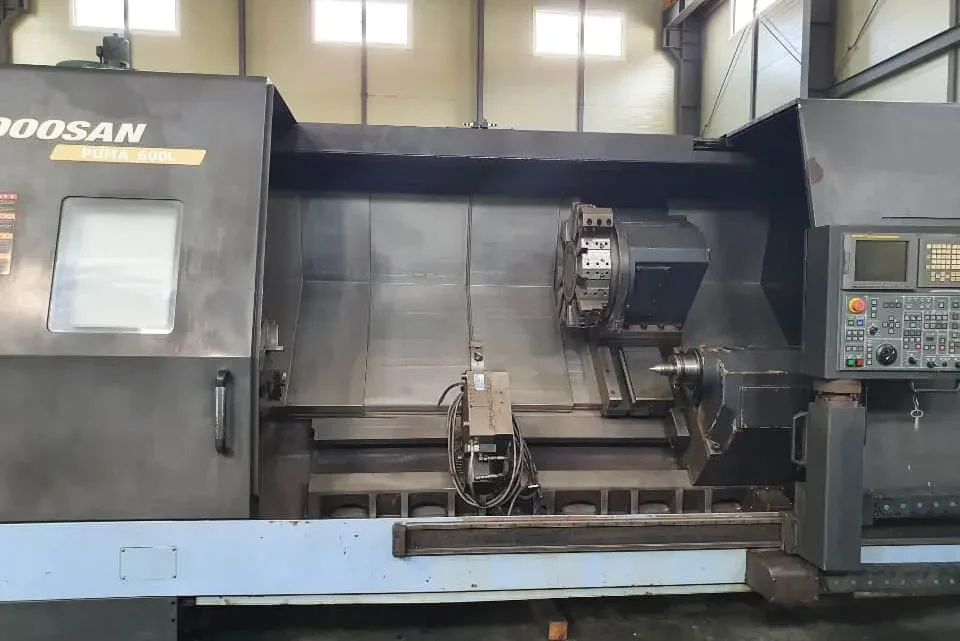
If you’re considering buying a pre-owned Doosan Puma 600L (or 600LM / 600L-series heavy-duty lathe), there are many technical, mechanical, operational, and economic factors to check. Below is a detailed set of recommendations (from industry experts) plus known spec-values to compare against, and red flags to watch out for.
Typical Specifications / What You Should Know up Front
Understanding what the machine should be capable of helps you assess how “good” a used unit is:
| Spec | Approximate Value for Doosan Puma 600L II / 600LM etc. |
|---|---|
| Max Turning Diameter (chucking) | ~ 900 mm |
| Max Turning Length (between centers) | ~ 3,200 mm (for “L” bed versions) |
| Spindle Bore / Through Hole | ~ what is needed for ~ Ø375 mm for certain models in the 600/700/800 II series |
| Spindle Power / Torque | Up to ~ 55 kW, high torque for heavy cuts. |
| Rapid Traverse Rates (X, Z axis) | Typical rapid traverse ~ 12 m/min (X), ~10 m/min (Z) for many 600L II versions. |
| Number of Turret Stations | 12 stations are common in many configurations. |
| Tailstock travel / quill | Approx ~150-160 mm quill travel in many versions. |
These are rough benchmarks; there are many variants. When you inspect, confirm exactly which sub-model (600L, 600LM, etc.) it is, and which options (milling, driven tools, Y-axis, etc.) it has.
What Industry Experts Recommend Checking Before Purchase
To ensure you get a machine in good shape and avoid costly surprises, experts suggest carefully evaluating the following:
- Machine History & Maintenance
- Usage hours: How many hours or parts has it “ridden”? Continuous duty with heavy cuts vs light duty makes big difference.
- Materials processed: Were these hard materials or abrasive, which accelerate wear?
- Maintenance records: Has the machine been regularly lubricated, coolant replaced/filtered, ways cleaned, spindle bearings serviced?
- Downtime and any major repairs: Especially spindle replacement, gearboxes, turrets, etc.
- Structural, Mechanical Condition
- Bed & ways: Check wear, flatness, twist. For long beds (3,200 mm or more), sag or deformation over the length matters. Any scoring, rust, pitting.
- Spindle & spindle bearings: Listen for noise, check for axial and radial play. Excessive run-out. Check for overheating.
- Turret / tool-holder mechanism: Does the turret index cleanly, quickly, accurately? Check tool holders, driven tools (if applicable) for wear.
- Drive systems: Motors, gearing, belts, gearbox if any. Check for backlash, drag, vibration.
- Tailstock condition: If included, check quill travel, alignment (tailstock to spindle), condition of taper, locking.
- Precision & Performance Testing
- Test parts: If you can, run a sample job: turning long shafts, large diameter, heavy cuts. Check dimensions, tolerances, roundness, surface finish.
- Repeatability & thermal behavior: Run warm-up tests; check if dimensions shift with machine temperature.
- Spindle speed & torque under load: Ensure it can deliver rated torque at lower RPM if necessary, and that spindle drive behaves properly under heavy load.
- Control System / Electrical, Diagnostics
- CNC control version: Is it up to date? Can you get support / spare parts for that control (Fanuc, Siemens, etc.)?
- Electrical panels, wiring: Check cleanliness, whether modifications have been done, whether wiring looks professional, no frayed wires or overheating.
- Sensors, safety interlocks: Guards, door interlocks, e-stops, light curtains etc. Are they working?
- Fluid / Cooling / Lubrication Systems
- Coolant system: Pump operation, cleanliness of coolant, filtration, coolant leaks. Bad coolant or filtration causes spindle, tool and surface finish issues.
- Lubrication of guideways, slideways, turret etc.: Automatic lubrication (if present) working? Oil quality? Any contamination?
- Hydraulics / pneumatics: For chuck, turret, any clamping systems. Leaks, response, pressure.
- Spare Parts Availability
- Important components like spindle bearings, gearbox parts, turrets, electronics – are they still manufactured, or are there reliable aftermarket suppliers?
- Tool holders, driven tools (if equipped), chuck, steady rest parts etc.
- Physical / Logistic Considerations
- Size, weight, installation requirements: These are very large machines: foundation, floor load, ceiling height, door/transport access, rigging.
- Power requirements: Voltage, phase, amperage. Cooling for spindle/motors.
- Space for chip removal / chip conveyor: These machines produce large chips; check if conveyor, guards are present.
- Safety & Regulatory Compliance
- Are guards, guards interlocks present and functional?
- Is the machine compliant with relevant local / EU / Turkish safety / electrical / emissions (fluids, coolant mist) regulations?
- Is there proper ventilation, containment, disposal for fluids/coolants?
- Economic / ROI Considerations
- Total cost = Purchase price + Transport + Installation / alignment + Refurbishment (if needed) + Operating costs + Spare parts + Energy.
- Estimate scrap rate, productivity (how many parts per hour), changeover time.
- Consider upgraded vs base-model: if the machine needs significant investment to reach full performance, is it still a savings vs a newer machine?
Specific Red Flags for Doosan Puma 600L Series
Based on feedback from users and common issues seen in forum discussions, watch out for:
- Spindle issues: Even though Doosan’s spindles are robust, bearing wear can degrade finish, repeatability. If there is “weird sizing, out of roundness, or noise from spindle”, many recommend avoiding unless repaired.
- Air lines, regulators, pneumatic components: These tend to degrade, especially if the machine sat unused, or in harsh environment. Old/corroded air supply leads to performance issues.
- Control obstruction / outdated control: If the CNC control version is old, support may be limited; retrofits or software upgrades might be expensive.
- Tool-holder wear, turret indexing issues: If turret is worn, slow, inaccurate, or has backlash, it needs repair / replacement.
- Coolant infiltration / contamination: If coolant has seeped into spindle bearing area, quill or internal parts, can cause serious damage.
- Wear on ways or bed: If there’s sagging, rust, gouges, this is expensive to repair, might reduce accuracy permanently.