What Industry Experts Recommend Before Purchasing a Pre-Owned / Second-Hand / used Göckel U3 PI – Grinding Machine?
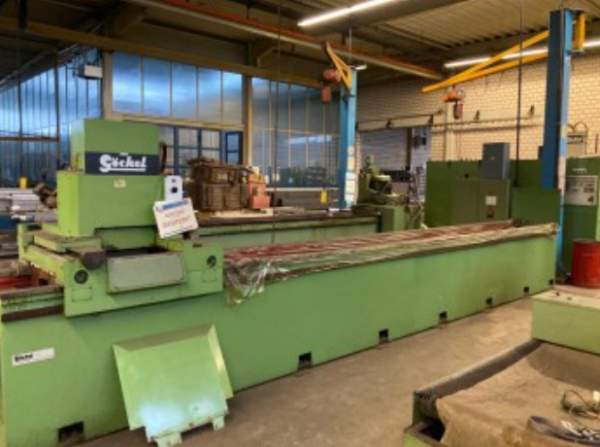
If you are considering buying a used Göckel U3 PI (or similar U3/PL) surface/long-table grinding machine, industrial experts advise doing a very detailed inspection. Göckel grinders are robust, but like any heavy-precision equipment, condition, alignment, maintenance, and spare-parts support make a big difference. Below is a comprehensive checklist of what to verify before purchase, plus known spec-values to compare against, and common red flags.
Known / Typical Specifications for Göckel U3 / U3 PI / U3 PL
Having these at hand helps you check what the machine should be capable of, so you can spot deviations.
| Parameter | Typical Spec for Göckel U3 / U3 PI / U3 PL |
|---|---|
| Maximum grinding length | ≈ 5,000 mm |
| Maximum grinding width | ≈ 300 mm |
| Grinding wheel diameter | ≈ 350 mm |
| Motor power | ~ 15 kW |
| Voltage / Electrical Supply | Often 380 V, 50 Hz (or matching local power) |
| Table size (grinding travel) | ~200 × 5000 mm in some listings |
These are baseline values. Any machine you inspect should be compared against these specs (or adjusted if different version/model).
What Experts Recommend Checking Before Purchase
Here is a detailed checklist of what to inspect, test, and verify, so you know the real condition and likely remaining useful life.
- General Machine History & Usage
- Ask for hours of operation or number of parts ground.
- What materials was it used for (hard/abrasive steel, carbide, etc.)? Harder materials accelerate wheel and table wear.
- Maintenance records: how often wheels dressed, coolant changed, lubrication done, way covers serviced.
- Structural / Mechanical Condition
- Bed, ways, cross-feed & longitudinal slide: Check for wear, scoring, flatness, straightness. Especially the long traverse (5m) can sag or warp over time.
- Grinding carriage: Are movements smooth (both in longitudinal and transverse directions)? Any binding or play?
- Wheel spindle / arbor assembly: Check for run-out (radial and axial), vibration, condition of bearings.
- Wheel guards / mounting shoulders: Are they intact, properly secured? Check for cracks or distortion.
- Grinding Wheel & Dressing System
- Inspect the grinding wheel itself: condition, wear, whether its full diameter is usable. If much of wheel diameter is lost, performance will suffer.
- Dressing mechanism: check that it works, is well aligned, that dressing wheels or dressers are still in good shape.
- Wheel balancing: make sure the wheel runs without excessive imbalance at grinding speeds.
- Table, Magnetic or Mechanical Chuck, Work Holding
- If the machine has a magnetic chuck or other holding device, test whether it holds uniformly across the full length and width.
- Check table flatness—if parts do not sit flat, problems arise in finish accuracy.
- Table drive motors (longitudinal feed, traverse) for smooth operation, accuracy, backlash.
- Electrical / Control Systems
- Condition of control panel, wiring, switches. Are all controls responsive? Are there error signals, worn buttons?
- Sensors, interlocks (door guards etc.). Safety features: make sure they are functioning.
- Ensure compatibility of voltage / phase / Hz with your factory supply. If modifications were made, check quality and safety of those modifications.
- Coolant / Lubrication Systems
- Coolant system condition: pump(s), piping, filtration, whether the coolant is contaminated or degraded. Poor coolant leads to poor surface finish and damaging heat.
- Lubrication of slides, ways, leadscrews: verify that oiling / greasing provisions are working and were used regularly.
- Check for leaks (hydraulic, coolant, oil).
- Accuracy, Flatness & Grind Performance
- Run test parts (if possible) of a size & material similar to what you’ll be processing. Check for flatness, surface finish, parallelism, dimensional precision.
- Measure table travel accuracy: does it meet specs over full length? Any lost motion or play, especially in long traverse?
- Check thermal stability: run machine for some time and see whether accuracy shifts as machine heats up.
- Wear-Parts & Spare Parts Availability
- Critical parts like spindle bearings, wheel arbors, dressers, way wipers, slides: are these still available new or second-hand? How expensive?
- Consumables: wheels, dressing wheels, filters, etc. Should factor into maintenance cost.
- Are there parts unique to Göckel U3 PI, or is this machine common enough that parts are interchangeable?
- Safety & Compliance
- Guards, shields, emergency stops, interlocks in place and working.
- Does the machine meet local electrical safety regulations (grounding, wiring, etc.)?
- Is coolant disposal / mist extraction handled properly? Is there ventilation / filtration for grinding dust?
- Operational / Economic Aspects
- Transport, installation: a large, long table machine needs special rigging, strong foundation, precision alignment.
- Floor space & utility demands: electrical capacity, coolant supply, drainage, floor loading.
- Cost to refurbish vs buying newer one. If many parts are worn, you may spend heavily on grinding wheel replacements, bearings, alignment, etc.
- Downtime risk: older machines may require more frequent maintenance; plan for spare parts lead time.
Red Flags & Common Weaknesses
Here are warning signs that often indicate deeper issues or costs:
- Table sag or bed twist over long length (for 5,000 mm travel); often hard to fully restore cheaply.
- Excessive play or backlash in slides or table feeds.
- Grinding spindle bearings worn; may produce vibration or poor finish.
- Dressing system broken, misaligned, or excessively worn.
- Coolant system neglected (rust, sludge, inadequate filtration) — leads to overheating, burns, poor surface quality.
- Electrical or control system parts obsolete or modified badly (affecting safety or reliability).
- No documentation/manuals; missing parts.
- Past accidents or damage (dropping a wheel, crash, etc.), which may have caused latent damage.