What Industry Experts Recommend Before Purchasing a Pre-Owned / Second-Hand / used AWR VBX-260 Automated CNC Loading and Unloading Robot Cell?
Here’s a detailed list of what industry experts recommend you check when evaluating a used/pre-owned AWR VBX-260 Load & Go automated CNC loading/unloading robot cell. These are derived partly from the published specs of that model and from general best practices for buying used robot automation cells.
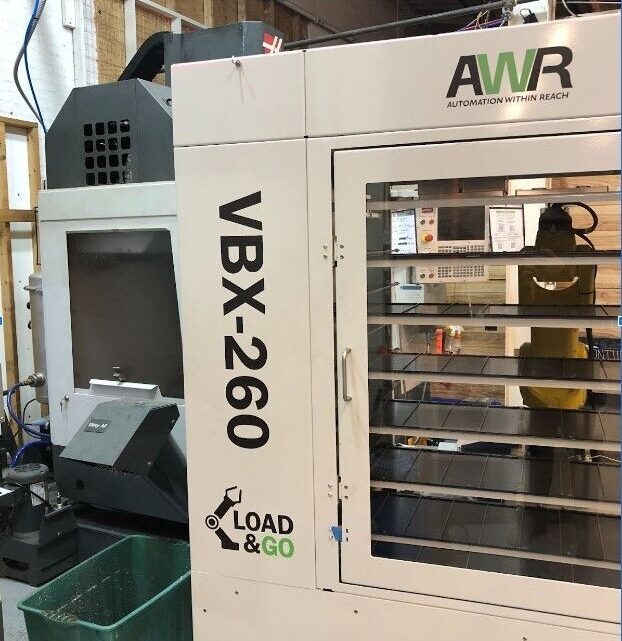
What is the AWR VBX-260 — Key Specs & Features
Before inspection, make sure you know what the VBX-260 is supposed to do. Some of its published specs and features are:
- Robot: 6-axis Fanuc LR Mate 200iD.
- Payload: 21.6 lb (≈ 9.8 kg) including the top jaws + the part.
- Horizontal reach: ~ 35.86 in (≈ 910.84 mm)
- Shelving: customizable shelves; can use 3, 4, 5, 6, or 8 parts per shelf.
- Part size capacity: maximum ~8-inch cube in many cases (“8″ cube max part size”) for the VBX-260.
- Comes with various jaw sets (top jaws + base jaws), calibration kit, vises, etc.
- Interface: “Easy VBX User Interface”, hand-held tablet connected to robot.
Knowing these gives you baseline expectations — what the system should be capable of, what capacity, what tooling should be included.
What to Inspect / Test Before Buying Used
Here are the expert-level criteria and tests to perform. Some are generic for robot/CNC cells; others specific to VBX-type machine tending systems.
| Area | What to Check / Questions to Ask | Why It Matters / What to Look for |
|---|---|---|
| Usage / Operational Hours & History | • How many operating hours has the VBX-260 done (not just powered hours). • What mix of parts / workloads (how heavy vs light, frequent change-overs, how many cycles per hour). • Was it idle for long periods or in harsh conditions (dust, coolant spray, heat, humidity)? • Maintenance history: e.g. has the robot been overhauled, calibrations done, shelves/wall wear, sensor replacements, controls software updates. | Heavy use or ill-maintenance leads to wear, drift, failures. Idle or poorly stored systems may have rust, seized parts, electronics degraded. Accurate data helps project future maintenance cost. |
| Robot Condition (Manipulator, Joints, Gearboxes, Motors) | • Check each axis for smooth movement, any backlash or loose joints. • Listen for weird sounds under motion (grinding, whining) especially in gearboxes or joints. • Check for oil or grease leaks in robot joints or reducers. • Check axis limits, whether homing is accurate. • Inspect cables, harnesses, connectors — especially those that flex with movement. • Check the end-of-arm tooling (jaws, grippers), and whether the MultiGrip top jaws/base jaws are still in good shape and align properly. | The robot is central: poor robot performance degrades speed, accuracy, parts quality, causes downtime. End-of-arm tooling wear can affect grip, repeatability. Replacement jaws may be expensive or custom. |
| Shelving / Part Storage System | • Inspect the shelves, racks: are they straight, undamaged, free of distortion / warping? • Check mechanisms for loading/unloading parts into shelves (slots) for smoothness, tolerances. • Check top shelf (reserved for OP10/OP20 jaws) and whether the jaws fit and seat as intended. • Inspect the calibration kit: is it included, in good condition, are brackets and locators still accurate. • Look for signs of collisions, abrasion, misalignment from past misuse. | If shelves or part locating system are worn or misaligned, parts may be damaged or mis-loaded; accuracy and cycle time will suffer. Calibration is key to repeatable positioning. |
| Interface, Controls & Software | • Does the “Easy VBX User Interface” still work correctly? Is the tablet controller functional, any missing/ broken buttons, displays or software glitches? • Are safety interlocks functioning: doors, guards, sensors. • Firmware/software version: is it up to date; are there vendor-supplied updates; are licenses valid. • Is the robot controller Fanuc LR Mate model well supported; are spare parts and software updates available. • Electrical panels: wiring condition, signal cables, I/O integrity. • Is there camera/live monitoring included; is it operational. • Are logs available (e.g. error history, cycle-to-cycle data). | Controls are what make usage feasible. Malfunctioning safety features are not just a risk but can prevent operation until fixed (or violate regulations). Software compatibility and support affect longevity. |
| Power, Pneumatic and Other Utilities | • What are the power requirements, is the supply in your facility adequate/stable? • Check pneumatic systems: compressors, air lines, regulators; any leaks; is air pressure and flow within specification (look for required PSI). • Check coolant or rinse systems if VBX has rinse/tank/drier; plumbing, cleanliness, pumps. • Examine whether there are other utilities: compressed air, vacuum, etc. • Check floor loading: weight of the VBX cell, needed space, foundations, anchoring. • Safety/guarding, floor plates, enclosures. | Without proper utilities, performance is compromised; retrofitting utilities or infrastructure can be expensive. Safety and regulatory compliance depend on power / guards etc. |
| Physical Condition & Mechanical Integrity | • Overall frame condition: no bent components, rust, distortion. • Robots’ base, mounts and alignment w.r.t the CNC machine it will tend. • Check structural joints, mounting points. • Inspect wear on mechanical parts: rails/guides, slides, trays, conveyor surfaces. • Inspect for damage from chips/dust/coolant – sometimes corrosion or abrasion under trays or in joints. • Inspect the jaws / vises mechanically (wear, alignment, flatness). | Mechanical misalignment or wear causes misloads, misdrives, less precise parts, more maintenance. Structural issues are hard to remediate. |
| Performance & Testing Under Load | • Run a full cycle with parts similar to what you’ll use: load, unload, throughput, changeover time. • Test the system under production speed: check for vibrations, timing issues, misfeeds, accuracy drift over multiple cycles. • Check repeatability: fix a reference part and check that its position is consistent cycle-to-cycle. • Test the jaws gripping, releasing, part orientation, part swing/drop if any. • Observe whether any delays happen in sensing/pick/place, whether sensors are clean and responsive. • Monitor robot motion for smoothness (no stuttering, sudden servo overshoot or lag). • Test safety interlocks live (doors, guards, emergency stop). • Watch for heat buildup in motors, joints after extended use. | Real operation may reveal issues invisible in a static inspection. Repeatability, reliability, speed, safety are all what actually matter in production. |
| Documentation, Spare Parts & Support | • Manuals: operator’s manual, parts manual, schematics for VBX-series and for the robot (Fanuc). • Maintenance records, vendor service reports. • Warranty or possibility of service contract with AWR or robot vendor. • Spare parts availability: jaws, vises, robot joints, sensors, tablet, electrical boards. • Check lead times and cost for consumables. • Is calibration / recalibration supported; does it require special tools. • Does the seller provide calibration kit and necessary tools. | Even a system in good shape will degrade; if you can’t get replacement parts or support, downtime and costs can eat up your savings. Good documentation reduces risk. |
| Safety and Regulatory / Compliance Issues | • All guarding, light curtains, doors, interlocks must be intact, functioning, compliant with applicable safety standards in your country. • Electrical safety certifications, wiring up to code. • Pneumatic safety (pressure safety, locking out, etc.). • Emergency stop accessible; robot speed limits; collision detection or safe speed mode. • Floor/space safety: whether the layout meets safety zones; whether robot swing envelope is safe. • Operator training (see if available). • Any risk of non-compliance (if you import it, customs safety, electrical voltage differences etc.). | Safety failures can lead not just to damage/injury, but regulatory fines, insurance problems, work stoppage. Also, retrofitting safety features can be expensive. |
| Cost & Total Cost of Ownership | • Purchase price vs. new/reconditioned alternative. • Shipping / installation / set-up costs (alignment with CNC, utilities). • Cost to repair or refurbish discovered issues. • Cost of consumables (jaws, vises, replacement jaws). • Downtime / integration time. • Operator/maintenance training costs. • Expected lifetime remaining; resale value. • Software licenses / firmware upgrades if needed. | Savings on purchase are only meaningful if post-purchase cost doesn’t become excessive. A cheaper unit that needs heavy repair may cost more in total. |
Specific Red Flags for VBX-260
Here are things particularly relevant to the VBX-260 model (based on its design/features & what multiple offerings mention):
- Missing or damaged jaw sets / vises / calibration kit: since these are essential for its “MultiGrip” workholding and custom part queues. If sets of top jaws or base jaws are damaged, misaligned, missing, you’ll lose flexibility or parts will be misloaded.
- Shelf / slot wear / misalignment: The VBX uses shelves and slots for holding jaws + parts. If these have wear or the slots are deformed, parts could be mispositioned, or loading/unloading could bind.
- Interface / Teach Pendant / Tablet Quality: Some VBX-260s advertise a hand-held tablet; check whether it’s included and fully functional. Also check whether the “Easy VBX UI” has glitches.
- Robot Reach and Payload Integrity: The capacity (21.6 lb) includes jaws + part; if you plan to run large/heavy parts, verify that the loaded jaws + part don’t exceed payload; check the robot’s ability to handle repeated cycles near its maximum reach without drift.
- Cleanliness and environment of past operation: if the system has been operated in a dirty/coolant/chips environment without proper guarding or regular cleaning, contamination may have damaged sensors, linear slides, pneumatic components.
- Software / Firmware Version & Licensing: Ensuring all licenses are valid; not missing parts of code; whether updates are needed or included.
- Safety system state: Doors, guards, interlocks are vital. VBX safety manuals show many safety warnings (for example VBX-160 manual) and interlock switches for doors etc. If any are missing or nonfunctional, the machine may not be safe or may require costly modifications.
Questions You Should Ask the Seller
Here are good questions to ask to uncover hidden issues or to ensure transparency:
- What is the total run-time (in cycles) and how many parts have been processed (especially at max payload)?
- Has the robot ever had axis replacement / gearbox repair / major joint tendon service?
- Is the original calibration kit included? When was it last used / calibration done?
- Are all the jaw sets, vises, top jaws, base jaws included? Are there replacements/ spares?
- What is the history of maintenance and software/firmware updates? Any recalls or known bugs?
- What was the environment (coolant, chips/dirt, humidity, temperature) in which the cell was operated?
- Are there any known defective sensors, interlock problems, electrical issues?
- What is included in the sale (software, teaching pendant / tablet, tooling, manuals)?
- What utilities does the cell currently use (power, air, coolant), and are all parts of those systems in working order?
- Can I witness a full operational test (your parts or similar) under load, through a full working cycle?
How to Use the “Offer / Negotiation” Angle
- Evaluate any wear or missing parts and get cost estimates to repair/replace; subtract these from your offer.
- Ask seller to include missing tooling / jaw sets / calibration kit as part of the deal, perhaps for a premium.
- Negotiate based on how many hours / cycles are left until major maintenance (e.g. robot joint overhaul, vises replacement).
- Document everything: any defects you find during inspection should be in writing/photos.