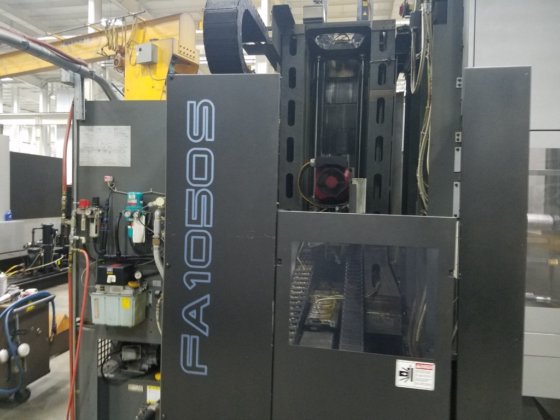
What Industry Experts Recommend Before Purchasing a Pre-Owned, Second-Hand, Surplus, Used Toyoda FA1050S CNC Horizontal Machining Center made in Japan
Typical Specs & Features to Use as Benchmarks
Here are published specs for the Toyoda FA1050S / FA1050 (5-axis / horizontal variant) to help you judge whether the candidate machine is within reasonable tolerance or has been modified:
- Pallet size: 41.3″ × 41.3″ (1,050 mm × 1,050 mm)
- Travels: X = 63″ (1,600 mm), Y = 55.1″ (1,400 mm), Z = 45.2″ (1,150 mm)
- Spindle: 6,000 RPM direct-drive as a standard (though options for 15,000 RPM are sometimes offered)
- Table / pallet load capacity: around 6,600 lb (3,000 kg)
- Rapid feed (X/Y/Z): ~944 ipm (≈ 24 m/min)
- Accuracy & repeatability: Linear position accuracy ±0.00012″ (±0.003 mm) full stroke, repeatability ±0.00008″ (±0.002 mm)
- Table index accuracy: rotary (1° indexing) with high precision (±3 arc seconds) for 4th axis / pallet indexing
- Machine structure: heavy box-way structure, robust column & bed, use of box guideways.
These numbers are what the manufacturer claims; a used machine may deviate. Use them as reference targets, not absolutes.
What Industry Experts Recommend You Verify (Before Purchase)
Below is a structured checklist (pre-screen, visual, functional, metrology, control, logistics, and contractual safeguards) adapted for this class of high-end, heavy, precision horizontal (or trunnion) machining center.
1. Pre-qualification / Screening
Before traveling to the machine, filter candidates to avoid waste of time:
- Documentation Request
Ask the seller for:
• Maintenance logs, repair / rebuild history, alignment & calibration certificates
• Original shop drawings, parts manuals, schematics, control parameter backups
• Spindle hour meter or cumulative running hours (if available)
• Control software / firmware versions, customization, modifications
• Photographs / videos of the machine in operation (spindle running, axis jogging, table indexing) - Verify Model & Serial Number
Obtain the serial number / build year and, if possible, check with Toyoda (or JTEKT) whether that machine’s build matches claimed specs. Sometimes machines are “Franken-rebuilt” from parts of multiple machines. - Support / Spare Parts Availability
Check whether critical parts (spindle bearings, servo modules, ball screws, guideways, pallet indexing drives, control modules) are still available or can be sourced.
Check for local or regional service / reconditioning firms familiar with Toyoda / JTEKT machines. - Suitability for Your Production Needs
Ensure that the machine’s spindle speed, torque, table load, axis travels, throughput, and tool change capacity match your part geometry, materials, and cycle-time demands.
If the seller’s machine has non-standard configuration (e.g. non-standard spindle, aftermarket modifications), check whether these changes are acceptable to you. - Red Flag Filter
If the seller refuses to provide documentation, refuses video, or does not allow inspection or metrology, treat with high suspicion.
2. Visual / Walkaround / Structural Inspection (Before Power-Up)
A careful visual inspection often reveals signs of abuse, neglect, or major wear. Key items:
- Machine Frame, Base & Structure
Look for cracks, weld repairs, patches, distortions in the bed, column, gantry, or support structure.
Check for sag, bending, misalignment, or inconsistent paint covering that hides flaws. - Way Covers, Guards, Enclosures
Check whether way covers, sheetmetal guards, enclosure doors, chip guards exist and are not damaged or missing. Missing covers often indicate prior neglect.
Inspect for misalignment or broken linkages in covers. - Guideways / Linear Slides / Box Ways
Inspect slide surfaces, box way surfaces, guide surfaces for scoring, pitting, corrosion, gouges, or uneven wear.
Examine lubrication wipers, seals, covers, and check whether coolant or chips may have infiltrated the guides.
Check for uniform wear; severe localized wear is a red flag. - Ball Screws / Nuts / Couplings
Inspect ball screws and nuts (for the X-, Y-, Z-axes) for signs of wear, backlash, dust ingress, or lubrication issues.
Check coupling alignment, housing condition, end support, and whether coupling flanges are polished or damaged. - Pallet / Table & Indexing System
Inspect the pallet surfaces, fixture interface (e.g. T-slots, locating pins), flatness, wear marks.
Check the indexing drive (servo or hydraulic) for signs of wear, backlash, play, or leakage.
Examine the rotary bearings or indexing mechanisms for signs of damage, excessive backlash or wear. - Spindle & Spindle Housing
Inspect spindle nose, taper, mounting surfaces, bearing housings, seals, lubrication inlets/outlets.
Check for discoloration (heat), corrosion, scuffs or deformation.
At visible portions, examine whether bearings have been replaced, or modifications applied. - Tool Magazine & Tool Changer
Check the magazine carousel or chain (if present) for damage, wear, loose parts, or misalignment.
Inspect tool pockets, drawbars, clamping mechanisms, and any actuation systems for integrity. - Cooling / Lubrication / Fluid Systems
Inspect coolant tanks, pumps, piping, hoses, filters, valves, and flow paths.
Look for leaks, corrosion, sludge buildup, contamination, or blockages.
Check the lubrication / oil systems for ball screws, slides, spindle, and check lines, fittings, and cleanliness. - Electrical / Wiring (Pre-Power)
Visually inspect wiring, conduit, cable carriers, drag chains, connectors for wear, insulation brittleness, splices or non-original wiring.
Check for signs of overheating (discoloration, melted insulation) or moisture ingress.
Check electrical enclosures for cleanliness, accessibility, and water / chip ingress protection. - General “Tone” of Maintenance
A machine that is clean, well-cared-for, with intact covers and good housekeeping is more promising.
Excess oil leaks, worn paint, patched parts, missing guards, signs of patch repairs all raise red flags.
If you spot structural damage (cracks, deformations) or severe wear, factor repair cost heavily or walk away.
3. Power-Up & Functional / Motion Testing (No Load / Light Load)
After the visual pass, proceed with careful functional verification. Always use proper safety measures, and bring your own technical expert if possible.
- Power-Up Diagnostics & Control Initialization
Power the machine incrementally, watch for abnormal current draw, voltage dips, or errors.
Check the CNC / control diagnostics, error logs, runtime hours, alarms or warnings.
Test homing / referencing sequences, limit / overtravel switches, safety interlocks, E-stop circuits. - Axis Jog / Manual Movement Tests
Move the X, Y, Z axes slowly across full travel; observe for smoothness, binding, stick-slip, notches, and consistency.
Reverse direction, check for backlash or hysteresis.
Return to zero multiple times to check repeatability and drift. - Pallet / Table Indexing / Rotary Motion Test
Command pallet indexing or table rotation (if applicable) through multiple cycles; check for smooth motion, accuracy, backlash, vibration, or binding.
Cycle back to home position and verify return accuracy. - Spindle Run-Up / No-Load Rotation
Run the spindle from low to high speeds; monitor for abnormal noise, vibration, heating, or irregular behavior.
If the spindle has multiple speed ranges (direct-drive, gear-drive, or high-speed option), test across all regimes.
Check for smooth acceleration and deceleration, look for any fluctuations, bearing hum or irregular vibration. - Tool Change & Magazine Cycling
Cycle tools in and out of the magazine; monitor for proper indexing, mechanical smoothness, clamping / unclamping reliability, and any mis-seating or jamming. - Coolant & Fluid System Tests
Activate coolant pumps, check for stable flow, pressure, leaks, or cavitation.
Observe coolant delivery to cutting zone, ensure hoses and nozzles are intact. - Light “Soft” Test Cut / Simulated Operation (if permitted)
If allowed, mount a soft test block (e.g. aluminum or mild steel) and run a light cut pass (low depth / low feed).
Observe vibration, stability, chatter, surface finish, machine response.
After stop / restart, check whether spatial reference or zero points have shifted. - Thermal / Warm-Up Drift Test
Run idle or low-motion cycles for a period (30–60 minutes) to allow thermal settling.
Check whether position references, repeatability, or motion behavior drift under heat. - Safety & Fault Tests
Test E-stop, overtravel, limit switch behavior, safety interlocks, cover doors.
(Under safe conditions) simulate limit override or fault conditions to verify safe behavior.
If the machine exhibits weird noises, drift, vibration, or control errors, quantify repair cost or escalate negotiation.
4. Metrology, Alignment & Precision Verification
Because your production tolerances depend heavily on the machine’s actual geometric fidelity, you must validate alignment, repeatability and precision.
- Baseline Geometric Checks
Use precision instruments (dial indicators, laser interferometer, autocollimators, granite reference surfaces) to check:
• Straightness and flatness of slides across travel
• Perpendicularity / squareness of axes
• Parallelism of spindle axis to table axes
• Table flatness, pallet surface flatness, and locating surface condition
• Runout of spindle (radial & axial) if measurable
• Rotary / indexing table accuracy if applicable - Repeatability / Positional Accuracy Tests
Move to a reference position repeatedly and measure deviation.
Move to multiple offsets and back; check whether the machine always returns to the same point (hysteresis, backlash).
Check whether the machine drifts or shifts over cyclic returns. - Test Part / Sample Machining Validation
If the seller allows, run a representative part or standard test geometry and measure resulting parts: surface finish, dimensional accuracy, positional deviation, over multiple cycles.
Check whether performance is stable over multiple parts (consistency). - Error Mapping & Compensation Capability
Determine whether the control supports error compensation (backlash compensation, linear scale compensation, thermal compensation) and whether compensation tables have been maintained or tampered with.
Check whether those compensation parameters are accessible / editable. - Cross-Check Seller’s Calibration / Alignment Records
If the seller has alignment / calibration certificates, compare your own measurements to theirs.
Large discrepancies may suggest that their records are not trustworthy or that the machine has degraded since.
If the machine cannot be adjusted (via compensation or refurbishment) to meet your tolerance requirements within your acceptable cost, its value is severely compromised.
5. Control, Electronics & Software Inspection
It is not enough for the machine to look mechanically sound — the control system, electronics, feedback, and drives must also be in good shape.
- Control Cabinet & Component Health
Open the control / electrical cabinets; inspect for dust, coolant ingress, corrosion, burn marks, or signs of overheating.
Check fan operation, filters, ventilation, and cleanliness inside racks. - Servo Drives, Amplifiers, Motors
Check fault logs or error codes in drive systems.
Power up axes and monitor current, responsiveness, torque, and stability.
Check whether any drive modules are disabled or in error state. - Encoder / Scale Feedback Systems
Inspect encoder cables, shielding integrity, connectors, and routing.
Check signal continuity where possible or inspect diagnostic feedback signal quality.
Ensure feedback signals aren’t noisy or intermittent. - HMI, Parameter Access, Control Software
Test operator interface (HMI): menus, parameter screens, diagnostics, offsets, editing rights.
Confirm you can access compensation tables, backup / save / restore, and parameter memories.
Try uploading / downloading NC programs, verifying memory integrity, and backing up the control. - Network / Remote Diagnostics / Connectivity
If the machine offers Ethernet, DNC, remote diagnostics, or network integration, verify that all these connections are functioning.
Check for required license keys, memory modules, and whether any custom modifications exist. - Safety / Fault Interlock & Protection Systems
Test safety interlocks, light curtains, guard doors, overtravel detection.
Check built-in fault detection (temperature, vibration, overload) and verify that fault logic is intact and functional. - Wiring, Cable Routing, Drag Chains
Inspect wiring runs, particularly around moving axes. Look for abrasion, worn or frayed insulation, spliced connectors.
Check cable carriers / drag chains — broken links, binding, misalignment, or stress positions.
If the electronics or control is partially defective, missing, or obsolete beyond repair, the machine may not be salvageable at a reasonable cost.
6. Logistics, Installation & Commissioning
Even a mechanically perfect machine can run into serious issues in transport, reinstallation, and setup. Plan carefully.
- Disassembly & Lifting Evaluation
Check that lifting points, eyebolts, structural supports, and brackets are intact and rated.
Assess whether heavy subassemblies (spindle head, columns, table) can be removed or shipped safely.
Consider that internal alignment may be disturbed during disassembly. - Transport Risks & Packaging
Plan for shock and vibration protection, securing of moving parts, bracing of table, spindle, axes, and guarding.
Insure the machine during transport; define risk in contract. - Foundation, Leveling & Anchoring
Ensure your shop floor can support the machine’s weight, and that proper rigid foundation, anchoring, and vibration isolation are possible.
Leveling, shimming, and base alignment are critical for precision machines. - Utilities & Environmental Readiness
Verify that power (voltage, phase, capacity), cooling, compressed air, chip removal, exhaust, and ventilation are adequate.
Ensure your facility environment (temperature stability, humidity) is compatible with achieving precision. - Final Alignment, Calibration & Warm-Up Period
Allow time for precise alignment, geometry calibration, warm-up cycles, compensation adjustments, and test runs.
Bring your metrology tools, reference pieces, and technicians. - Acceptance Runs & Test Part Commissioning
Before accepting the machine, run production-equivalent parts (using your tooling, feeds/speeds, full-depth cuts) and verify the output meets tolerance, repeatability, finish, and cycle-time expectations. - Spare Parts & Consumables On-Hand
Order or bring critical spares (bearings, seals, fuses, sensors, coupling parts, lubricants) in advance to reduce downtime risks. - Insurance & Liability Clauses
Ensure the machine is insured during transport, installation, and until final acceptance.
Clearly allocate liability for damage in transit or reassembly. - Buffer & Contingency Time
Always expect surprises — plan schedule buffers for repair, alignment, debugging, or minor damage.
7. Contractual Safeguards & Purchase Terms
To protect yourself, structure your purchase contract with strong clauses:
- Inspection / Acceptance Clause
Make the purchase conditional upon full inspection, metrology verification, operational testing, and your approval.
Include the right to retract or renegotiate if defects are uncovered. - Performance / Test Part Guarantee
Require the seller to allow or perform a full production test run (with your tooling or representative sample) to confirm that tolerances, stability, cycle times, and repeatability are met.
Define clear acceptance criteria (e.g. dimensional tolerances, surface finish, consistency over multiple parts). - Warranty / Limited Liability Period
Negotiate a limited warranty (e.g. 90 days, 6 months) covering major subsystems (spindle bearings, drives, slides, pallet indexing).
Define liability for latent defects discovered after commissioning. - Inclusion of Documentation / Spare Parts / Tooling
Require all original manuals, drawings, wiring diagrams, backup parameter files, and any spare parts or consumables be transferred.
Ask the seller to include critical spare modules or parts (bearings, sensors, drive modules) as part of the sale. - Payment Tied to Milestones / Acceptance
Don’t pay full amount upfront. Hold back a portion until successful installation, alignment, calibration, and test-run acceptance. - Transport & Reassembly Risk Allocation
Clearly state who is responsible (and insures) disassembly, transport, reassembly, and damage until final acceptance.
The seller (or carrier) should accept liability for transit damage. - Title, Liens & Ownership Warranty
Require certified clear title, guarantee no liens, and that the seller has the legal right to transfer machine ownership. - Support / Startup / Training Commitment
If possible, include a period of start-up support, training, or remote/onsite technical assistance post-commissioning. - Disclosure of Known Defects / Conditions
Require the seller to disclose all known defects, prior repairs, modifications, or crashes in writing.
Ensure the machine is delivered in the same condition as inspected (not cosmetically “freshened up” internally degraded). - Escrow / Retention Clause
Hold a portion of payment in escrow or retention until final acceptance and performance verification.
8. Red-Flag Warning Signs & Risk Indicators
During inspection, these warning signs should make you pause or walk away:
- Structural cracks, weld repairs, or evidence of frame damage or bending
- Severe wear, scoring, pitting, or damage to guideways, box ways, slides
- Excessive backlash, slop, drift, or hysteresis in axes motion
- Unusual noises, vibration, instability during spindle run-up or axis motion
- Spindle bearing hum, erratic vibration or heating under no load
- Pallet / indexing drive wear, backlash, play, or missing components
- Control or drive modules missing, malfunctioning or obsolete with no replacement path
- Encoder feedback issues, intermittent signals, or sensor failures
- Electrical cabinets with water damage, corrosion, messy wiring, or missing modules
- Coolant / lubrication systems clogged, corroded, or non-functional
- Tool magazine or changer malfunctioning, misalignment, tool sticking
- Cosmetic refurbishment (fresh paint) that hides internal neglect
- Seller refusal to permit full functional test, metrology verification or third-party inspection
- Hidden, hard-to-repair modifications or non-factory components
- Excess transport / installation risk (fragile parts, poorly supported structures, weak lifting points)
If a candidate machine shows multiple red flags, your risk is high. Proceed only if the price reflects the repair risk and you have budgeted for refurbishment.