12/10/2025
What Industry Experts Recommend Before Purchasing a Pre-Owned, Second-Hand, Surplus, Used Leadwell V-32i CNC Vertical Machining Center made in Taiwan
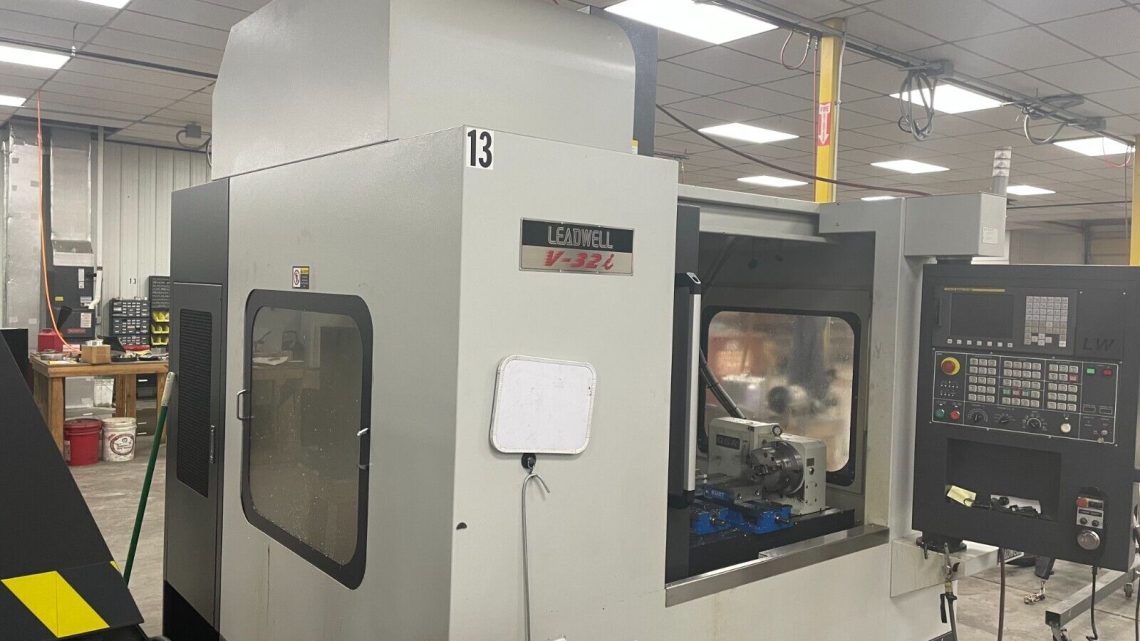
Context / Typical Specs & Baselines
It helps to know what a “healthy” V-32i should look like. These benchmarks let you spot deviations that suggest hidden wear or modification:
- According to listings, the Leadwell V-32i has X = 800 mm, Y = 520 mm, Z = 610 mm travels.
- Table area ~ 890 × 500 mm (L × W), with a max table load ~ 500 kg.
- Spindle: typically 12,000 rpm, taper #40, motor ~ 11 kW.
- Tool magazine: ~ 24 positions.
- Rapid traverse speeds: often 36 m/min in X/Y/Z (≈ 1417 ipm) in used listings.
- Machine weight: ~ 4,700 kg in one listing.
Use these as rough “expected ranges.” Deviations beyond ±10–20 % (for parameters like speed, motor power, travel) should trigger deeper scrutiny.
What Experts Recommend You Check (Before Purchase)
Below is a structured roadmap:
| Domain | Key Checks / Tests | What to Watch For / Red Flags |
|---|---|---|
| Pre-Visit / Screening | • Ask for service logs, rebuild history, alignment / calibration certificates, electrical schematics, backups, control parameter archives. • Ask for photos / video of the machine running (spindle idle, axis jogging, tool change) from multiple angles. • Get the serial number & build year; see if you can trace it back to Leadwell / Taiwan support. • Ask which control (Fanuc, Siemens, Mitsubishi, etc.), and whether any modifications or retrofits have been applied. • Check whether critical spares (spindle bearings, linear guides, ballscrews, control modules, tool magazine parts) are still available locally or regionally. | If seller refuses to produce documentation, disallows control access, or cannot show the machine running, treat as risk. If the control or electronics are heavily customized or modified, you may lose support. |
| Visual / Mechanical / Structural Inspection (pre-power) | • Frame / base / column: examine for cracks, weld repairs, deformations, misalignments. • Way covers, mudguards, enclosures: check for missing parts, damage, signs of abuse. • Linear guides / rails / box ways: inspect for scoring, rust, pitting, chip intrusion. • Ballscrews, nuts, couplings: look for backlash, wear, contamination. • Spindle nose, taper, housing: check for fretting, discoloration, damage. • Tool magazine / ATC: inspect magazine carousel, tool pockets, drive mechanisms, whether tools seat cleanly. • Coolant / lubrication / fluid systems: check tanks, pumps, hoses, filters, signs of leaks, contamination, sludge. • Wiring harness / cable carriers / drag chains: look for worn insulation, splices, damaged wiring. • Guards / interlocks / safety covers: ensure that all safety hardware is intact and properly fitted. | Hidden welds, uneven paint (concealing cracks), missing covers, rust in guideways, sloppy wiring, and signs of coolant leaks into slideways are strong red flags. If the machine has been “cosmetically” refreshed (fresh paint, new decals) but internal components look neglected, that’s a warning. |
| Power-Up & Functional Tests (light / no-load) | Before doing any heavy cutting: • Power up gradually, monitor voltage, current spikes, and check control diagnostics, error logs. • Test limit switches, homing / referencing, interlocks, E-stop functionality. • Jog each axis slowly through full travel; observe smoothness, binding, stick-slip, and any resistance. • Reverse direction; feel or measure backlash / hysteresis. • Run the spindle (no load) across its RPM range (low → high → low), listen for unusual noises or vibration. • Cycle the tool changer / magazine, insert and extract tools, verify seating accuracy. • Run coolant pumps, checking flow, pressure, hose leakages. • If allowed, perform a dummy / “soft” cut (low depth, low feed) to sense vibrational behavior or instability. • Warm-up drift test: run idle or small motion for 30–60 min, then re-check reference positions for drift. • Safety / overtravel tests: simulate limit conditions, test E-stop behavior. | If you hear grinding, scraping, or abnormal resonances in slides or spindle, that’s a red flag. Sloppy or inconsistent axis motion, jumps, “notches,” or drift in returning to zero points suggest wear or servo issues. Tool changer faults (mis-indexing, jamming) are common in used machines and costly to fix. |
| Metrology / Alignment & Accuracy | • Use precision measurement tools (dial indicators, granite surface, laser interferometer) to check: – Straightness / flatness of slides / axes – Squareness of X / Y axes – Parallelism of spindle axis to table axes – Spindle runout radial & axial (if accessible) – Table flatness and repeatability of table positioning • Cycle to a reference point multiple times; measure repeatability / drift. • If possible, machine a reference block / test part and measure final dimensions / surface finish / tolerances. • Cross-check seller’s alignment / calibration certificates (if provided) with your own measurements. • Determine whether the control can accept or has compensation tables (backlash compensation, scale compensation, thermal drift) and whether those are editable. | If geometric error exceeds your tolerance budget, you may need costly rework (scraping, realignment, parts replacement). If the compensation capacity is exhausted or locked, the machine may never reach your target performance. |
| Control / Electronics / Drives | • Open control / electrical cabinets: check for dust, coolant ingress, burnt wiring, corrosion. • Examine servo drives / amplifiers, inspect fault logs, test drive modules for responsiveness. • Check encoders, feedback cables, shielding, connectors for cleanliness and continuity. • Test the HMI / parameter screens: verify parameter editing, backups, offset tables, data logging, diagnostics. • Try program upload / download, backup / restore functions if possible. • Test communications / network links (Ethernet, DNC) if available. • Test safety circuits / interlocks, limit overrun detection. • Inspect cable routing, drag chains for damage, wear, or tight binding. | Defective or obsolete drive modules, intermittent encoder feedback, or locks in the control software can render the machine useless. Non-standard hacks or “black-box” modifications by prior users are risky. If spare parts for control electronics are no longer available or extremely costly, your risk climbs. |
| Logistics, Installation & Commissioning | • Examine lifting / mounting points, structural rigidity, and whether heavy modules can be safely removed or shipped. • Assess floor / foundation requirements at your site (weight, anchoring, vibration isolation). • Ensure your facility can supply required power (voltage, phase, current), clean supply, grounding. • Confirm coolant, chip handling (conveyor), filtration, drainage, and HVAC readiness. • Plan for alignment, shimming, leveling, calibration, warm-up, reference setting. • Expect some break-in period and test cycle runs before production. • Bring with you metrology tools, spare critical parts (filters, seals, fuses) to reduce downtime risk. | Damage during transport, misalignment at installation, or neglect of foundation leveling are common cost traps. If the machine doesn’t fit doors or has awkward dimensions, transport becomes tricky and expensive. |
| Contractual Safeguards & Purchase Terms | • Make the contract conditional on full inspection, test runs, alignment verification, and the right to reject. • Define a performance / test part guarantee (use your representative parts) with agreed acceptance criteria (dimensional tolerance, repeatability, surface finish). • Include a limited warranty (e.g. 90 days) covering critical components (spindle, slides, drives). • Require transfer of all documentation, electrical / hydraulic / lubrication schematics, calibration records, and spare parts if available. • Tie payments to milestones (e.g. delivery, installation, acceptance). • Insure the machine in transit; clearly assign risk for disassembly, reassembly, and damage until final acceptance. • Ensure clean title, no liens, legal transfer of ownership. • If possible, negotiate support or start-up aid from seller or prior operator. • Secure a holdback / escrow of part of purchase price until acceptance. | Beware “as-is” clauses that waive your right to claims. Sellers resisting inspection or test runs often hide issues. Without performance guarantees or acceptance thresholds, you’re exposed. |
| Red-Flag Indicators | • Missing or inconsistent maintenance records. • Fresh paint / overhaul externally but worn internals. • Cracks, weld repairs, or structural distortion. • Severe scoring, corrosion, or damage on ways, guides or slides. • Excessive backlash, hysteresis, drift, or noisy motion. • Tool changer or magazine mis-indexing, jamming, or mechanical slop. • Spindle bearing noise, vibration, or overheating. • Control errors, drive faults, missing or custom electronics with no support. • Encoder or feedback signal instability. • Coolant infiltration of slides or wiring, leaks into enclosure. • Seller refusing metrology, test runs, or third-party inspection. • Obsolete parts, long lead times, or no local support for control / drive modules. | Multiple red flags should lead you to withdraw or negotiate steep discounts plus repair contingency reserves. At worst, the machine becomes a liability. |
Special Notes & Pitfalls for Leadwell / Taiwanese Machines
- Guideway / way cover corrosion / chip ingress is a known issue in machines used in “dirty” environments. Taiwanese machines may have used lower cost sealing or way wipers; you should inspect those closely.
- Tool changer / magazine reliability: the 24-tool carousel and its motor / indexing systems are often a weak point in used machines. Mis-indexing, binding, or wear in pockets is not uncommon.
- Control / retrofit modifications: Many users retrofit older Leadwells with newer controls or drives, which may introduce non-standard wiring, custom boards, or mismatches. Make sure those modifications are documented.
- Spindle / bearing replacement cost may be significant. If spindle bearings are gone, replacement or reconditioning can be more expensive than the savings you made buying used.
- Compensation tables / limits used up: If the machine was heavily “tuned” in prior life, the compensation ranges (for error / backlash) may be exhausted and no longer extendable.
- Electrical / power supply compatibility: ensure that local power (voltage, phase) matches the machine or that you can feasibly adapt.