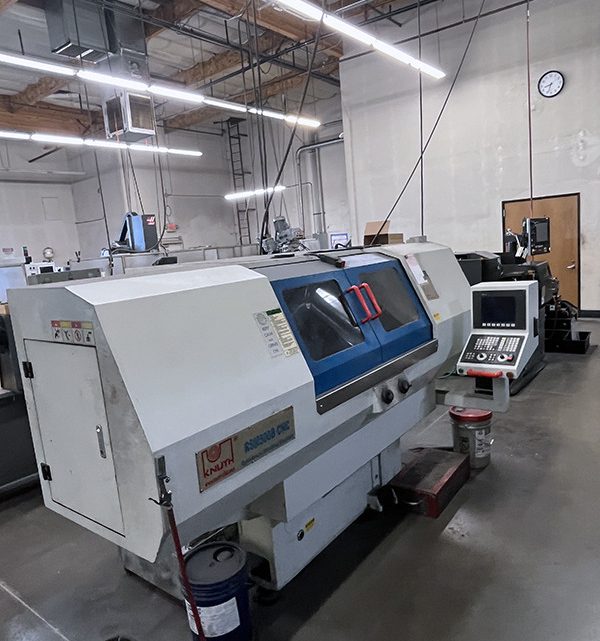
What Industry Experts Recommend Before Purchasing a Pre-Owned, Second-Hand, Surplus, Used Knuth RSMB500 Grinding Machine made in Germany
If you’re evaluating a used / surplus Knuth RSMB500 (or equivalent cylindrical / surface grinding machine made by Knuth, Germany / Europe), here’s a deep, expert-level checklist and recommendation set that experienced machine tool buyers, refurbishers, and precision shops typically rely on. Use this to assess condition, risk, and negotiating leverage.
Background & Machine Spec Context
Before you inspect, it helps to know what the machine represents and what common problem areas exist for grinders.
- The Knuth RSMB500 is a cylindrical grinder model (or variant) with modest size (e.g. ~5 ” center height, ~22 ” length capacity) in many listings.
- Typical features include: hydraulic / infinitely variable feed, rigid cast frame, high-precision guideways, internal and external grinding capability, possibly swivel or headstock features.
- Because grinding demands extremely fine tolerances, small deviations in wear, alignment, vibration, or thermal behavior can ruin a machine’s utility.
- Spindle bearings, table ways, headstock alignment, vibration damping, and rigidity are among the most critical subsystems to inspect.
Given that, here is what industry experts (and experienced shop owners) typically recommend before buying.
Expert Checklist & Recommendations for Evaluating a Used Knuth RSMB500 (or similar)
Below is a structured evaluation framework, with the major points to check, risks to watch for, and tips for how to measure or test. Ideally bring a metrology technician or grinding specialist with you.
| Stage | What to Check / Test | Why It Matters / Risk | How to Do It / Acceptable Indications |
|---|---|---|---|
| Pre-visit / Documentation | • Request machine serial number, year, build documentation • Ask for maintenance / service logs (bearing replacements, spindle overhauls, way regrinds) • Request photos / video of machine in operation (spindle running, axes moving) • Ask for tooling and accessories: arbors, centers, chucks, dressers, balancing mandrels • Ask about previous usage (light duty, production, intermittent) • Verify power, coolant, auxiliary systems included | Helps you calibrate expectations (how much wear is “reasonable”), and spot discrepancies between what you see and what was claimed | Use the machine spec sheets (e.g. from Knuth) as baseline to compare what the seller claims vs actual. |
| Visual & Structural Inspection | • Examine the cast base, column, saddle, headstock, bed for cracks, repairs, welds, distortions • Look for corrosion, pitting, coolant / chip damage, especially in corners or recesses • Inspect way covers, guards, bellows, and protective covers for damage or missing parts • Inspect table (or spindle slide ways) for visible wear, surface marks, scoring • Inspect headstock exterior, spindle nose, taper, seals, coolant leaks | Structural defects or cracks compromise rigidity and will impact accuracy severely Missing guards or way covers expose internal components to abuse | Use bright lighting, mirror, borescope if needed; take photographs of suspect areas |
| Guideways / Sliding Surfaces | • Run the table (or traverse axes) manually / slowly and feel for nonuniform motion, sticky spots, jumps, binding • Use a precision level or straightedge with feeler gauges to check flatness and straightness of the ways over the travel. One machinist suggested using a sensitive level (0.0005″/10) over blocks to detect bending or uneven wear. • Check transitions between segments of the ways (end zones) where wear is often greatest • On reciprocating tables, see if there is ripple or high-frequency vibration (gear or rack wear) • If the machine has linear rails or box / V-ways, look for pits, galling, wear marks | Wear or nonflatness on ways is among the most serious defects for grinders — it limits the ability to hold flatness, introduces graduation errors, and may necessitate costly regrinding or full re-scraping | Use a granite flat and test indicators; move slowly and monitor indicator readings; compare repeat traversals |
| Spindle & Bearings | • Run the spindle at low, medium, and (if safe) high speeds and listen / feel for abnormal noise, runout, vibration • Check for radial and axial play (using a test bar or dial indicator) • After running, feel whether the spindle housing warms excessively (warm is okay, hot is a red flag) • Inspect taper, nose, threads, mount surfaces for damage • Inspect seal areas, coolant-facing surfaces for leaks or carryover | Bad bearings or worn spindle geometry can destroy grinding quality and are expensive to repair | Use a test bar or hardened ground bar; sweep a dial indicator; rotate the spindle (if possible) by hand and check endplay |
| Feed / Drive / Mechanism Tests | • Jog or feed the axes (X, Z, etc.) slowly/continuously, in both directions, and detect jerks, stiction, backlash, lost motion • Command small back-and-forth moves to quantify backlash • Run speed at different feed rates and see if the behavior is uniform (no sudden speed-related issues) • If hydraulic or mechanical feed is present, test responsiveness and consistency • If the machine has a power traverse or automatic feed, test that system too | Inaccurate or jerky feed / drive systems degrade surface finish, introduce chatter, missteps | Use a dial indicator on the table or slide, command known displacements, check actual travel vs commanded |
| Control, CNC / Electronics & Wiring | • Power up the control (if allowed) and check whether it boots cleanly, no alarms • Test operator interface, buttons, jog keys, displays • Browse menus, offsets, compensation tables, calibration routines • Check whether software / control is current / supported; ask about spare part availability • Inspect wiring, cabinets, servo drives / amplifiers: look for burnt wires, overheated terminals, missing covers • Verify cable routing (shielded cables, no chafing) | Even if mechanical condition is good, a failing or unsupported control can render the machine useless Poor wiring or overheating parts lead to future failures | Ask for electrical/drawing diagrams; inspect condition of PCBs, power modules, connectors |
| Coolant, Lubrication & Auxiliaries | • Check coolant system: pump, tank, piping, leaks, contamination, filter condition • Inspect lubrication systems or greasing lines for moving parts • Test any coolant-through or internal coolant if the grinder supports it • Inspect chip removal, coolant splash guards, drains, filters • Inspect hydraulic / pneumatic circuits (if present) for leaks, stale oil, or poor condition | Poor coolant or lubrication condition shortens life of bearings, screws, and ways; leaks indicate neglected maintenance | Run coolant pump, see whether flow, pressure, temperature are stable; inspect oil cleanliness |
| Safety & Guards | • Test emergency stops and safety interlocks (doors, access panels) • Verify that limit switches or soft/hard travel limits operate and stop motion properly • Check protective guards, splash shields, safety doors, and that no critical safety items are missing or bypassed | Safety is nonnegotiable — lack of proper guards or disabled interlocks is a deal-breaker | Open doors while in idle (if safe) and see whether motion is inhibited, test E-stop during idle motion |
| Test Grinding / Trial Run | • Bring a known test workpiece (representative material) and perform a grinding run (face, OD/ID, etc.) • After grinding, measure flatness, parallelism, surface finish, and other geometry (e.g. concentricity) • Run multiple passes and check repeatability and drift • At different locations along travel (beginning, mid, end) check consistency of results • Monitor for chatter, vibration, thermal drift, or deviations under load | Many defects (vibration, misalignment, instability) only show under real load — a dry motion check is not sufficient | Use calibrated measurement tools (surface plates, dial gauges, finish meters), run multiple cycles |
| Metrology & Geometric Checks | • Check straightness, flatness, and squareness of axes using precision instruments • Check table / chuck flatness, run-out • Check angular alignment of headstock to wheel axis • Check backlash or lost motion quantitatively • After warm-up, repeat key measurements to detect thermal drift | These tests yield quantified error data you can compare against your tolerance needs | Carry a test bar, calibrated surfaces, gauges, laser tools (if available) |
| Risk Assessment & Cost Estimation | • Capture all observed defects and their estimated repair cost • Investigate spare part availability (especially for controls, drives, spindles) • Assess how much refurbishment (alignment, scraping, regrinding) would be needed to return machine to acceptable precision • Add contingency budget for unknown surprises • Negotiate discount based on defects (not a fixed % “used” discount) • Insist on some acceptance period or warranty on critical systems (bearings, spindle) if possible | Even a good-looking grinder may require heavy rework — you need to know what risk you are taking | Prepare a “punch list” of issues and use that in negotiations |
| Documentation & Title Transfer | • Ensure you receive electrical / wiring diagrams, control manuals, maintenance logs • Verify machine identity (serial plate) matches documentation • Check that any included tooling, accessories, spare parts are all transferred • Have a signed purchase agreement clarifying condition, warranty, acceptance terms | Without proper documentation, repairs, servicing, or retrofits become much harder | Ask seller to provide all original manuals, drawings, schematics; verify transfer of all items |
Specific Tips / Insights from Grinders & Machinist Community
- Some machinists emphasize checking whether the machine was used predominantly for light bench work (which tends to preserve condition) vs heavy production grinding (which imposes more wear).
- In grinder purchase threads, people often advise: “aside from spindle bearings, you want to make sure the ways don’t have wear on them and make sure there aren’t hydraulic leaks.”
- It’s common practice to grind a known flat plate (both faces) and then check for thickness variation or curvature to reveal underlying way or table problems.
- Many used-grinding buyers recommend bringing your own precision level (sensitivity ~0.0005″ or better) and feeler blocks for level / way testing.
- Don’t overly trust “hours run” or “motive hours” figures — often the actual cutting hours or intensity of use matter more than cumulative time.
- Pay close attention during test cuts to chatter frequencies or subtle vibrations, which may mean imbalance, poor damping, or degradation in the spindle or bearings.