12/10/2025
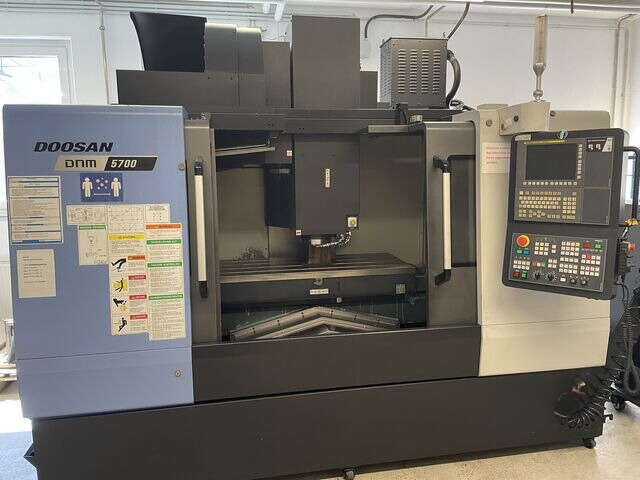
What Industry Experts Recommend Before Purchasing a Pre-Owned, Second-Hand, Surplus, Used DOOSAN DNM 5700 CNC Vertical Machining Center made in South Korea
Typical Specs / Benchmark for the Doosan DNM 5700
These are typical or published specs of the DNM 5700 platform (especially 4th generation or later) — use as comparison targets, not rigid thresholds:
- Travels: X ≈ 1,050 mm (≈ 41.3 in), Y ≈ 570 mm (≈ 22.4 in), Z ≈ 510 mm (≈ 20.1 in)
- Table size: ~ 1,300 mm × 570 mm (≈ 51.2″ × 22.4″)
- Max table load: up to ~ 1,000 kg (depending on variant)
- Spindle: 12,000 RPM typical; CAT 40 BigPlus taper often used; typical motor ~ 18.5 kW / ~25 HP (varies with version)
- Rapid traverse rates: ~ 36 m/min (X & Y), ~ 30 m/min (Z) in many published spec sheets
- Tool changer / ATC: 30-station side-mount in many used units (some variants 40 or more)
- Control: often FANUC (FANUC i-series or FANUC 0i-M) in used units
Knowing these helps you spot deviations (e.g. if the spindle speed is only 8,000 RPM or the travels have been modified).
What Industry Experts Recommend You Scrutinize Before Purchase
Here’s a domain-by-domain deep inspection & validation plan:
| Domain | Key Checks & Tests | What to Watch / Tolerances & Pitfalls |
|---|---|---|
| Pre-visit / Initial Screening | • Request full maintenance / service history, alignment / calibration records, rebuilds, spare parts list, electrical / hydraulic / schematic documentation. • Ask for photos / video of the machine running (jog motion, spindle run-up, ATC cycles, coolant, chip conveyor). • Get the serial number, build year, and variant (e.g. 4th generation, spindle option) and check with Doosan / DN Solutions if possible. • Confirm which control version, firmware, and whether any retrofits or non-OEM modifications were done. • Check availability of critical spares (linear guides, ball screws, spindle bearings / seals, control electronics, ATC modules). | If the seller refuses documentation, demo videos, or denies inspection, treat that unit with high suspicion. |
| Visual & Structural / Mechanical Walkaround (Before Power-Up) | • Inspect the machine base, column, saddle, and frame for cracks, weld repairs, distortions, misalignment, or signs of stress. • Examine way covers, guards, chip shields; missing or damaged covers often point to prior neglect. • Look at linear guide rails / roller guides (or whatever guide type): check for gouges, scratches, corrosion, pitting, surface wear. • Inspect ball screws, nuts, couplings for condition, end support, play, backlash. • Check the spindle nose, taper, mounting surfaces, housing for fretting, corrosion, damage or discoloration. • Examine the ATC / magazine unit: check pockets, clutch / lock mechanisms, magazine drive, indexing, tool seating. • Examine coolant / lubrication system plumbings, hoses, filters, valves, pumps, seals; check for leaks, corrosion, sludge. • Look at external wiring, harnesses, cable carriers / drag chains, connectors for insulation wear, splices, exposed wires. • Inspect guards, doors, interlocks, covers, safety features for completeness and integrity. | Even superficial cracks in the base or column can lead to large realignment costs. Misalignment or wear on guides shows up in geometry errors. Missing / damaged guards often correlate with rough usage. |
| Power-Up & Functional / Motion Testing (No Load / Light Moves) | • Power up carefully; observe starting current, voltage stability, error codes or warnings in the control. • Check limit switches, homing, referencing, interlock / safety logic, E-stops operate properly. • Jog each axis slowly across full travel (X, Y, Z); observe for binding, stick-slip, notching, or “weak spots.” • Reverse directions to sense backlash or hysteresis. Run multiple passes to check consistency. • Run the spindle (no-load) across its RPM range; monitor for vibration, noise, smoothness, heating anomalies. • Index / cycle the ATC / tool changer: tool pick / place, speed, repeatability, pocket seating. • Turn on coolant / through-spindle coolant (if present); check for stable flow, leaks, pump noise. • Run the machine idle for some time (warm-up) and re-check reference positions for drift. | If motions feel jerky or inconsistent, that can point to worn guides, ballscrews, drive issues. Spindle vibration or noise under no load is a red flag. ATC mis-indexing is a common failure mode. |
| Metrology, Geometric Accuracy & Repeatability | • Use precision instruments (granite surface plate, dial indicators, laser interferometer, straightedge) to measure: – Straightness / flatness over travel – Squareness between axes (X vs Y, X vs Z, Y vs Z) – Parallelism of spindle axis relative to table surfaces – Spindle runout (radial & axial, if accessible) – Table flatness and geometric consistency • Perform return-to-origin / repeatability tests (move to position, return, measure deviation). • If possible, do a test cutting of a known geometry (flat surface or step) and measure part accuracy, finish, and dimensional deviation. • Compare measurements with any calibration or alignment records the seller claims to have. • Check whether control supports compensation (backlash, scale error, thermal compensation) and whether those are used or have headroom. | If geometry errors exceed your tolerance budget (e.g. > tens of microns), repair may require scraping, re-grinding, or component replacement. If compensation has been maxed out, you cannot “tune” it further. |
| Control, Electronics & Drives | • Inspect control / electrical cabinets for cleanliness, signs of coolant ingress, burned wiring, corrosion, or modifications. • Check servo drives / amplifiers; inspect fault logs, communication errors, module statuses. • Test that each axis drive responds promptly without delays, current anomalies, or fault outputs. • Inspect encoder / feedback wiring: continuity, shielding, connectors. • Validate the HMI, parameter screens, diagnostic menu, memory backup / restore, offset tables, custom logic. • Upload / download NC programs, check firmware versions, parameter backups. • If there is network / DNC / remote diagnostics capability, test those links. • Check safety interlocks, limit overtravel logic, E-stop, and fault recovery behavior. • Review wiring harnesses and cable chains for wear, rubbing, insulation damage. | An obsolete or damaged control module or drive card may cost more to replace than the machine is worth. Encoder signal degradation or interference is a subtle but serious issue. |
| Logistics, Installation & Commissioning | • Inspect lifting / mounting points, structural supports, and assess whether major subassemblies (column, saddle, head) can be safely moved. • Check shop floor plan at your site: floor strength, vibrational isolation, anchoring, leveling requirements. • Ensure utilities at your site match machine needs: power (voltage, phase, current), cooling, compressed air, chip removal, coolant handling. • Plan for alignment, leveling, and geometric revalidation after move. • Include burn-in and trial runs time in your scheduling. • Bring metrology tools, reference artifacts, spare filters / seals / fuses to reduce downtime. | Poor leveling or base misalignment at installation can permanently degrade performance. Transport damage to precision surfaces or electronics is common without care. |
| Contractual Safeguards & Terms | • Include a conditional “inspection & acceptance” clause that allows you to reject or renegotiate if the machine doesn’t meet stated specs under test. • Require the seller to permit a full functional and geometric test (with your technician or third-party) before final payment. • Negotiate a limited warranty period (e.g. 90 days) for critical subsystems (spindle, drives, axes, ATC). • Demand all documentation: drawings, manuals, schematics, alignment sheets, parts lists, backups. • Tie payments to milestones (delivery, installation, acceptance). • Assign shipping / transport risk and require insurance until you accept the machine. • Ensure clear title, no liens, ownership transfer. • If possible, secure support / startup assistance from seller or OEM. • Hold back part of purchase price in escrow or retainer until successful acceptance. | Be wary of “as-is” clauses that cut your recourse. Sellers who resist inspection or test cycles often hide defects. |
| Red-Flag Indicators | • Missing or inconsistent maintenance / alignment records • Fresh paint but internal wear or mismatched components • Cracks, weld repairs, or distortion in base or column • Severe wear, scoring, or damage on guide rails or screws • Jerky motion, drift, position jumps or deviation in test motion • Spindle vibration, noise, overheating in no-load run • ATC mis-indexing, tool clamping errors or jamming • Control / drive modules in fault, custom “black-box” modifications • Encoder / feedback signal issues, noise, or dropouts • Coolant or lubrication system corrosion, leaks, clogged plumbing • Seller’s refusal to allow full tests or independent inspection • Obsolete or irreplaceable components (drive cards, control boards) | If you see multiple red flags and the seller won’t discount or repair them, consider walking away or negotiating a large reserve for repairs. |
Summary & Recommendation
The Doosan (DN Solutions) DNM 5700 is a heavy-duty, high-capability vertical machining center. If well-maintained, it can be a workhorse in your shop. But the cost of repair—or tolerance degradation—can be very high. Before writing a check:
- Insist on full functional, geometric, and dynamic testing.
- Verify that critical parts (guides, screws, spindle bearings, drive modules) are available and not obsolete.
- Protect yourself contractually with inspection, acceptance, and warranty clauses.
- Build in contingency for refurbishment, alignment, and downtime post-installation.