09/11/2025
What Industry Experts Recommend Before Purchasing a Pre-Owned, Second-Hand, Surplus, Used Chevalier EM2040L CNC Vertical Machining Center made in Taiwan?
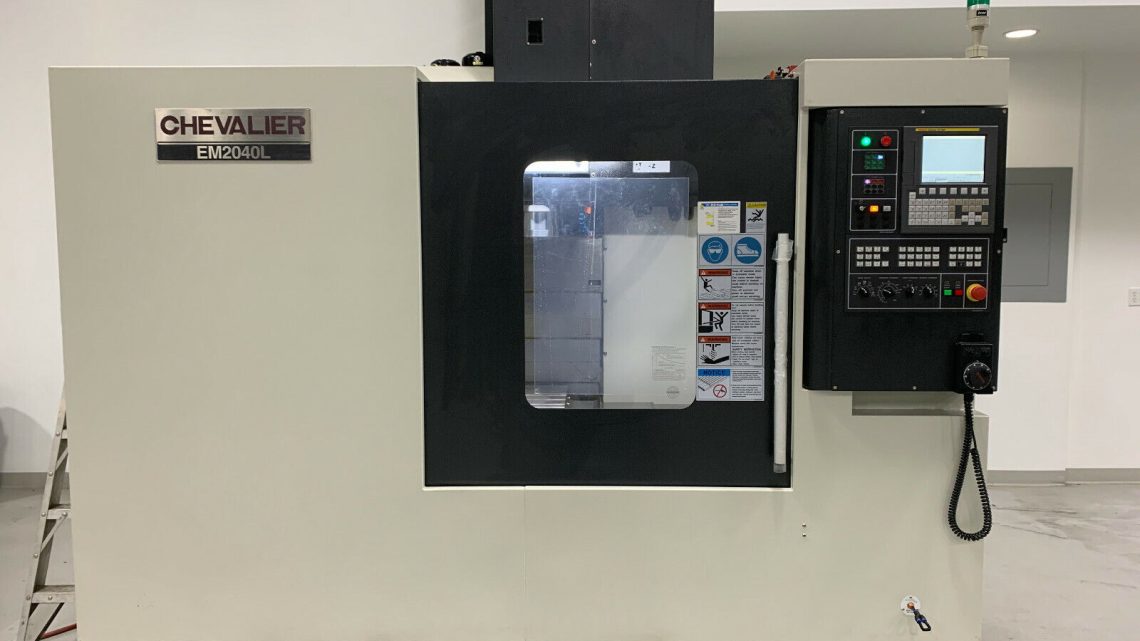
When considering the purchase of a pre-owned, second-hand, surplus Chevalier EM2040L CNC Vertical Machining Center (a model built in Taiwan) many industry experts recommend a detailed evaluation across mechanical, electrical, operational, and business-fit aspects. Below is a thorough checklist and explanation of the key areas you should inspect and questions you should ask before committing to purchase.
Key Pre-Purchase Checks & Expert Recommendations
1. Machine identity & history
- Confirm the exact model (EM2040L), serial number, and year of manufacture. The EM2040L is part of Chevalier’s EM-series high speed VMCs.
- Ask the seller for the machine’s usage history: number of hours, type of work done (mold, automotive, general machining), whether it ran multiple shifts, whether it was used for high-speed aluminium or harder steels.
- Understand the reason for sale: relocation, upgrade, business closure—these motivations might hint at underlying issues.
- Ask for maintenance and service records: major repairs, spindle replacements, ball‐screw replacements, level or alignment checks.
2. Mechanical condition & structural integrity
- Check the spindle condition: bearing noise, run-out at tool tip, heating behaviour, condition of spindle taper (EM2040L uses CT-40 / BIG-PLUS®).
- Inspect axes (X, Y, Z): check for smooth movement, measuring backlash and travel repeatability if possible. The EM2040L has travel of ~X 40.2″ / Y 20.9″ / Z 20.1″.
- For the table and work support: check table flatness, condition of the work surface, any signs of repair or welding or excessive wear.
- Check for wear on guide-ways, ball-screws, bearings: many high-speed machines like the EM series use linear ways and pretensioned ballscrews for precision.
- Inspect tool changer and related components: the EM2040L originally shipped with 24+1 arm‐type ATC, tool change time ~2.5-3 sec.
- Inspect chip-conveyor / chip flush systems, coolant tanks, filters: poor extraction or coolant contamination can accelerate wear.
3. CNC control, software & automation features
- Confirm that the control system is fully functional—The EM series often uses FANUC 0i-MF or other controls.
- Verify software version, macro availability, tool databank, program memory, and optional features installed. For example the EM2040L supports Ethernet, USB, memory card slot and high-speed machining mode AICC.
- Check for availability of spare parts and support for the control in your region (spares, drives, CNC modules).
- If there are special options (e.g., coolant-through-spindle, 4th axis, linear scales) verify that they are present and functioning.
4. Accuracy, repeatability & performance test
- If possible, witness a sample cut or request the seller to demonstrate a typical part. Check for dimensional accuracy, surface finish, chatter, tool life.
- For high-speed machines like the EM2040L, check that the spindle is still capable of high rpm without excessive vibration or bearing noise (10,000 rpm spec).
- Perform a quick test of tool change speed and axis responsiveness. ATC performance often degrades with wear.
- Check for table load capacity vs your parts: The EM2040L spec lists maximum table load ~1,320 lbs (600 kg) on the largest version.
- If the machine has linear scales or probing, check they are still functional and calibrated.
5. Installation, environment & compatibility
- Confirm that your facility can accommodate the machine: floor space, load capacity, power supply, air supply. For the EM2040L the footprint is about 107″ × 83″ × 90″ and net weight ~13,640 lbs.
- Ask if the machine has been relocated and whether it was re‐leveled or alignment checked—moving large machines often introduces alignment issues.
- Confirm that chip management and coolant systems are appropriate—they influence machine longevity.
- Check for environmental conditions: was the machine operated in a clean, well-maintained environment or a harsh production line? The latter may indicate more wear.
6. Spare parts & lifecycle cost
- Determine availability of critical spares: spindle bearings, linear guide kits, control drives, tool changer parts.
- Ask about major maintenance history: has the spindle been rebuilt? Have guide-ways or ballscrews been renewed?
- Consider the remaining useful life: wear on high-speed machines might be greater than on moderate-speed machines. The EM2040L is built for high speed, so if used heavily, its life may be curtailed.
7. Total cost of ownership
- Beyond purchase price, budget for transport, rigging, installation, re-leveling, calibration, training for operators, tooling refresh.
- Factor in downtime risk: if this machine is integrated into production, time to restore to full performance matters.
- Check whether any parts or options required for your use case (e.g., high-pressure coolant, 4th axis) are missing and need to be added, affecting cost.
8. Documentation & compliance
- Ensure you receive machine documentation: manuals (mechanical, electrical), wiring diagrams, service records, part lists, control manuals.
- Check that the machine meets your country’s electrical and safety standards (especially if importing).
- Ask if any recent alignments or calibration certificates exist—these help verify accuracy claims.
9. Contracts, inspection rights & warranty
- Ideally, schedule an onsite inspection or remote video walk‐through of the machine executing tasks and startup sequences.
- Include in your purchase contract: condition of machine, included tooling, fixtures, software backups, right to withdraw if major issues are found.
- Confirm what is included in sale (ATC, tooling, probes, coolant system, chip conveyor) and the condition of each item.
Specific Considerations for the Chevalier EM2040L
- Because this machine is designed for high-speed machining with linear ways and high rapid traverse rates, ensure wear hasn’t degraded its high-speed capability. The brochure emphasises “high speed linear ways on all axes… servo motor coupling directly linked with the screw” for accuracy.
- Check the BIG-PLUS® spindle interface (for the CT40 version) for run-out and taper wear—this affects tool life and accuracy.
- The tool change speed is a feature (tool‐to‐tool ~2.5-3 seconds) in the spec; older machines may have degraded ATC speed—check actual performance.
- The series often offers optional 12,000 rpm spindle and CT40/BT40 tooling; check if your machine has this or if the spindle is standard 10,000 rpm. The physical condition of the spindle at high rpm matters for high-accuracy applications.
- Consider spare toolholder availability for CT40/BT40 interface and any tooling required for your parts.
- Given the machine size and load limit (1,320 lbs table), verify your part size and weight fit within its envelope—oversized parts may lead to vibration or reduced accuracy.