09/11/2025
What Industry Experts Recommend Before Purchasing a Pre-Owned, Second-Hand, Surplus, Used BROTHER SPEEDIO M140X2 CNC Vertical Machining Center made in Japan?
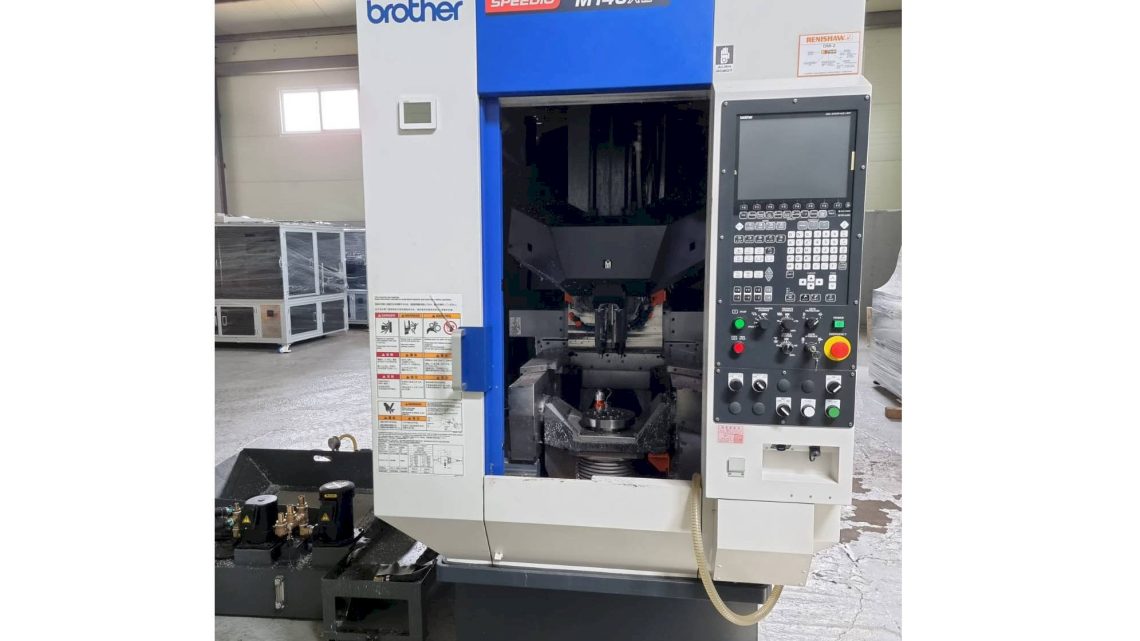
When evaluating a pre-owned or surplus machine such as the Brother SPEEDIO M140X2 (made in Japan) 5-axis vertical machining centre, industry experts recommend a comprehensive inspection and due-diligence checklist. Below is a detailed guide tailored to this class of compact high‐speed machining centre.
Pre-Purchase Checklist & Expert Recommendations
1. Machine identity, history & usage profile
- Confirm exact model (M140X2), serial number, manufacturing date, and country of origin (Japan).
- Obtain usage hours and duty cycle: high-speed machines like these are often used in high-volume production environments—check if this model had long continuous runs. E.g., spec shows table diameter Ø140 mm, max load 40 kg.
- Understand reasons for sale: factory upgrade, relocation, line shut-down — such reasons may hint at underlying issues.
- Review service records: any spindle rebuilds, major component replacements, re-alignment or calibration work.
2. Mechanical and structural condition
- Inspect spindle condition: listen for abnormal noise, measure run-out, and evaluate purposes for which the machine was used (aluminium high-speed, steel heavy cuts, etc.).
- Check axes (X, Y, Z, plus A/C rotation) for smooth movement, backlash, wear. For the M140X2 spec lists X=200 mm, Y=440 mm, Z=305 mm.
- For 5-axis/trunnion machines like this, verify tilt (A-axis) and rotation (C-axis) mechanisms for play or vibration.
- Inspect tool magazine/ATC: the spec shows 22-station ATC for M140X2.
- Check coolant systems, chip evacuation, guards and conveyors. High-speed machines generate significant thermal loads and chip volumes.
3. CNC control, software & automation features
- Verify control system (e.g., Brother CNC-C00) is operational, software version documented, user interface fully working.
- Check that any automation, axes drives, tool offsets, and probing systems are still functioning and spare parts are available.
- Ensure all axis servos and drive units are original or documented as replaced/upgraded.
4. Accuracy, repeatability & test run
- Whenever possible, witness a live demo or test-cut: check dimensional accuracy, surface finish, tool change speed, and repeatability over multiple parts.
- For high-speed machine, check if proper materials have been used (aluminium vs hardened steels) and whether the machine still meets positional accuracy specs.
- Confirm table load limits: M140X2 spec shows max load ~40 kg.
- Check spindle taper and tooling condition (tool holder wear, tool change reliability, pull-stud condition).
5. Installation, environment & compatibility
- Ensure your facility can support the machine: floor loading, footprint, crane access, electrical supply, air supply and cooling requirements. The machine weight for an example M140X2 is ~2,700 kg.
- Check previous installation alignment, relocation history (re-levelling, calibration), and whether the machine was in a clean, stable environment or high-throughput factory with minimal maintenance.
- Verify chip handling and coolant systems: high speed machine needs good evacuation and filtration.
6. Spare parts, support & lifecycle cost
- Confirm availability of key consumables and spares: spindle bearings, linear guides, rotary/tilt table components, tool magazine parts, CN-control modules.
- For a Japanese-manufactured machine, check your region’s dealer support or third-party support network for Brother machines.
- Assess remaining useful life: high-speed production machines may have more wear in spindle/axes than typical VMCs.
7. Total cost of ownership
- Beyond purchase price: factor in transport, rigging, installation, re-leveling, calibration, tooling set-up, possible refurbishment or spindle rebuild.
- Evaluate how the machine fits your production profile: does it match your part size, throughput needs, flexibility vs dedicated job-shop use. Note that many forum users say the M140X1/2 has small table load capacity and envelope—designed for high-volume small parts.
- Consider training, tooling inventory, automation (e.g., robotic loading) if high-throughput expected.
8. Documentation & compliance
- Ensure full access to manuals (mechanical, electrical, CNC), wiring diagrams, calibration certificates, maintenance logs.
- Check machine’s safety compliance (CE, local electrical standards, guarding) especially if importing or relocating.
- Verify any export/import restrictions: the spec sheet mentions relocation detection lock for certain models.
9. Purchase terms, inspection rights & warranty
- Negotiate terms allowing onsite inspection or “inspection at buyer’s expense” clause. Confirm the machine is in running condition before payment.
- Include right to withdraw if major condition issues (spindle run-out, major wear) are discovered.
- Clarify what comes in the sale: machine, tools, fixtures, program libraries. In high‐speed machines, tooling cost can be significant.
Specific Considerations for the M140X2 & Compact High‐Speed Machines
- Because the M140X2 is built for high productivity small parts (with table diameter approx Ø140 mm, max load ~40 kg) it may not be suited for large workpieces — verify your part size and weight compatibility.
- Wear on tilt/trunnion axes: high speed A/C motion can lead to wear in bearings/gearboxes—check for backlash in A/C axes.
- Tool magazine: 22-station may be limiting if you have many tools; check current tooling inventory vs. capacity.
- Spindle: high rpm means increased wear risk—check when the spindle was last balanced or rebuilt.
- Thermal stability: high acceleration/deceleration requires good thermal stability; check ambient conditions and cooling system condition.