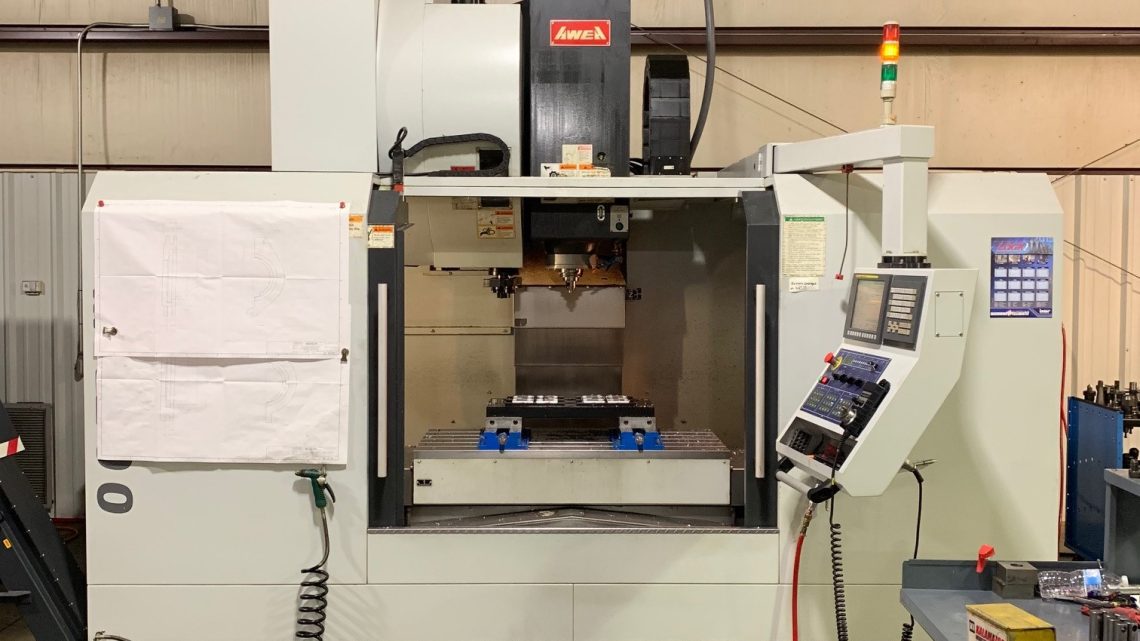
What Do Buyers Look for Before Investing in a Pre-Owned, Used, Secondhand, Surplus CNC Equipment Before Purchase Yama Seiki BM-1200 CNC Vertical Machining Center made in Japan
When evaluating a pre-owned / used / surplus Yama Seiki BM-1200 vertical machining center (VMC), you need to apply a similarly rigorous checklist as with any used CNC—but tuned to the specific design features, strengths, and common weak points of the that model and its class. Below is a detailed guide: what to look for, what tests to run, and what red flags to watch out for.
Basic Understanding & Specification Background
Before going on-site, you should know the “as-new” specifications so you can benchmark what’s acceptable wear or deviation. Some relevant specs of the BM-1200 (or its variants) include:
- It is part of the BM series from Yama Seiki / AWEA.
- The design emphasizes rigid structure and heavy-duty cutting. The axes use box ways on three axes for rigidity and durability under load.
- The BM series uses an in-house gearbox spindle to balance torque and speed.
- Typical travel & features for BM-1200 variants:
• X-travel ~ 1,200 mm (~ 47.2″)
• Y-travel ~ 600 mm (~ 23.6″)
• Z-travel ~ 680 mm (26.8″) in some configurations
• Table load capacity in one listing: 2,650 lbs (~1,200 kg)
• Spindle: often a 2-speed gearbox type, with CAT-50 tapers and a 30-tool side-mount magazine in some builds. - The manufacturer advertises hand-scraped surfaces, precise alignment, and super rigidity as differentiators.
Knowing these helps you judge whether the machine you’re inspecting is close enough to spec or degraded beyond useful tolerance.
What Buyers Should Inspect / Test — General + BM-1200 Specific
Here is a detailed checklist for inspecting a used BM-1200. Some items are “must do” on location; others are questions to get from the seller.
1. Machine History & Documentation
- Running / “power-on” hours, and if possible cutting hours (i.e. time under load vs idle).
- Maintenance logs: lubrication, inspection, repairs, spindle rebuilds.
- Past crash or collision history; whether any repairs or structural modifications were performed.
- Reasons for sale (upgrade, underutilized, broken, relocating).
- Original configuration: spindle type, tool changer, control, coolant / chip systems, etc. Confirm what was original and what’s been modified.
2. Structural Integrity & Frame / Base / Alignment
- Check for visible cracks, welds, repaired breaks, or misalignments in the machine column, bed, saddle, and base.
- Inspect condition of the hand-scraped bearing surfaces, especially on box ways; look for scoring, galling, and uneven wear.
- Verify that the machine is still level, rigid, and that its foundation (if installed) is stable.
- Check for signs of foundation settling or shifting.
3. Guideways, Ways, Box Ways, Slides & Wear
- Because the BM series uses box ways on its axes, inspect the box way bearing surfaces carefully. Deep scratches, uneven wear, or metal fatigue are serious problems.
- Check whether there has been excessive play or backlash in the axes. Move each axis manually (if possible) and evaluate smoothness along full travel.
- Use feeler gauges or preload checks (if possible) to detect where wear is greatest.
- Check for binding, stiction, or uneven motion, especially near the ends of travel.
4. Ball Screws, Drives, Motors & Backlash
- Check ball screws (if the BM-1200 uses ball screws on some axes) for signs of wear, backlash, noise, or torque irregularity.
- Check servo motors, couplings, and feedback (encoder) signals.
- Monitor drive currents, especially under load, and check for overheating or overload history.
- Test rapid traverse moves; check response, noise, and smoothness.
5. Spindle & Gearbox
- Because the BM has a gearbox spindle design, inspect the gearbox itself: gear noise, oil leaks, lubrication condition, backlash in gears, gear teeth wear.
- Run the spindle at various speeds (low, mid, high) and listen for noise, vibration, bearing hum, or grinding.
- Measure run-out of the spindle (both radial and axial) using a precision indicator.
- Check whether the spindle bearings show wear or looseness.
- Check the cooling/lubrication for the spindle & gearbox (oils, filters, seals).
6. Tool Changer / ATC / Tool Handling
- If the machine uses a side-mounted tool changer (e.g. 30-tool capacity in some examples) as in one listing of BM1200 with Fanuc control.
- Inspect the tool changer mechanism: indexing, repeatability, grippers, sensors, collisions, tool shank condition.
- Test tool change cycles under operation to see if mechanical or timing issues emerge.
- Check magazine condition: wear, dents, misalignment.
7. Control / CNC / Electronics / Wiring
- Identify the control model (Fanuc Oi-MD, Oi-MF, or other) and software version. (One listing cites Fanuc Oi-MF.)
- Check for backup memory, program integrity, error logs, alarm history, I/O diagnostics.
- Open electrical cabinet(s): inspect wiring, signs of overheating, dust, corrosion, cable stress, connector quality.
- Check servo drives, power supply modules, circuit boards, fuses, and how many spares or replacements remain available.
- Ensure compatibility / ability to upgrade control modules if needed.
8. Thermal Effects, Warm-Up Stability & Compensation
- Run the machine for a few hours and watch for thermal drift in axis positions.
- Measure geometric stability over time (e.g. repeated positioning tests) after warm-up.
- Ask whether the machine had thermal compensation systems or sensors (if built in) and whether those are functional.
9. Accuracy, Repeatability & Geometric Test Runs
- Perform positioning repeatability tests: e.g., move to same point multiple times and record deviation.
- Ballbar test or circularity test over a full travel to detect geometric distortions, straightness, and roundness errors.
- Run cuts at various locations across work envelope—test for taper, flatness, parallelism.
- Test at full travel extremes, not just the “sweet spot” in the center.
10. Auxiliary Systems: Cooling, Chip Handling, Lubrication, Auxiliary Devices
- Check coolant pumps, filters, piping, coolant quality, chiller (if any).
- Inspect chip conveyor(s) and how well chips were handled. Missed or broken conveyors are frequent problems.
- Check lubrication systems (central lube, grease lines, oil lines), their condition, whether they were well maintained.
- Inspect safety interlocks, guarding, enclosure doors, coolant splash guards, and chip guard condition.
- If there are optional systems (mist extraction, flood coolant, coolant-through tooling, etc.), check them too.
11. Spare Parts, Service Support & Obsolescence
- Confirm whether key replacement parts (gears, bearings, spindle parts, control boards) are still available, either from Yama Seiki (or successor), third-party suppliers, or aftermarket.
- Ask whether control modules, servo drives, I/O modules, and electronics are still in production.
- Evaluate availability of service engineers or retrofits in your region.
- Obtain part numbers of critical components and check whether they are still listed in catalogs or offered by suppliers.
12. Logistics, Installation & Commissioning
- Budget for disassembly, shipping, rigging, reassembly, leveling, alignment, calibration, and re-verification at your site.
- Check size, weight, and whether your facility floor and access points can accommodate the machine.
- Confirm power/voltage compatibility (e.g. 220 V / 380 V, ± tolerances), air supply, and other utilities.
13. Red Flags / Deal-Breakers
Here are warning signs you should treat as serious (or deal-breakers, unless heavily discounted):
- Excessive spindle vibration or audible gear noise.
- Rotary or axis motor faults, missing axes, or locked axes.
- Poor or no documentation of maintenance and repairs.
- Obsolete control or electronics for which replacement parts are unavailable.
- Missing or heavily damaged tool changer, broken grippers, or mis-indexed tool changes.
- Structural damage, cracks, or significant misalignment.
- Severe wear on guideways or box ways that indicates the machine is near end-of-life.
- Auxiliary systems missing or nonfunctional (chip handling, coolant, lubrication).
- The seller refuses inspection, test cuts, or access to control cabinets or internal wiring.