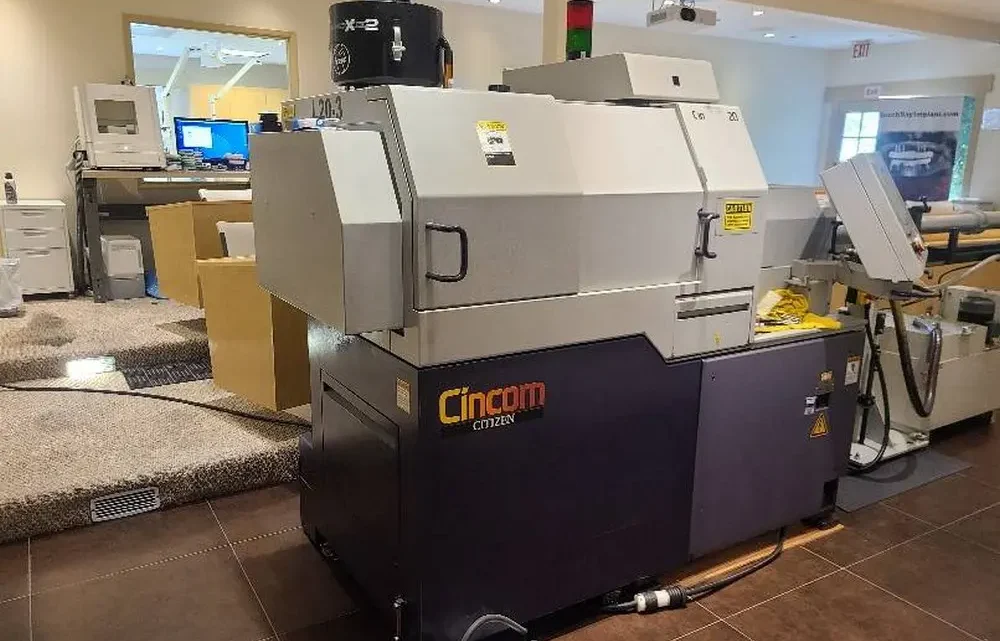
What Do Buyers Look for Before Investing in a Pre-Owned, Used, Secondhand, Surplus CNC Equipment Before Purchase Citizen CINCOM L20 CNC Swiss Lathe made in Japan
When assessing a pre-owned / used / surplus Citizen CINCOM L20 (Swiss-type sliding head / Swiss lathe) for purchase, the evaluation has to be especially rigorous. Swiss-type lathes are precision machines with many moving parts, close tolerances, and sensitivity to wear. Below is a comprehensive checklist and guidance: what to inspect, test, and ask, plus red flags specific to the the L20 / Swiss-type class.
Understanding the Machine & Baseline Specs
Before walking into a shop, arm yourself with the L20’s design features and typical specifications so that you can tell when parameters have degraded too far.
Some relevant features / background from Citizen’s documentation:
- The Citizen L20 is part of the “L-series” of CNC Swiss machines.
- It may incorporate guide bushing mode and non-guide mode (for shorter parts) in some variants.
- Later models may have “LFV” (Low Frequency Vibration) chip breaking technology to help manage chip control.
- Bar capacity, spindle speeds, number of axes, tooling capacity, and control system options will vary depending on the specific L20 variant (for example, L20XII, L20E, etc.)
- Example spec: a used L20 listing provides bar capacity of 0.78″ (~20 mm), spindle speed up to 10,000 rpm, multiple axes, etc.
- Another listing: a 1997 L20 has bar capacity ~1.23″, 10,000 rpm, turret with 12 stations, turning diameter ~7.87″, turning length ~7.87″ (200 mm range) etc.
By having these specs in hand (for the exact variant you are evaluating), you can compare what the machine should do vs what it actually does under inspection.
What Buyers Must Inspect / Test
Below is a detailed inspection guide for a Swiss lathe like the L20. Many of these apply to Swiss machines generally, but with emphasis on what tends to degrade or fail in the L20 series.
| Area / System | What to Check / Test | Why It Matters / What to Watch For |
|---|---|---|
| Machine History & Documentation | – Total power-on hours, and ideally “cutting hours” (time under load) – Maintenance logs (lubrication, cleaning, adjustments) – Any crashes, repairs, spindle rebuilds – Modifications or upgrades made (e.g. replaced modules, control swaps) – Reason for sale | Good documentation is often a sign of a cared-for machine; missing history is a risk. |
| Structural Integrity & Frame | – Look for cracked welds, repaired supports, misaligned frames – Check machine leveling & foundation integrity – Check for signs of bending, distortion, or structural fatigue | If the machine frame has shifted or been repaired poorly, precision will suffer. |
| Guide Bushing / Guide Bushing Sleeve | – Condition of the guide bushing and whether it is worn, scored, or oversized – Bushing alignment, clearance, deformation – Whether the machine was ever converted / adapted to non-guide mode (which could stress parts) | The guide bushing is central to Swiss lathe precision. Wear here dramatically degrades concentricity and part quality. |
| Sliding Headstock / Main Spindle / Bar Feed Path | – Bar feed path alignment, smooth feeding, no binding – Spindle internal health: runout, vibration, noise – Spindle bearings, seals, lubrication – Check for internal scoring, rust, or damage inside the sliding headstock – Compatibility/health of back spindle (if present) | Failures in the sliding head or spindle will severely reduce performance or be expensive to repair. |
| Axes, Ball Screws, Linear Guides, Motion Systems | – Check for backlash, play, binding, irregular motion – Test all axes (X, Z, Y, if applicable) over full travel – Check encoder feedback, motor current signature – Inspect couplings, belts, drive elements, flexible joints if present | Wear in axes or drives can degrade repeatability and accuracy. |
| Tooling & Turrets / Tool Posts / Live Tooling | – Inspect tool holders, turret indexing, repeatability – Test tool change cycles under operation – Check condition of live tooling (if installed) and their bearings – Check tool offsets, repeatability, and tool change misalignment | Tool change errors or worn tooling systems cause downtime, errors, and crashes. |
| Control, CNC Electronics & Wiring | – Identify the control (Mitsubishi, other) and software version – Check backup memory, program logs, alarms – Open cabinets: inspect wiring, dust, heat damage – Condition of servo drives, I/O boards, connectors – Spares / availability of electronics modules | Obsolete or damaged electronics are major failure risks; having replacements is critical. |
| Thermal Stability / Warm-Up Drift | – Warm the machine up (run idle / light moves) and monitor drift over time – Test repeated positioning over time – Check whether any thermal compensation was built in and whether it’s still functioning | Temperature drift will degrade dimensional accuracy, especially in Swiss lathes which operate with tight tolerances. |
| Accuracy, Repeatability & Geometric Tests | – Move to the same point repeatedly and record deviation (repeatability) – Perform circular interpolation or test cuts to measure roundness, taper, straightness – Run actual cutting tests on real parts across full machine range (not just near center) – Check across full Z-axis length and at outer bar diameters – Use calibration artifacts or gauge blocks to measure deviations | These are the proof tests: they reveal whether the machine still meets your tolerance demands. |
| Auxiliary Systems: Coolant, Chip Management, Lubrication | – Coolant pumps, filters, piping | clogged or damaged lines – Chip conveyor, chip evacuation, flood / high-pressure coolant systems – Lubrication systems: auto lube, oil lines, checking for leaks or blockages – Seals, gaskets, guarding, door / enclosure integrity |
| Spare Parts, Support & Obsolescence | – Check availability of replacement parts (guide bushings, spare sealing parts, electronics modules, axes parts) – Confirm whether control modules are still supported or have modern equivalents – Check service network, compatibility with upgrades or retrofits | Even a well-functioning machine can become unusable if you can’t get spares. |
| Logistics / Installation / Commissioning Costs | – How to disassemble / transport / rig into your facility – Floor loading, access constraints, power and utility compatibility – Alignment, calibration, leveling, test cuts after install – Costs to refresh consumables, seals, minor wear parts before use | These costs often get under-estimated; factor them in. |
Red Flags & Deal Breakers (for Citizen L20 / Swiss Machines)
- Worn or oversized guide bushing, or bushing showing signs of damage or machining to compensate.
- Significant spindle vibrations, bearing noise, or runout beyond acceptable limits.
- Tooling system or turret mis-indexing, dropped tools, or repeated tool change failures.
- Crashes or repaired damage around critical geometry (e.g. sliding head, bushing alignment).
- Obsolete control modules or electronic boards that are no longer available.
- Missing or nonfunctional auxiliary systems (coolant, chip removal, lubrication).
- Inability or refusal by the seller to allow you to run test cuts, open cabinets, or fully inspect.
- Excessive repair / refurbishment cost needs hidden behind the price.
- Structural damage, bent frames, or visible warpage.
Practical Strategy for On-site Inspection & Negotiation
- Bring an Expert / Specialist
Someone with Swiss lathe experience, especially with Citizen machines. - Request a Live Demonstration with Real Parts
Ask to see the machine running under actual cutting, ideally parts similar to what you plan to produce. - Cold & Warm Tests
Start with cold moves (no load) to check smoothness, backlash, motion. Then run for some time to warm up and repeat geometric tests. - Measure & Record Results
Use dial indicators, test bars, gauges, data logging to capture deviations over multiple runs. - Probe All Extremes
Test end-of-travel, near limits, large diameter, deep Z, combinations of axes. - Ask for History & Spares Inventory
Ask which components they have already replaced and whether they have spare parts to go with the machine. - Negotiate Contingency / Warranty
If possible, try to get a short “ride-out” guarantee or condition on acceptance after commissioning. - Account for Refurbishment / Rebuild Costs
Be conservative in your estimates for what might need refreshing (guide bushings, seals, electronics).