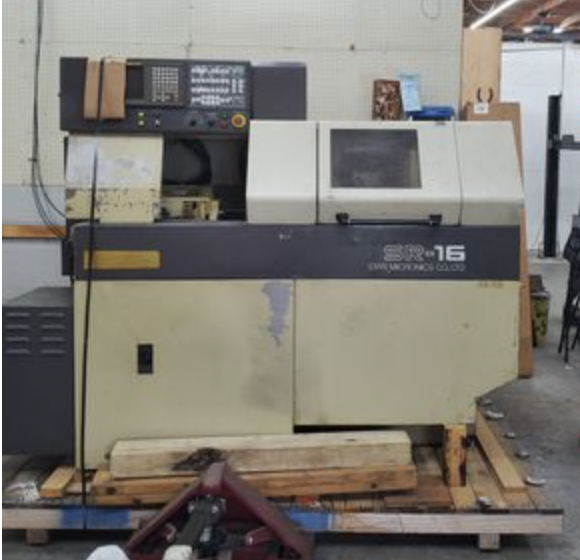
What Do Buyers Look for Before Investing in a Pre-Owned, Used, Secondhand, Surplus CNC Equipment Before Purchase STAR SR16 CNC Swiss Lathe made in Japan
When considering a used / surplus STAR SR16 CNC Swiss lathe (or similar Swiss-type sliding head machine) for purchase, it’s crucial to carry out a rigorous inspection. Swiss machines are high-precision, high-complexity systems, so wear or faults that might be tolerable in simpler equipment can be unacceptable here. Below is a detailed “due diligence” checklist and tips — tailored to the SR16 class — showing what buyers should look for, how to test, and red flags.
Background & Typical Specifications (for STAR SR16)
Before going on site, you should know the “in-spec” parameters for that model so you can tell how far it might have fallen from ideal. Some data sources for the SR16:
- The SR16 is part of STAR’s “SR” series of sliding-head (Swiss-style) machines.
- Example specs from a used listing: spindle speed up to 10,000 rpm, 5 HP spindle motor, turning length ~3″, bar capacity ~5″ (but exact variant will vary)
- The SR16/20R is also listed in technical catalogs as a small Swiss-type automatic lathe capable of turning & machining small parts.
- STAR’s own materials show SR series up to modest diameters (for sliding-head machines) in their portfolio of Swiss lathes.
Note: “SR16” might have variants (SR16R, SR16/20, etc.), so always confirm the exact sub-model, control, options, tooling, etc.
With that in mind, here is what to check.
Inspection & Testing Checklist for STAR SR16 (Swiss Lathe)
Below is a structured checklist. Some items you can check visually or with simple tests; others require running the machine or specialized gauges. Bring suitable metrology tools (indicators, gauges, test bars) and ideally someone familiar with Swiss machines.
| Area / Subsystem | What to Check / Test | Why It’s Important / What to Watch Out For |
|---|---|---|
| Machine History & Documentation | • Ask for total “power-on” hours and ideally “cutting hours” • Maintenance and repair logs (lubrication, alignments, spindle overhauls, guide bush replacement) • Crash history or damage (especially to sliding head or guide bushing area) • Modifications or non-original components • Reason for sale | Well-documented history strongly reduces risk. Undocumented machines are riskier. |
| Structural / Frame / Base Integrity | • Inspect machine frame, column, base, mounting surfaces for cracks, welds, distortion • Check whether the machine is level and properly mounted • Any signs of shifting or rework | A deformed or shifting frame cannot guarantee precision under load |
| Guide Bushing System | • Condition of guide bush: check for wear, scoring, ovality, looseness • Check whether bushing alignment is still good (concentric with spindle) • Whether any offset bushing or oversized bushings were used (which may indicate wear) • Whether the machine has non-guide (collet only) mode and whether that was used (which can stress the machine) | Since Swiss lathes rely on the guide bushing for rigidity and precision, deterioration here is a major liability |
| Sliding Headstock / Spindle / Bar Feed Path | • Check bar feeding path for smooth motion, no binding or misalignment • Inspect headstock internals (if accessible) for wear, scratches, rust • Run the spindle at various speeds (idle & under light load) and listen for vibration or noise • Measure run-out (radial and axial) of spindle using precision indicator • Check spindle bearings and seals • If a sub-spindle is present, check its performance and synchronization | Spindle / guiding defects directly degrade part quality; repairs are costly |
| Axes, Motors, Drives & Backlash | • Test all axes (often X, Z, possibly Y or C) across full strokes for smoothness • Check for backlash, hysteresis, stiction • Monitor encoder feedback, motor currents (if possible) • Couplings, belts, flex shafts—check for wear, looseness | Poor axis performance ruins repeatability and dimensional control |
| Tooling / Turrets / Sleeves / Live Tooling | • Inspect tool holders, turret indexing, repeatability • Run through tool change cycles under operation • Check live tooling (if installed): rotation quality, tool life, vibration • Check tool offsets, consistency, and whether tool change collisions occurred in past | Tooling errors or misalignments mean losses in uptime and quality |
| Control / CNC / Electronics / Wiring | • Identify the control (e.g. STAR proprietary, Fanuc, etc.), version and whether it is still supported • Program backups, alarm history, diagnostics • Open control cabinets: inspect for dust, burnt components, poor wiring, signs of overheating • Servo drives, I/O boards, connectors – condition and availability of spares | Electronics are among the most fragile and expensive failures in a used machine |
| Thermal / Warm-Up Drift & Stability | • Start the machine, run it idle or light moves for an hour or two to allow thermal stabilization • Test repeated positioning to see drift over time • If thermal compensation or sensors exist, verify they still operate correctly | Even a machine that is geometrically good when cold may drift as it warms up |
| Accuracy / Repeatability / Geometric Tests | • Command repeated moves to the same point and record deviation (repeatability) • Perform circular interpolation tests to check roundness / radial error • Run test cuts across the working envelope (various diameters, lengths) and measure resulting parts • Use gauge blocks or calibration bars to detect taper, straightness, runout • Test near the extremes of travel, not just in the “sweet spot” | If the machine doesn’t maintain the tolerances you need, it loses its value |
| Auxiliary Systems: Coolant, Chip Evacuation, Lubrication | • Coolant pumps, filtering systems, piping – check for leaks, contamination, wear • Chip removal or conveyor / catcher systems • Lubrication / greasing system: check lines, valves, condition, whether auto-lube works • Guards, splash covers, doors, seals | Even good mechanical parts are compromised if coolant or lubrication fails |
| Spares / Maintenance Support / Obsolescence | • Are replacement parts (guide bushings, spindles, electronic modules) still available? • Are control hardware or software modules obsolete? • Does Star or aftermarket support exist for this model? • Ask for part numbers of critical components and check current availability | A machine can be excellent now, but unusable if you have no path for future parts |
| Logistics / Installation / Commissioning Costs | • Disassembly & packing, shipping, transport, rigging • Reinstallation, leveling, alignment, calibration at your facility • Power, air, utilities compatibility • Time for break-in, test runs, fine-tuning | Often, the hidden costs in shipping and setup are large and kill the deal viability |
Red Flags & Deal-Breakers
- Guide bushing or spindle wear beyond acceptable limits, especially if oversized / compensating bushings are used
- Spindle vibration, noise, or high run-out
- Tool change errors, mis-indexing, dropped tools
- Electronics or control modules that are obsolete or unobtainable
- Past crashes that damaged structural alignment
- Missing or nonfunctional auxiliary systems (coolant, lubrication, chip handling)
- Seller refusal to allow you to run test cuts, open cabinets, or inspect internal components
- Repairs needed that cost more than the price differential to a newer machine