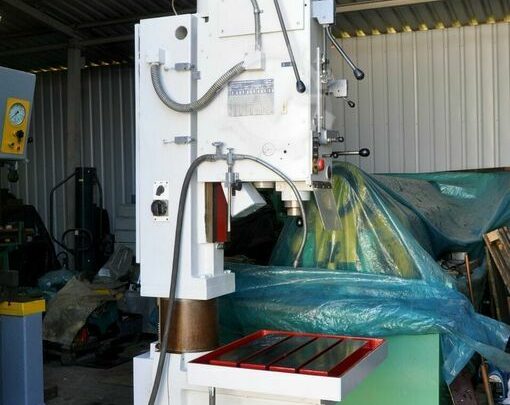
What Do Buyers Look for Before Investing in a Pre-Owned, Used, Secondhand, Surplus CNC Equipment Before Purchase WMW HECKERT SABO STANDARD BS 63 Radial Arm Drilling made in Germany
When considering a pre-owned / used / surplus WMW Heckert Sabo (Standard) BS 63 radial (or pillar / column) drilling machine (or similar heavy duty drill press / radial drill), a buyer should perform a thorough inspection because such machines, while seemingly “simple,” have many wear points and hidden issues. Below is a detailed due diligence / inspection checklist, plus “red flags,” and special considerations related to this class of machine.
Reference Specs & What to Benchmark
Before inspection, gather the “as built” / nominal specifications for the BS 63 (or equivalent) to use as benchmarks. Here are some published values for the BS 63 class (or close models) that help you judge claims:
- The BS 63 (pillar / column drill) has a bore capacity in steel of ~ 63 mm (i.e. drilling up to Ø 63 mm) as per WMW Saalfeld datasheet.
- Spindle speed range: 32 – 1,400 rpm (12 steps)
- Automatic feed rates: 9 steps, ~ 0.11 to 1.73 mm per revolution
- Quill (spindle) stroke / spindle travel (drilling stroke): ~ 280 mm quill stroke in some listings
- Table size: ~ 770 × 650 mm or ~ 630 × 500 mm in variants.
- Power (motor) rating: ~ 7.8 kW (≈10.5 HP) in many units
- Column / frame diameter, adjustable head or table travel, etc.
Use these as reference points: if the seller claims much higher speeds, deeper strokes, or larger capacity without substantiation, you should demand proof (drawings, tests).
Inspection / Evaluation Checklist
Below is a systematic checklist across mechanical, spindle, motion, structure, alignment, safety, and overall performance. Ideally, bring metrology tools (dial indicators, straightedges, measurement gauges, test probes) and an experienced machinist if possible.
| Area | What to Check / Ask / Measure | Why It Matters / What to Watch Out For |
|---|---|---|
| Documentation & History | – Request original machine drawings, schematics, parts lists, maintenance / repair logs, and retrofit history. – Ask about hours of use, type of work done (heavy duty, large holes, tough steels vs light work), and any damage history (spindle crashes, overloading). – Ask whether parts (e.g. spindle, quill, feed mechanisms) have been rebuilt or replaced. – Get photos or videos of the machine operating under test if possible. | Knowing the machine’s history helps you anticipate wear items or hidden damage. Without this, you take more risk. |
| Structural Frame / Column / Base | – Inspect base, column, and head / arm (if radial or adjustable arm) for cracks, weld repairs, distortion, or signs of past collisions. – Check for straightness and alignment of the column and head; use a precision straightedge or test indicator. – Inspect the arm (if radial) or head slide (if adjustable) for wear, binding, looseness, or slack. – Look for loosened fasteners, misaligned parts, shifted panels, or evidence of poor maintenance. | Any structural deformation or looseness will reduce accuracy, degrade tool alignment, and make future repair more expensive. |
| Spindle / Quill / Bearings | – Run the spindle (no load) across its speed range and listen for noise (grinding, growl, hum, rattling). – Use a test bar or precision indicator to measure radial and axial runout. – Check for axial play (push/pull the spindle or quill) or lateral play / looseness. – Inspect spindle taper, quill surfaces, and mating interfaces for wear, dents, or corrosion. – Check lubrication of the spindle bearings / quill; verify seals and oil / grease supply are intact. – Ask whether spindle bearings or quill guides have been replaced / serviced. | The spindle / quill is a critical component; worn bearings or misalignment can ruin drilling accuracy, shorten tool life, and be costly to repair. |
| Quill / Spindle Feed / Depth Mechanism | – Inspect the feed mechanism (gears, cams, feed shafts, feed selector) for play, wear, missing parts, or backlash. – Test automatic feeds (9 feed steps, as per spec) and manual feed; verify that feed values match what the selector says. – Measure feed accuracy: feed the spindle a known distance and compare actual vs commanded movement. – Test the quill’s smoothness and check for stiction, sticking spots, or jumpy motion. – Check depth stop / quill stop mechanism for stability and repeatability. | Inaccurate or erratic feed leads to inconsistent hole depths, tool breakage, or surface defects. Feed mechanism wear degrades precision over time. |
| Table / Work Surface / Clamping | – Inspect the table surface, T-slots, and workholding surfaces for wear, divots, damage, rust. – Verify table movement (if table is adjustable / movable) for smoothness, play, or backlash. – Check whether the table can be rotated (360°) or swivelled (if equipped) and test for alignment errors. (Some BS63 machines feature a rotating drill table) – Measure flatness and parallelism of table surface relative to spindle axis. – Check clamping capacity and rigidity — whether the table, vise, or fixtures hold firmly under load. | A damaged or misaligned table reduces machining accuracy and can complicate fixture mounting. Poor clamping causes vibration, movement under load, and unsafe operation. |
| Column / Head Adjustments / Radial Arm (if applicable) | – For radial drills (if the machine has a radial arm), test the arm’s ability to swing or reach, check bearings / slides for wear or backlash. – If head / radial arm can move up/down or in/out, test that motion for smoothness, play, and locks. – Inspect mechanisms for height adjustment, locking clamps, and guiding rails or bearings. – Confirm locking mechanisms (clamps, screws, hydraulics) are strong and hold under load without drift. | If the arm / head movement is sloppy or cannot be locked firmly, you will lose precision or risk dangerous shifts during drilling. |
| Drilling Capability & Performance Trial | – Perform test drilling on representative materials (steel, aluminum, etc.) through full travel; check hole quality (size, roundness, finish). – Drill deep holes near the quill’s travel limit to test full capability. – Test at different speeds and feeds; verify consistency in performance. – Measure hole diameter vs nominal; check for taper, runout, or misalignment. – Monitor behavior under load (vibration, deflection, chatter) and see how the machine behaves under sustained drilling cycles. – Test the speed / feed changes in mid-operation to see whether the machine tolerates variable conditions. | The real proof is how the machine drills under load. Problems often only appear under active operation — e.g. the spindle or feed mechanism failing, vibration, poor hole quality, heat drift, etc. |
| Motor / Drive / Electrical / Power | – Inspect the motor(s), wiring, electrical panels, switches, and control circuits. – Run the motor under load and observe whether it stalls, overheats, or shows abnormal behavior. – Check power supply wiring, fuse / breaker condition, cable insulation, and grounding. – Verify motor nameplate matches expected power rating (7.8 kW in many BS63 units) – Check any variable speed drives or gearbox (if the machine has gear / step speed control) for noise, backlash, or slippage. – Inspect wiring harnesses, connections, junction boxes, ensure no overheating or poor splices. | Faulty electrical or drive systems can lead to unreliable operation, safety hazards, or expensive replacements. |
| Lubrication, Slides, Guideways, Wear | – Check all guideways, sliding surfaces, and columns for wear, scoring, rust, or pitting. – Inspect lubrication systems (if automatic or manual) and verify lubricant reaches sliding parts. – Check for play or looseness in guide surfaces or sliding mechanisms. – Inspect seals, wipers, protective covers, and ensure they are intact to keep contaminants out. | Worn guides reduce rigidity, increase deflection, degrade accuracy, and accelerate further wear. |
| Safety & Guards / Compliance | – Confirm all safety guards, splash shields, chip guards, covers, and interlocks are present and operational. – Check emergency stop (E-stop) circuits, limit switches, and safety cutouts. – Inspect grounding, electrical enclosures, and insulation for safety. – Ensure that safety systems have not been bypassed or disabled. – Verify whether the machine meets (or can be made to meet) the local safety and machine standards in your country (CE, ISO, OSHA, etc.). | A machine without proper safety features is a liability and may not even be legal to operate. |
| Parts Availability & Service / Spare Components | – Research whether parts (spindle bearings, feeds, motor, quill assemblies, gears, cables) are available from original manufacturer, third-party suppliers, or salvage networks. – Ask whether the seller includes spare parts or consumables (belts, bearings, etc.). – Check whether the machine uses proprietary or custom parts that are hard to replace. – Ensure that service / technical support is accessible in your region. | Even a mechanically sound machine can become unusable if critical parts fail and you cannot source replacements. |
| Logistics, Installation & Total Cost | – Determine the machine’s weight, footprint, and rigging requirements. – Check whether your facility floor, foundation, and lifting equipment (cranes, hoists) can handle it. – Plan for leveling, alignment, and calibration after installation. – Estimate costs for refurbishment: cleaning, lubrication, replacing worn parts, calibrating, test running. – Consider power supply compatibility (voltage, phase, capacity) and whether upgrades are needed. – Plan for downtime and possible rework after installation. | The hidden costs of transport, installation, calibration, and initial refurbishment often add up significantly. |
| Contractual Terms, Warranties, Acceptance Conditions | – Insist on a conditional acceptance or inspection period post-delivery, during which you can test and reject if major defects are found. – Try to secure a limited warranty (if seller can offer) for major components (spindle, drive, feed system). – Require the seller to disclose known defects, maintenance history, and repairs in writing. – Define who is responsible for damage during transport, rigging, and reinstallation. – Withhold some payment until satisfactory commissioning / performance is verified. | Good contractual protection helps mitigate the risk of hidden faults and provides recourse if the machine does not meet expectations. |
“Red Flags” / Warning Signs to Be Especially Wary Of
When inspecting, certain findings should raise serious concern or justify significant discounting or walk-away:
- Excessive play or looseness in spindle / quill bearings (axial or radial)
- High spindle noise (rumble, knocking) during test runs
- Erratic feed behavior: feed changes not accurate, slippage, jumpy motion
- Binding or sticky zones in quill or spindle travel
- Feed mechanism wear / backlash beyond acceptable tolerance
- Table / work surface damage (pits, cracks, severe wear)
- Structural cracks / repairs / welds in column, base, arms
- Electrical / motor / wiring faults, overheating signs, bad insulation
- Lubrication / guide wear: severely worn guideways or sliding surfaces
- Safety guards missing or bypassed, disabled interlocks
- No ability to run drilling tests under load or refusal to allow full functional check
- Parts / spares unavailable or too expensive
- Performance significantly lower than specs (slower speeds, weak feed, drift)
- Seller refuses warranty or inspection rights
Each of these could foreshadow expensive repairs or operational limitations.
Summary & Buyer Strategy
- Prior to inspection, obtain the exact variant (BS 63 model, serial number, features) so you know what specs to expect.
- Use published data (e.g. speeds, feed steps, quill stroke, table size, motor power) as your benchmarks.
- Systematically inspect mechanical, structural, spindle, feed, guides, lubrication, safety, electrical, and performance.
- Conduct real drilling tests under representative load to validate hole quality, consistency, spindle stability, and feed accuracy.
- Ensure parts availability and technical support in your region.
- Negotiate a purchase agreement with safeguards: conditional acceptance, warranty (if possible), disclosure obligations, payment tied to performance.
- Budget for transport, installation, calibration, refurbishing, and initial test and tuning.