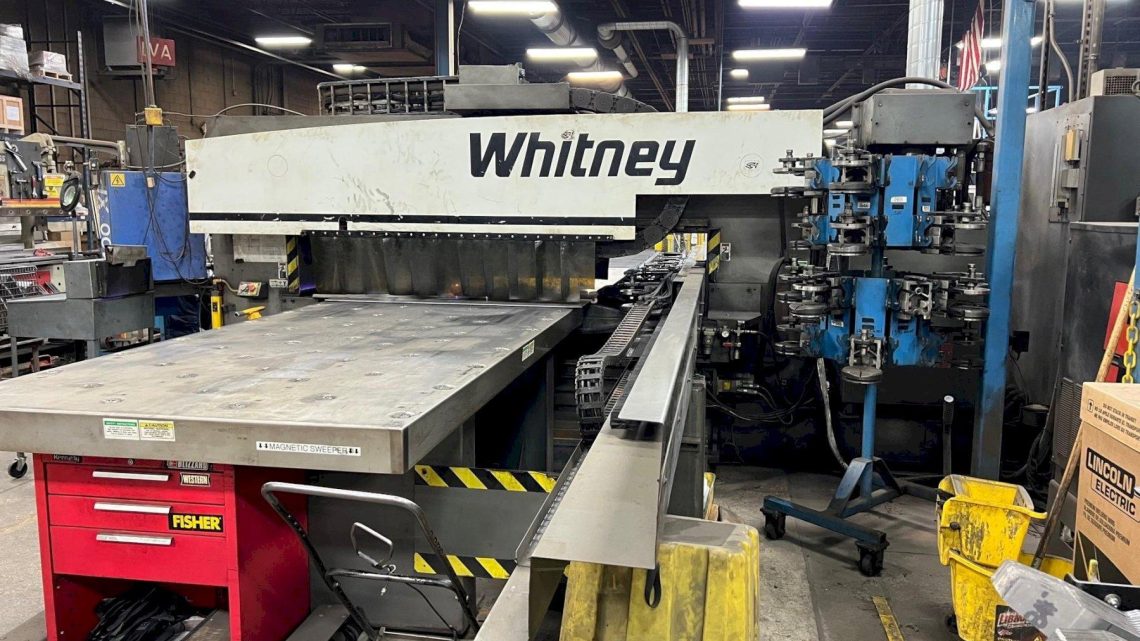
What Do Buyers Look for Before Investing in a Pre-Owned, Used, Secondhand, Surplus CNC Equipment Before Purchase WHITNEY 3400XP CNC Punch & Plasma Plate Fabricator Combination Machine made in USA
When you’re evaluating a used (pre-owned, surplus, secondhand) Whitney 3400XP CNC Punch & Plasma Combination Machine (a hybrid “punch + plasma” plate fabricator) for purchase, you must combine the inspection criteria for CNC machines plus those relevant to plasma cutting, punching / turret machines, material handling, and environmental systems (dust, slag, thermal, etc.). The complexity is higher because failures or wear in either the punching system or the plasma system (or their interaction) can ruin the machine’s utility.
Below is a detailed due-diligence checklist, highlighting what to check, tests to run, red flags, and negotiation strategies. Use this as a framework when visiting the seller or commissioning a third-party inspection.
Key Known Specs & Features (for Reference)
Before inspection, arm yourself with the nominal specifications & features of the 3400XP so you know what to expect and what to benchmark against. Some published specs / capabilities include:
- It is a punch + plasma combination machine (i.e. it can punch holes and also contour / cut with plasma) in a single setup.
- Punching capacity: 40 tons (360 kN) is standard in many builds.
- Material thickness limits: from ~0.060″ (1.5 mm) up to ~0.500″ (12.7 mm) for punching.
- Max punch diameter up to 5.000″ (127 mm) in certain configurations.
- Positioning / travel: X-axis ~141.3″ (≈ 3590 mm), Y-axis ~61.6″ (≈ 1565 mm) in certain versions.
- Nominal blank size: 60″ × 120″ (≈1.5 m × 3.0 m) without repositioning, larger with repositioning / auxiliary tables.
- Positioning speed per axis: ~1,200 in/min (≈ 30 m/min)
- Positioning accuracy: ±0.005″ (~0.13 mm)
- Control & motion: uses a rail tool changer with 9 stations, 36TC style tooling, and a CNC control (often Siemens or similar).
- The plasma component is often a Hypertherm / MaxPro or other plasma system (e.g. MAXPRO200) integrated into the machine.
- There are integrated subsystems such as dust collection, slag chambers, work clamps, automatic part drop / unloading, a “halo” torch collision detection, and a repositioning mechanism for larger blanks.
- Foundation requirement: the machine base needs a reinforced concrete foundation (e.g. ~200 mm thick) beneath the press frame.
- Power / electrical: 480/3/60 (in some builds), ~120 kVA for base machine, but can vary.
Use these specs as ballparks when checking the candidate machine’s performance, wear, and deviations.
Inspection & Testing Checklist
Here is a detailed checklist of subsystems and observations you should perform (or demand) when assessing a used 3400XP. Some items require you to run the machine, make test cuts, or measure deviations.
| Subsystem / Area | What to Check / Test | Why It Matters / What to Watch For |
|---|---|---|
| Machine History & Documentation | • Total operating/power-on hours, and ideally the “working hours” under load (how much punching/plasma use) • Maintenance / servicing records: plasma system service, torch replacements, punch cylinder rebuilds, calibration • Records of crashes, collisions, misalignments, part damage • Documentation of component replacements (pumps, plasma power supply, tooling, clamps, rails) • Verify model, serial number, configuration and optional upgrades • Ask why the machine is being sold | A well-documented history helps gauge how “worn” the machine is. Lack of documentation is a risk. |
| Structural Frame, Base & Alignment | • Inspect the machine frame, base, columns, rails for cracks, weld repairs, signs of distortion or warpage • Check that the foundation is still solid and level (especially under the punching frame) • Verify whether the machine has shifted or sunk — examine alignment of long rails • Check the integrity of supports for the X and Y motion rails • Check mounting surfaces and reference surfaces for wear or damage | The punching portion exerts large forces; any misalignment or frame fatigue will degrade accuracy under load |
| Rails, Guides, Linear Motion & Drive System | • Move X and Y axes over full travel in both directions, feeling for binding, uneven motion, stick-slip • Note if motion is smooth at all speeds • Measure backlash, hysteresis, repeatability in both axes • Inspect drive motors, couplings, gearboxes, linear rails, ball screws (if present), belts, rails, sliding surfaces • Check drive current profiles (if accessible) to see anomalies or load spikes • Examine the rail tool changer (its travel rail) for wear or misalignment • Check gearboxes, reducers, couplings for backlash / wear | Wear or looseness in motion systems reduces positional accuracy and repeatability, especially critical in punch/plasma combos where the two operations must align precisely |
| Punching System | • Run the punch cylinder (hydraulic or mechanical) across its working stroke under no-load and full load • Listen / feel for binding, jumpiness, hesitations • Measure alignment of punch vs die: do the holes align cleanly? • Inspect punch tooling, tooling cartridges, punch adapters, die adapters for wear, deformation, misfit • Check stripper mechanisms, ejectors, alignment of punch, and whether punch “sticks” in material • Check hydraulic power unit: pressure levels, leaks, control valves, filters, reservoir, pump behavior • Verify punch capacity (force) is still near spec via test punches (if safe) • Inspect stripping action, clamping / hold-down mechanism which keeps sheet flat during punch • Inspect punch guide bushings, liners, wear surfaces • Check number of punches, turret action, tool change speed, and whether punch changeovers are reliable | If the punch system is degraded, you lose the advantage of fast, precise punching. Misaligned or worn tooling yields poor holes, misfits, edge distortion |
| Plasma Cutting System | • Inspect the plasma torch, torch mount, height control / Z motion (if present) • Check whether the plasma system powers on, pierces, and cuts cleanly • Run sample cuts (straight, contours, corners) and examine edge quality, dross, kerf width, angularity • Check torch consumables, nozzle condition, wear, misalignment • Test plasma height control / standoff (if automated) • Verify gas supply, gas lines, regulators, filters, and connections • Inspect the slag / plasma chamber, torch collision detection (e.g. “Halo” or equivalent) • Check the slag collection / refractory lining of the chamber • Check the dust / fume extraction system is functioning properly • Test switching between punch and plasma in a combined operation to see if alignment is maintained | Plasma system degradation (worn nozzles, mis-standoff, poor arc, misalignment, slow pierce) erodes cutting quality, throughput, and wastes consumables |
| Synchronization & Registration Between Punch & Plasma | • Run a test where you punch internal features and plasma cut outer profiles in the same part—check alignment (are holes in correct position relative to cut contour?) • Check whether the transition between punch / plasma is smooth and accurate (no offsets) • Monitor positional drift during combined operations • Run “coincident” operations many times to ensure repeatability across toolpaths | The value of a punch + plasma combo is that you can do both in one setup with alignment – if the synchronization is off, you lose that advantage |
| Tool / Tool Changer / Tool Cartridges | • Inspect the tool magazine / cartridge system (rail tool changer with 9 stations in many builds) • Test tool change cycles: speed, accuracy, tool drop / misindexing, repeatability • Examine tool holders, adapters, alignment rings, spring-fit, wear • Confirm tool change reliability (i.e. change under motion, no collisions) • Check if tooling can be set up offline and swapped in (reduces idle time) • Check maximum tool diameter / compatibility (some models support up to 5″) • Confirm strain or damage to tooling rails or guides | If tool changes are slow, mis-indexed or unreliable, machine throughput suffers significantly |
| Work Clamping / Hold-Down / Stripping / Sheet Flatness | • The work clamp system must hold the sheet flat during punch and plasma operations—test clamping and verify no micro-shift • Inspect clamps for wear, alignment, hydraulic leakage or slippage • Check clamp verification sensors (that confirm proper clamp pressure / position) • Test sheet with camber or slight curvature (if machine supports it) and see whether clamp system can compensate • Inspect retractable stops / reference stops for misalignment • If the machine has a repositioning assembly, check its accuracy in repositioning clamps | Poor clamping leads to sheet movement under operation, misalignment, defects, tool damage |
| Motion / Speed / Velocity, Accuracy & Repeatability | • Run the machine at various speeds (both X and Y axes) and see whether motion remains stable • Measure repeatability: command the same point repeatedly, record deviations • Use gauges or calibrated markers to measure positional accuracy across the travel area • Spot-check at extremes of travel for positional error / drift • Check acceleration / deceleration behavior, overshoots, backlash • Compare against spec values (e.g. ±0.005″ or ±0.13 mm) published for the model. | Motion inaccuracy or drift reduces edge quality, hole alignment, consistency |
| Control / CNC & Electronics / Wiring | • Open control cabinets: inspect wiring, connectors, look for signs of overheating, burnt insulation, repairs • Inspect motor drives, servo modules, I/O boards, fans, cooling, dust accumulation • Check software version, license status, CNC control responsiveness, interface • Inspect diagnostic logs, alarm history, error codes • Check communication paths (Ethernet, fieldbus, PLC, sensors) • Test motion commands, tool changes, mode switching, overrides • Ensure backup / restore functionality works • Confirm that control modules or spare parts are still available in your region | Electronic / control system breakdowns often become the most expensive and crippling failures in used machines |
| Environmental / Dust / Slag / Fume Management & Cleanliness | • Visually inspect inside rails, enclosures, motion guides, drive components for dust, slag, metal debris ingress • Check dust / fume extraction systems, filters, ducting, spark traps • Check how well the system was maintained (i.e. is there buildup of slag, splatter, metal dust) • Inspect plasma chamber lining, refractory surfaces, slag accumulation • Check for corrosion, oxidation, moisture damage in electrical/electronic compartments • Verify routine cleaning access & whether guards / enclosures are intact | A dirty, slaggy environment accelerates wear on rails, optics, drive components, and causes electrical issues |
| Hydraulic / Pneumatic Systems | • Check hydraulic systems (for punch cylinder, clamp actuators): pressures, leaks, motors, valve response • Inspect hydraulic power unit, filters, reservoirs, hoses, seals • Inspect pneumatics: valves, air supply, sensors, cylinders (for parts drop / mechanisms) • Test actuation speed, pressure consistency, response times • Check for leakage, contamination, air supply stability | Weak or leaking hydraulic / pneumatic systems degrade punch force, response, clamping reliability |
| Spare Parts, Consumables, Support & Obsolescence | • Ask for parts lists, tooling catalogs, consumables (punches, dies, plasma nozzles, electrodes) • Determine whether these are still produced or supported • Ask which parts have already been replaced (and when) • Request the machine’s spare module inventory (e.g. extra tooling cartridges, drops, spare electronics) • Check whether manufacturer (Whitney / Piranha) support or parts network is available in your region • Confirm software / controller license transferability (some Whitney machines use proprietary licenses) • Verify whether critical electronic modules are obsolete or difficult to source | Even a machine that works today may become useless if spares or consumables cannot be obtained |
| Safety, Guards, Interlocks & Compliance | • Check all safety guards, enclosures, interlocks (especially around punch, plasma torch, moving axes) • Test emergency stops, limit switches, door interlocks • Check whether torch collision detection is functioning (e.g. “Halo” or equivalent) • Inspect exhaust / ventilation / fume handling safety • Confirm that the electrical system meets your local safety / electrical standards | Safety compliance is essential; bypassed safety is a red flag and a liability |
| Logistics / Installation / Commissioning | • Plan disassembly, packing, transport, and consider misalignment risk during shipping • Check whether your facility can accommodate length, width, height plus roof / overhead clearance • Ensure foundation capability (machine weight, dynamic load, reinforced slab) • Estimate time and cost for re-leveling, alignment, calibration, test cutting, tuning • Ensure utilities (electrical power, compressed air, gas, extraction / ventilation) are compatible • Budget for cleaning, replacing consumables, verifying control / software setup • Test after reinstallation under real production loads before final acceptance | Many used equipment deals “fail” because transport, re-commissioning, or hidden alignment costs blow the budget |
Red Flags & Deal-Breaker Warnings
When inspecting, these should raise serious concern or demand a heavy discount / refusal:
- Punching system is misaligned, sluggish, or requires enormous force to complete punch strokes.
- Punch tooling or die adapters are deformed, excessively worn, or misfitted.
- Punch cylinder “sticking” or inconsistent operation, or hydraulic leakage.
- Plasma torch or consumables heavily worn, misaligned, or unstable arcs / poor cut quality in test cuts.
- Poor alignment / registration between punch and plasma cuts (holes not matching contours).
- Tool changer (rail or carousel) mis-indexing, collisions, slow tool swap failures.
- Motion drift, inconsistent positioning, backlash in axes, or major deviations at travel extremes.
- Control electronics with burnt wiring, previously abused, missing modules, patched parts.
- Dust, slag, debris accumulated inside motion systems, rails, or electrical compartments.
- Weak or leaking hydraulic / pneumatic systems, clamp slippage, low pressure.
- Missing safety systems or defective interlocks.
- Obsolete or non-available spare parts / consumables.
- Seller refuses you to run actual punch + plasma combined operations or to open enclosures.
- Cost of refurbishment or reconditioning is estimated to exceed the “savings” from buying used.
Strategy & Tips for Inspection / Negotiation
- Bring a fabricator or technician experienced in punch + plasma machines to assist.
- Insist on live demonstration with real sheet metal (ideally similar materials / thicknesses you plan to use).
- Run tests that combine punching + plasma to verify registration.
- Warm up the plasma / punch systems before testing, especially the plasma torch (it may behave poorly when cold).
- Use precision measurement tools (gauge blocks, laser alignment, dial indicators) to log deviations.
- If possible, get the machine run under production-like load for hours to observe stability, drift, error accumulation.
- Ask for spare tooling, spare parts (plasma consumables, punches, cartridges) to be included or discounted.
- Negotiate a conditional acceptance / trial period after installation.
- Build in a budget for refurbishment / spare parts (especially plasma consumables, punch tooling, cleaning).
- Confirm that control software / CNC / motion modules are licensed / transferrable / supported.
- Check that your facility can meet the machine’s power, ventilation, exhaust, foundation, and gas (if plasma uses gas) requirements.